Mississippi Science ENV.1.4
The Standard
- ENV.1
- Students will investigate the interdependence of diverse living organisms and their interactions with the components of the biosphere.
Describe symbiotic relationships (e.g., mutualism, parasitism, and commensalism) and other co-evolutionary (e.g., predator-prey, cooperation, competition, and mimicry) relationships within specific environments.
2026 Mississippi College- and Career-Readiness Standards for Science · Biosphere and Biodiversity
Teacher's field guide
What This Standard Means
What Students Need to Do
- Students describe how species affect each other in a named habitat. They identify mutualism, parasitism, commensalism, predation, competition, cooperation, and mimicry from specific examples. They explain how traits such as warning colors affect these interactions.
What Mastery Looks Like
- Given forest species pairs, students name each relationship and explain what happens to both species. They distinguish a tick feeding on a deer from an owl catching a mouse. They explain why an orchid growing on a tree and a hoverfly resembling a wasp are different relationships.
Common Misconceptions
- Students often call every pair that lives together mutualism. They may call a predator a parasite, assume commensalism benefits both species, or mistake mimicry for camouflage.
How to Assess It
- On an exit ticket, describe a forest tick feeding on a deer and an orchid growing on a tree. Ask students to name each relationship and explain the effect on both species.
Lesson moves
Ways to Teach It
Give groups forest bee-flower, deer-tick, and owl-mouse cards with benefit, harm, and no-effect counters to model each pair.
Ask: How might birds that avoid wasps affect which hoverflies survive, and why would wasp-like stripes help?
Hand out relationship bingo cards; call clues about deer-tick, orchid-tree, owl-mouse, competing saplings, pack-hunting wolves, and hoverfly-wasp pairs.
Show an orchard pollination photo; students explain what apple trees gain from bees and what bees get from apple blossoms.
Free download
Printable ENV.1.4 Worksheet
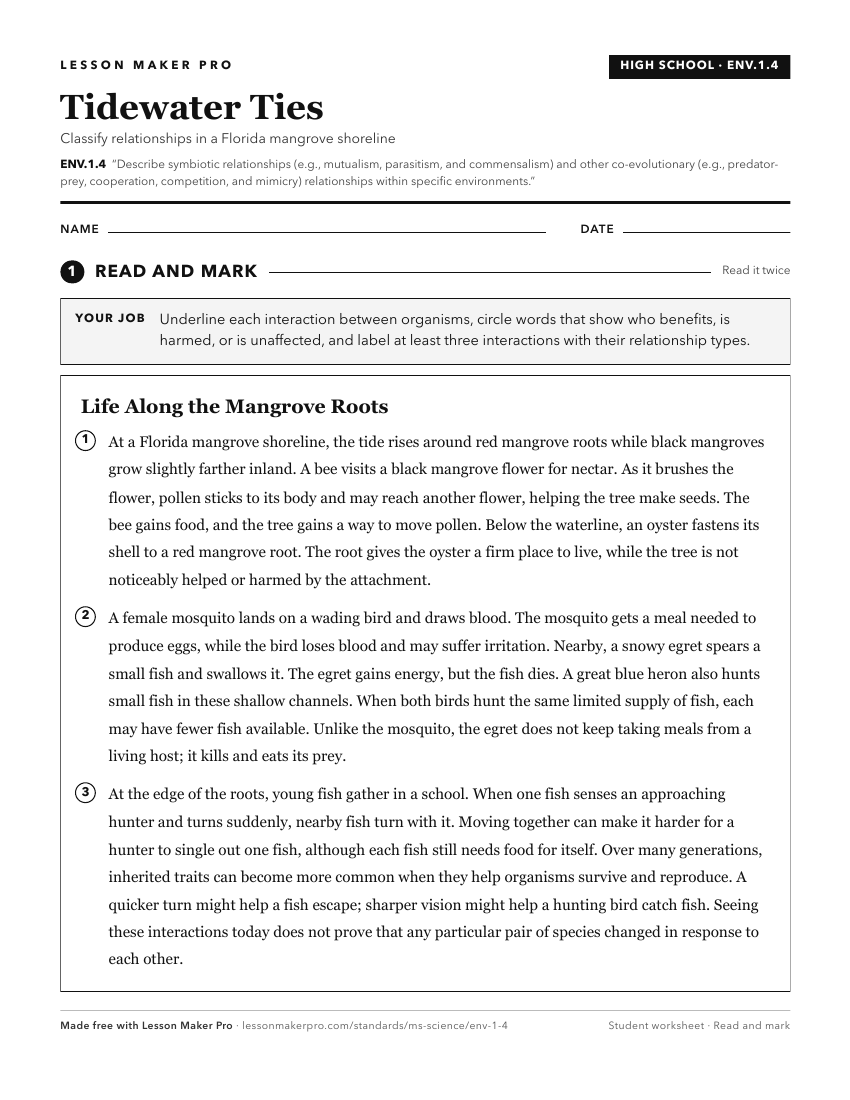
A ready-to-print activity worksheet aligned to ENV.1.4, with an answer key for the teacher on its own page. No account needed.
PDF, US Letter, prints cleanly in black and white.
Download the worksheetKeep exploring
Related Standards
- FB.6.6
Engage in scientific argument from evidence to distinguish organisms that exist in symbiotic (mutualism, parasitism, commensalism) or co-evolutionary (predator-...
- BIO.5.5
Evaluate symbiotic relationships (e.g., mutualism, parasitism, and commensalism) and other co-evolutionary (e.g., predator-prey, cooperation, competition, and m...
- L.6.3.4
Investigate organism interactions in a competitive or mutually beneficial relationship (predation, competition, cooperation, or symbiotic relationships).
- MAQ.6.7
Using key morphological and physiological adaptations found within animal taxa, assess how animals interact with their environment to determine their ecological...
Turn this exact standard into a lesson
Grade, subject, topic, and the complete standard are prefilled. Create one free, no account needed.
Also for this standard:Make a WorksheetMake a QuizMake a Sub Lesson