Mississippi Science L.6.3.2
The Standard
- L.6.3
- Students will demonstrate an understanding of the relationships between survival, environmental changes, and diversity as they relate to the interactions of organisms, populations, and the environment.
Develop and use models to describe the levels of organization within ecosystems (species, populations, communities, ecosystems, and biomes).
2026 Mississippi College- and Career-Readiness Standards for Science · Ecology and Interdependence
Teacher's field guide
What This Standard Means
What Students Need to Do
- Students make a labeled model of a woodland. They show one species, a local population of that species, and a community made of different populations. They add nonliving parts to show the ecosystem, then use climate and plants to identify the biome.
What Mastery Looks Like
- A student labels red oak as a species and five red oaks in one woodland as a population. They group the woodland’s populations into a community and add soil and sunlight to show the ecosystem. They use climate clues to identify the temperate forest biome.
Common Misconceptions
- Students may call one oak tree a population or lump every oak tree on Earth into one population. They may count soil and sunlight as part of a community. They may think a biome is simply one large ecosystem, rather than a group of ecosystems with similar climate and life.
How to Assess It
- Ask students to sketch five red oaks, two squirrels, soil, and sunlight in a temperate forest. Have them label a species, a population, the community, the ecosystem, and the biome.
Lesson moves
Ways to Teach It
Give pairs cards showing five red oaks, two squirrels, soil, and sunlight; have them build and label a woodland model on poster paper.
Have students write two sentences answering, 'Why are five red oaks in one park a population, but all its organisms a community?'
Run a sorting race with cards labeled red oak, five local red oaks, woodland organisms, woodland life plus soil and sunlight, and temperate forest.
Use a local park species list and climate chart to name one population, its community, its ecosystem, and its likely biome.
Free download
Printable L.6.3.2 Worksheet
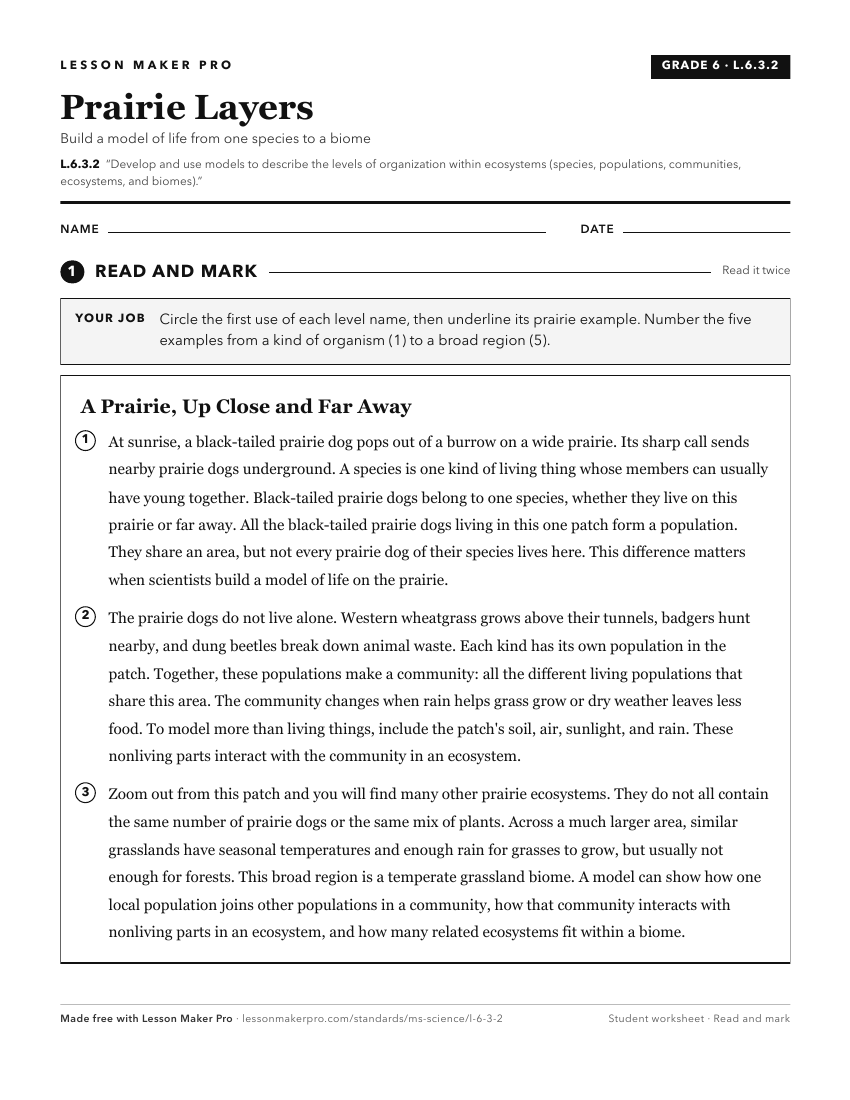
A ready-to-print activity worksheet aligned to L.6.3.2, with an answer key for the teacher on its own page. No account needed.
PDF, US Letter, prints cleanly in black and white.
Download the worksheetKeep exploring
Related Standards
- BIO.5.4
Develop and use models to describe the flow of energy and amount of biomass through food chains, food webs, and food pyramids.
- FB.6.4
Develop and use models to discuss the climate, flora, and fauna of the terrestrial and aquatic biomes of the world.
- L.6.1.6
Develop and use models to show relationships among the increasing complexity of multicellular organisms (cells, tissues, organs, organ systems, organisms) and h...
- BIO.5.1
Illustrate levels of ecological hierarchy, including organism, population, community, ecosystem, biome, and biosphere.
Turn this exact standard into a lesson
Grade, subject, topic, and the complete standard are prefilled. Create one free, no account needed.
Also for this standard:Make a WorksheetMake a QuizMake a Sub Lesson