Mississippi Science BIO.5.1
The Standard
- BIO.5
- Students will Investigate and evaluate the interdependence of living organisms and their environment.
Illustrate levels of ecological hierarchy, including organism, population, community, ecosystem, biome, and biosphere.
2026 Mississippi College- and Career-Readiness Standards for Science · Interdependence of Organisms and Their Environments
Teacher's field guide
What This Standard Means
What Students Need to Do
- Students draw or label six nested levels, from one living thing to all places on Earth where life exists. They show when other species and nonliving parts enter the picture. They distinguish a local ecosystem from a biome, a broad region with similar climate and life.
What Mastery Looks Like
- Given a forest scene, a student labels each level from one oak to the biosphere. They place soil and sunlight in the ecosystem, but not the community.
Common Misconceptions
- Students may call several different species a population or count rocks and sunlight as members of a community. They may treat one forest ecosystem as a whole biome or think the biosphere means only the atmosphere.
How to Assess It
- Give students a sketch of a forest with three oaks, a squirrel, mushrooms, soil, and sunlight. Ask them to label the organism, population, community, and ecosystem, then name the broader levels.
Lesson moves
Ways to Teach It
Give pairs six nested paper circles to sketch one oak, nearby oaks, other species, soil and rain, temperate deciduous forest, and Earth.
Ask: Why does adding soil and sunlight to an oak, squirrels, and fungi change the diagram from a community to an ecosystem?
Race to match cards showing one oak, local oaks, forest life, forest life plus soil, temperate deciduous forest, and Earth to level names.
Find your town on a biome map, name its biome, and explain how a nearby park ecosystem fits within it.
Free download
Printable BIO.5.1 Worksheet
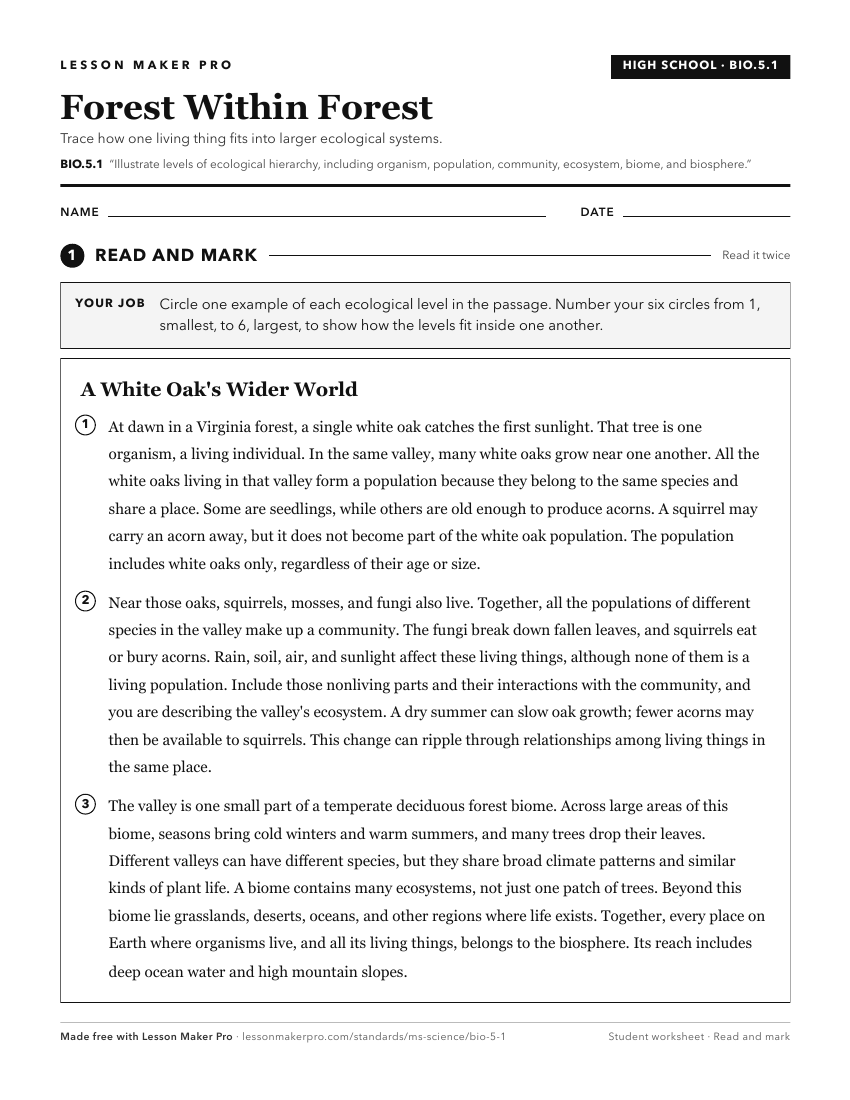
A ready-to-print activity worksheet aligned to BIO.5.1, with an answer key for the teacher on its own page. No account needed.
PDF, US Letter, prints cleanly in black and white.
Download the worksheetKeep exploring
Related Standards
- L.6.3.2
Develop and use models to describe the levels of organization within ecosystems (species, populations, communities, ecosystems, and biomes).
- L.6.3.5
Develop and use food chains, webs, and pyramids to analyze how energy is transferred through an ecosystem from producers (autotrophs) to consumers (heterotrophs...
- ENV.1.3
Use models to explain why the flow of energy through an ecosystem can be illustrated by a pyramid with less energy available at the higher trophic levels compar...
- L.6.1
Students will demonstrate an understanding that living things range from simple to complex organisms, are organized hierarchically, and function as whole living...
Turn this exact standard into a lesson
Grade, subject, topic, and the complete standard are prefilled. Create one free, no account needed.
Also for this standard:Make a WorksheetMake a QuizMake a Sub Lesson