Mississippi Science L.6.1
Standard Cluster
Students will demonstrate an understanding that living things range from simple to complex organisms, are organized hierarchically, and function as whole living systems. Use argument supported by evidence in order to distinguish between living and non-living things, including viruses and bacteria. Obtain and communicate evidence to support the cell theory. Develop and use models to explain how specific cellular components (cell wall, cell membrane, nucleus, chloroplast, vacuole, and mitochondria) function together to support the life of prokaryotic and eukaryotic organisms to include plants, animals, fungi, protists, and bacteria (not to include biochemical function of cells or cell part). Compare and contrast different cells in order to classify them as a protist, fungus, plant, or animal. Provide evidence that organisms are unicellular or multicellular. Develop and use models to show relationships among the increasing complexity of multicellular organisms (cells, tissues, organs, organ systems, organisms) and how they serve the needs of the organism.
2026 Mississippi College- and Career-Readiness Standards for Science · Hierarchical Organization
Cluster contents
Standards in This Cluster
L.6.1 is a cluster heading. These are the individual standards under it.
- L.6.1.1
Use argument supported by evidence in order to distinguish between living and non-living things, including viruses and bacteria.
- L.6.1.2
Obtain and communicate evidence to support the cell theory.
- L.6.1.3
Develop and use models to explain how specific cellular components (cell wall, cell membrane, nucleus, chloroplast, vacuole, and mitochondria) function together...
- L.6.1.4
Compare and contrast different cells in order to classify them as a protist, fungus, plant, or animal.
- L.6.1.5
Provide evidence that organisms are unicellular or multicellular.
- L.6.1.6
Develop and use models to show relationships among the increasing complexity of multicellular organisms (cells, tissues, organs, organ systems, organisms) and h...
Teacher's field guide
What This Cluster Means
What Students Need to Do
- Students use evidence to argue whether bacteria and viruses are living. They compare cells by their parts and show how those parts help organisms survive. They model how cells form tissues, organs, organ systems, and whole organisms.
What Mastery Looks Like
- A student uses cell images to explain that living things are made of cells and can be single-celled or multicellular. They identify a bacterium by its lack of a nucleus and use cell parts to sort plant, animal, fungal, and protist cells. They can trace a skin cell through tissue, organ, and organ system.
Common Misconceptions
- Students may call a virus a cell or think bacteria have nuclei. They may think every cell has chloroplasts, or that a tissue is one large cell.
How to Assess It
- Show pictures of a bacterium, a virus, and a plant cell. Ask students which are cells, which are living, and what evidence supports each answer.
Lesson moves
Ways to Teach It
Have pairs build plant and bacterial cells from clay, labeling membranes, walls, and the plant cell's nucleus, chloroplasts, vacuole, and mitochondria.
Ask: Is a virus alive if it reproduces only inside a cell? Write a claim with two pieces of evidence.
Play a card match: pair membrane, wall, nucleus, chloroplast, vacuole, and mitochondrion cards with cards describing their jobs.
Draw a scraped knee and label skin cells, epithelial tissue, skin, the integumentary system, and the whole person.
Free download
Printable L.6.1 Worksheet
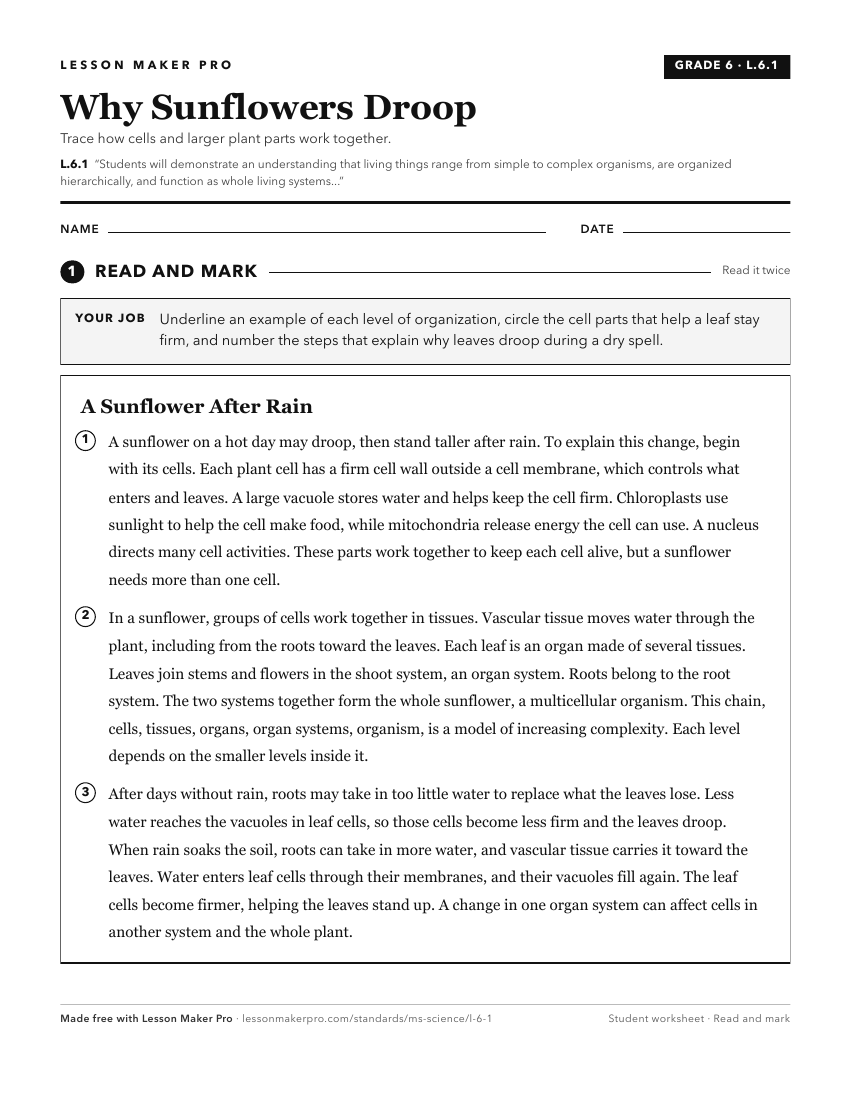
A ready-to-print activity worksheet aligned to L.6.1, with an answer key for the teacher on its own page. No account needed.
PDF, US Letter, prints cleanly in black and white.
Download the worksheetKeep exploring
Related Standards
- FB.3
Students will demonstrate an understanding of how the structure of living organisms supports the essential functions of life.
- BIO.1A
Students will demonstrate an understanding of the characteristics of life and biological organization.
- L.K.1A
Students will demonstrate an understanding of living and non-living things.
- L.2.3B
Students will demonstrate an understanding of the interdependence of living things.
Turn this cluster into a lesson
Grade, subject, topic, and the complete cluster are prefilled. Create one free, no account needed.
Also for this cluster:Make a WorksheetMake a QuizMake a Sub Lesson