Mississippi Science L.6.1.3
The Standard
- L.6.1
- Students will demonstrate an understanding that living things range from simple to complex organisms, are organized hierarchically, and function as whole living systems.
Develop and use models to explain how specific cellular components (cell wall, cell membrane, nucleus, chloroplast, vacuole, and mitochondria) function together to support the life of prokaryotic and eukaryotic organisms to include plants, animals, fungi, protists, and bacteria (not to include biochemical function of cells or cell part).
2026 Mississippi College- and Career-Readiness Standards for Science · Hierarchical Organization
Teacher's field guide
What This Standard Means
What Students Need to Do
- Students build models of plant, animal, fungal, protist, and bacterial cells with the parts each cell has. They use arrows and notes to explain how those parts work together to keep the cell alive.
What Mastery Looks Like
- A student puts a membrane in every cell model and a nucleus in the plant, animal, fungal, and protist models, but not the bacterial one. They explain how chloroplasts help a plant cell make food, mitochondria help it use food for energy, and its vacuole stores water. They put walls on plant and fungal cells, but not animal cells.
Common Misconceptions
- Students may put a nucleus in a bacterium or a cell wall around an animal cell. Some put chloroplasts in every protist, though only some protists have them. Others leave mitochondria out of plant cells because plants have chloroplasts.
How to Assess It
- On an exit ticket, have students draw a plant cell and a bacterium, labeling the parts each has. Ask them to write how two plant cell parts work together and why the bacterium has no nucleus.
Lesson moves
Ways to Teach It
Use paper cutouts to build plant and bacterial cells, then add arrows explaining how their parts work together.
Show leaf and mushroom cell diagrams and ask students to write why only the leaf cell has chloroplasts.
Hand out part cards and leaf, muscle, mushroom, amoeba, and bacterium mats; teams place valid cards and explain one choice.
Show a wilted houseplant photo; ask students why its cells lose firmness when vacuoles hold less water, despite their cell walls.
Free download
Printable L.6.1.3 Worksheet
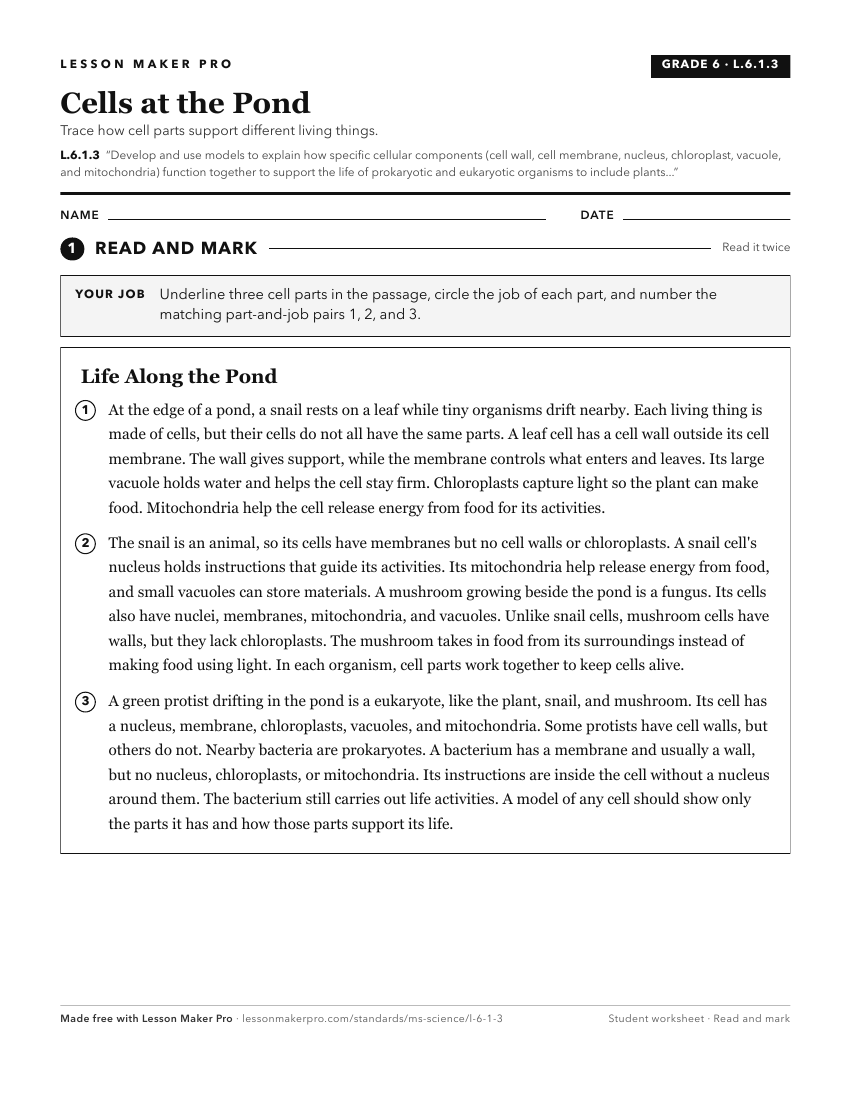
A ready-to-print activity worksheet aligned to L.6.1.3, with an answer key for the teacher on its own page. No account needed.
PDF, US Letter, prints cleanly in black and white.
Download the worksheetKeep exploring
Related Standards
- BIO.1B.1
Develop and use models to compare and contrast the structure and function of carbohydrates, lipids, proteins, and nucleic acids (DNA and RNA) in organisms.
- FB.3.2
Use models to investigate and explain structures within living cells that support life (e.g., cytoplasm, cell membrane, cell wall, nucleus, mitochondria, chloro...
- L.6.1.6
Develop and use models to show relationships among the increasing complexity of multicellular organisms (cells, tissues, organs, organ systems, organisms) and h...
- BIO.1C.1
Develop and use models to explore how specialized structures within cells (e.g., nucleus, cytoskeleton, endoplasmic reticulum, ribosomes, Golgi apparatus, lysos...
Turn this exact standard into a lesson
Grade, subject, topic, and the complete standard are prefilled. Create one free, no account needed.
Also for this standard:Make a WorksheetMake a QuizMake a Sub Lesson