Mississippi Science FB.3.2
The Standard
- FB.3
- Students will demonstrate an understanding of how the structure of living organisms supports the essential functions of life.
Use models to investigate and explain structures within living cells that support life (e.g., cytoplasm, cell membrane, cell wall, nucleus, mitochondria, chloroplasts, lysosomes, Golgi, vacuoles, ER, ribosomes, chromosomes, centrioles, cytoskeleton, nucleolus, nuclear membrane).
2026 Mississippi College- and Career-Readiness Standards for Science · Organization and Energy in Living Systems
Teacher's field guide
What This Standard Means
What Students Need to Do
- Students use cell models to identify structures in plant and animal cells. They explain how cell parts work together to make proteins, move materials, and release usable energy from food. They use a model to predict what happens when a part stops working.
What Mastery Looks Like
- A student labels a plant cell and an animal cell without putting chloroplasts or a cell wall in the animal cell. They trace a protein from the rough ER through the Golgi to the cell membrane. They predict what would happen if a cell lost its mitochondria.
Common Misconceptions
- Students may put chloroplasts or cell walls in animal cells. They may confuse the cell membrane with the cell wall, or say mitochondria make energy from nothing. Some think the nucleus makes proteins rather than storing the instructions for them.
How to Assess It
- Give students a plant-cell diagram with the cell wall, membrane, chloroplast, and mitochondrion unlabeled. Have them label each part and predict what would change if the chloroplast stopped working.
Lesson moves
Ways to Teach It
Give pairs paper organelle cutouts to build plant and animal cells, then add arrows showing how a protein reaches the cell membrane.
Display two cell diagrams and ask students to write what happens if the membrane breaks but the wall stays intact.
Deal organelle cards and job cards; students match pairs, then explain what would fail if each organelle were removed.
Compare printed leaf-cell and cheek-cell micrographs; students find chloroplasts and explain which cell can make sugar from sunlight.
Free download
Printable FB.3.2 Worksheet
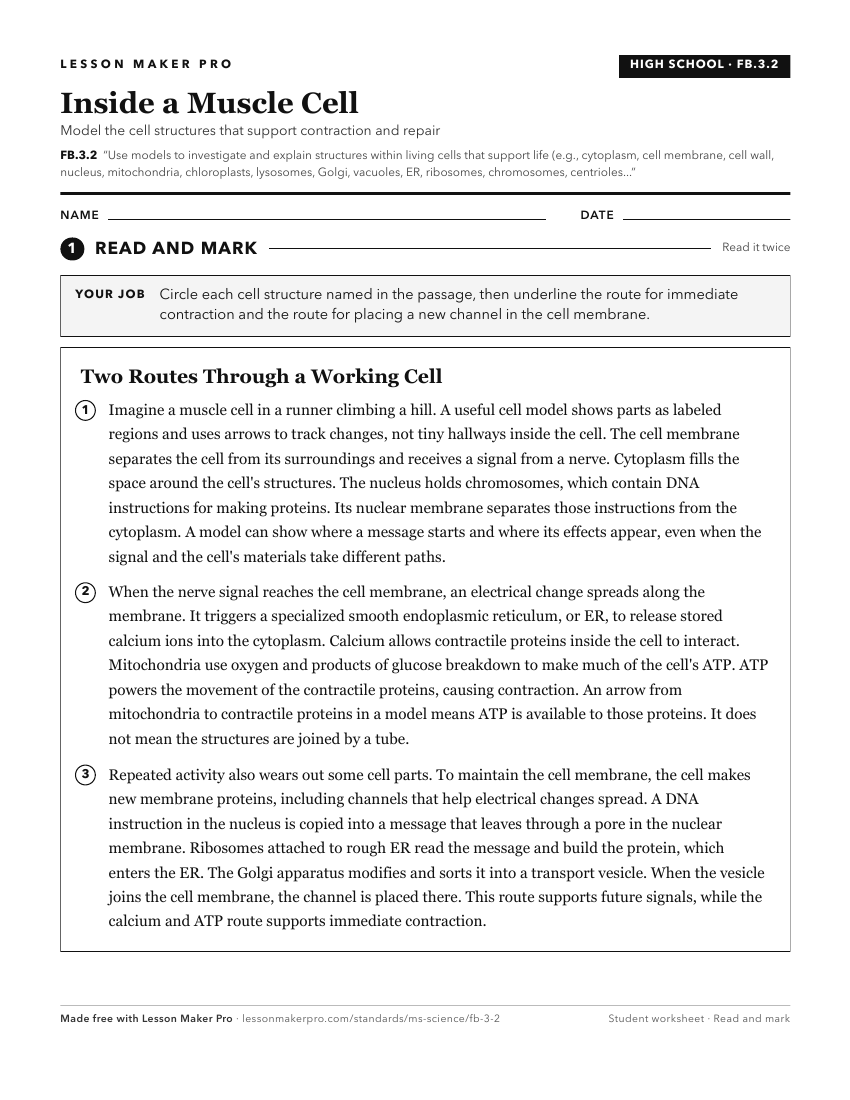
A ready-to-print activity worksheet aligned to FB.3.2, with an answer key for the teacher on its own page. No account needed.
PDF, US Letter, prints cleanly in black and white.
Download the worksheetKeep exploring
Related Standards
- BIO.1B.1
Develop and use models to compare and contrast the structure and function of carbohydrates, lipids, proteins, and nucleic acids (DNA and RNA) in organisms.
- L.6.1.3
Develop and use models to explain how specific cellular components (cell wall, cell membrane, nucleus, chloroplast, vacuole, and mitochondria) function together...
- BIO.1C.1
Develop and use models to explore how specialized structures within cells (e.g., nucleus, cytoskeleton, endoplasmic reticulum, ribosomes, Golgi apparatus, lysos...
- FB.2.7
Enrichment: Explore the structure of biomolecules using molecular models. Relate the structure of biomolecules to their function in living things (discuss types...
Turn this exact standard into a lesson
Grade, subject, topic, and the complete standard are prefilled. Create one free, no account needed.
Also for this standard:Make a WorksheetMake a QuizMake a Sub Lesson