Mississippi Science FB.2.7
The Standard
- FB.2
- Students will demonstrate an understanding of the structure and interactions of matter and how the organization of matter supports living organisms.
Enrichment: Explore the structure of biomolecules using molecular models. Relate the structure of biomolecules to their function in living things (discuss types bonding, importance of the strength and weakness of the bond in function, energy in bonds, enzyme function).
2026 Mississippi College- and Career-Readiness Standards for Science · The Chemistry of Life
Teacher's field guide
What This Standard Means
What Students Need to Do
- Use models to show how bonds give biomolecules their shapes. Connect DNA pairing and enzyme binding to strong and weak bonds. Explain that breaking bonds takes energy and forming bonds releases it.
What Mastery Looks Like
- A student can model covalent links along a DNA strand and weaker hydrogen bonds between paired bases. They can explain why DNA unzips without breaking its backbone and why an enzyme binds a matching substrate. They can compare the energy needed to break bonds with the energy released when new bonds form.
Common Misconceptions
- Students may think breaking a chemical bond releases energy, rather than requiring it. They may think DNA strands are held together by covalent bonds, or that any substrate fits any enzyme.
How to Assess It
- Exit ticket: Draw two base pairs on two DNA strands. Label a backbone bond and a bond between bases, then circle what breaks during unzipping and state whether that takes energy.
Lesson moves
Ways to Teach It
Use colored paper nucleotides, tape for covalent links, and paper clips for hydrogen bonds; build and unzip a two-pair DNA model.
Show sketches of two enzyme pockets and one lactose molecule; ask, "Which pocket could bind lactose, and what if its shape changed?"
Give pairs covalent and hydrogen bond cards and a DNA diagram; have them race to place each card on a matching link.
Read a lactose-free milk carton label, then sketch how added lactase binds lactose and splits it into glucose and galactose.
Free download
Printable FB.2.7 Worksheet
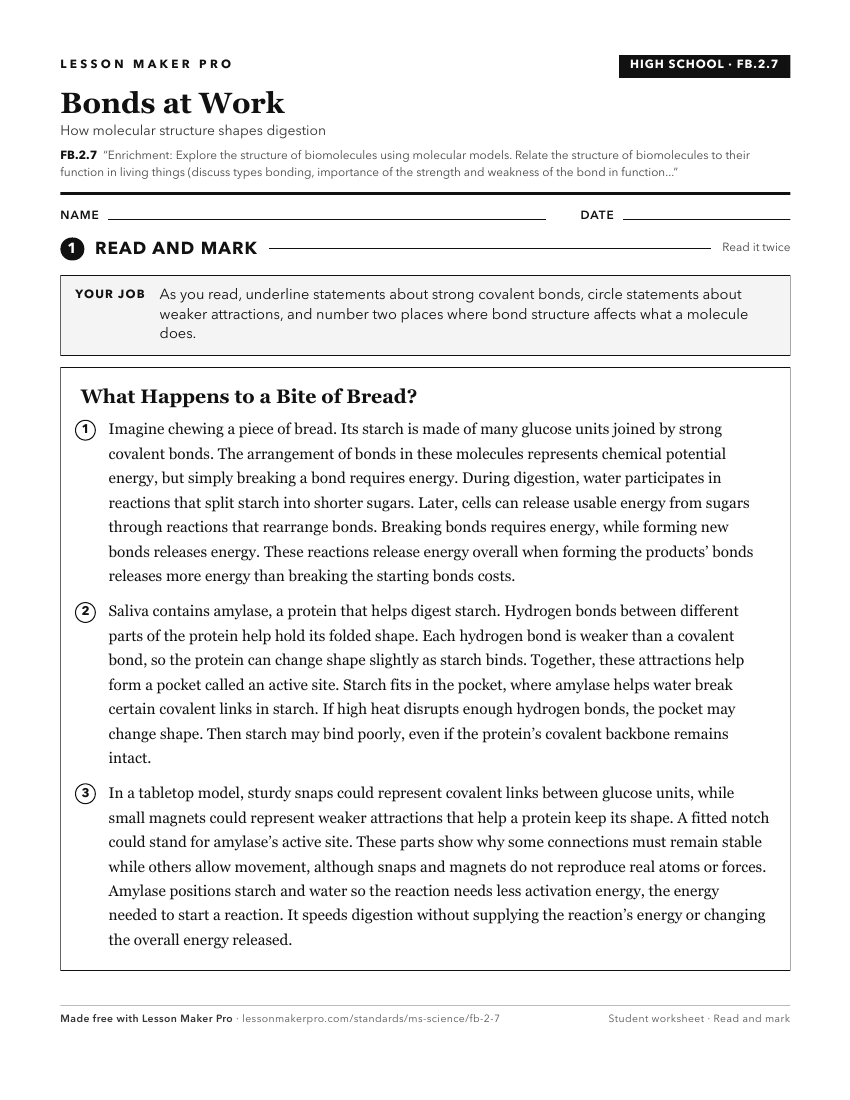
A ready-to-print activity worksheet aligned to FB.2.7, with an answer key for the teacher on its own page. No account needed.
PDF, US Letter, prints cleanly in black and white.
Download the worksheetKeep exploring
Related Standards
- BIO.1B.1
Develop and use models to compare and contrast the structure and function of carbohydrates, lipids, proteins, and nucleic acids (DNA and RNA) in organisms.
- FB.3.2
Use models to investigate and explain structures within living cells that support life (e.g., cytoplasm, cell membrane, cell wall, nucleus, mitochondria, chloro...
- CHE.12
Enrichment: Students will understand that the bonding characteristics of carbon allow the formation of many different organic molecules with various sizes, shap...
- CHE.12.1
Enrichment: Construct explanations to explain the bonding characteristics of carbon that result in the formation of basic organic molecules.
Turn this exact standard into a lesson
Grade, subject, topic, and the complete standard are prefilled. Create one free, no account needed.
Also for this standard:Make a WorksheetMake a QuizMake a Sub Lesson