Mississippi Science BIO.1B.1
The Standard
- BIO.1B
- Students will analyze the structure and function of the macromolecules that make up cells.
Develop and use models to compare and contrast the structure and function of carbohydrates, lipids, proteins, and nucleic acids (DNA and RNA) in organisms.
2026 Mississippi College- and Career-Readiness Standards for Science · Cells as a System
Teacher's field guide
What This Standard Means
What Students Need to Do
- Students draw models of carbohydrates, lipids, proteins, DNA, and RNA. They use the models to compare each molecule’s parts, shape, and job in an organism.
What Mastery Looks Like
- Given unlabeled models, students identify each molecule by its parts and arrangement. They explain how a protein’s folded shape helps it work, and how DNA and RNA differ in structure and job.
Common Misconceptions
- Students may think proteins are made of nucleotides or that DNA and RNA have the same structure and job. They may say carbohydrates and lipids only provide energy, missing other jobs such as forming cell membranes.
How to Assess It
- Show four sketches: a sugar chain, a fat molecule, a folded protein, and a DNA double strand. Ask students to name each, link one pictured feature to its job, and give one difference between DNA and RNA.
Lesson moves
Ways to Teach It
Give groups paper cutouts of sugar rings, glycerol, fatty acids, amino acids, and nucleotides to assemble and label molecule models.
Ask students to write how an enzyme’s folded shape and DNA’s paired strands help each do its job.
Play a card sort: match sketches of molecule parts to a carbohydrate, lipid, protein, DNA, or RNA and one job.
Use a food label to compare carbohydrates, fats, and proteins, then ask what each does in the body besides supplying calories.
Free download
Printable BIO.1B.1 Worksheet
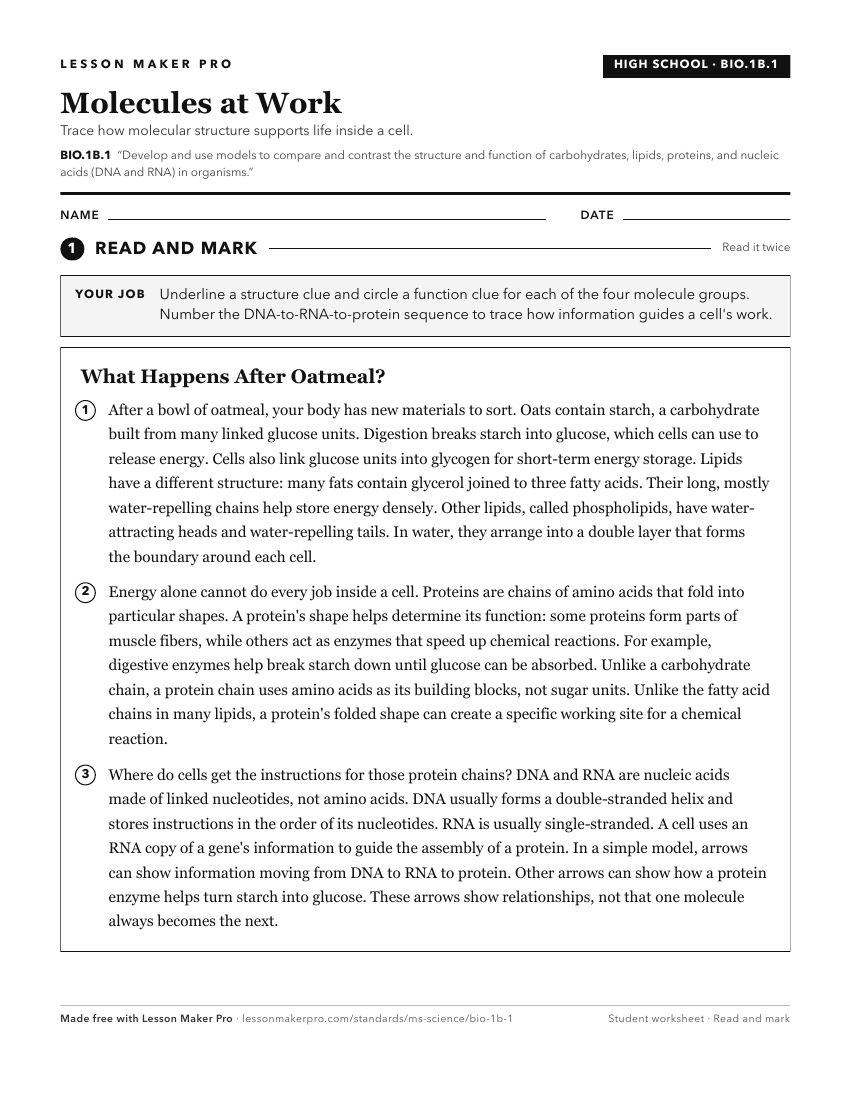
A ready-to-print activity worksheet aligned to BIO.1B.1, with an answer key for the teacher on its own page. No account needed.
PDF, US Letter, prints cleanly in black and white.
Download the worksheetKeep exploring
Related Standards
- FB.3.2
Use models to investigate and explain structures within living cells that support life (e.g., cytoplasm, cell membrane, cell wall, nucleus, mitochondria, chloro...
- FB.4.1
Compare and contrast the basic structure and function of nucleic acids (e.g., DNA, RNA).
- L.6.1.3
Develop and use models to explain how specific cellular components (cell wall, cell membrane, nucleus, chloroplast, vacuole, and mitochondria) function together...
- BIO.1C.1
Develop and use models to explore how specialized structures within cells (e.g., nucleus, cytoskeleton, endoplasmic reticulum, ribosomes, Golgi apparatus, lysos...
Turn this exact standard into a lesson
Grade, subject, topic, and the complete standard are prefilled. Create one free, no account needed.
Also for this standard:Make a WorksheetMake a QuizMake a Sub Lesson