Mississippi Science FB.4.1
The Standard
- FB.4
- Students will demonstrate an understanding of how genetic information is transferred from parent to offspring.
Compare and contrast the basic structure and function of nucleic acids (e.g., DNA, RNA).
2026 Mississippi College- and Career-Readiness Standards for Science · Molecular Basis of Heredity
Teacher's field guide
What This Standard Means
What Students Need to Do
- Students compare what DNA and RNA are made of and how they are shaped. They explain how DNA stores instructions and how RNA helps cells use those instructions to make proteins.
What Mastery Looks Like
- A student can identify the sugar, phosphate, and base in both molecules. They can point out that DNA uses deoxyribose and thymine, while RNA uses ribose and uracil. They can explain why a cell needs both.
Common Misconceptions
- Students may think RNA is just one half of a DNA molecule. They may put uracil in DNA or assume both molecules have the same sugar. Some think RNA stores the cell's long-term instructions instead of helping use them.
How to Assess It
- On an exit ticket, ask students to draw one DNA nucleotide and one RNA nucleotide, then label the sugar, phosphate, and base. Have them name one job of each molecule.
Lesson moves
Ways to Teach It
Give pairs paper nucleotides labeled deoxyribose or ribose; have them build a paired DNA segment and a single RNA strand using T or U correctly.
Ask: If DNA stays in the nucleus, how does a ribosome get instructions to make a protein? Have pairs explain RNA's role.
Sort cards reading 'has uracil,' 'stores instructions,' and 'contains phosphate' into DNA, RNA, or both; check answers with a partner.
Sketch a cell receiving mRNA from a vaccine; ask why the mRNA can guide protein production without replacing the cell's DNA.
Free download
Printable FB.4.1 Worksheet
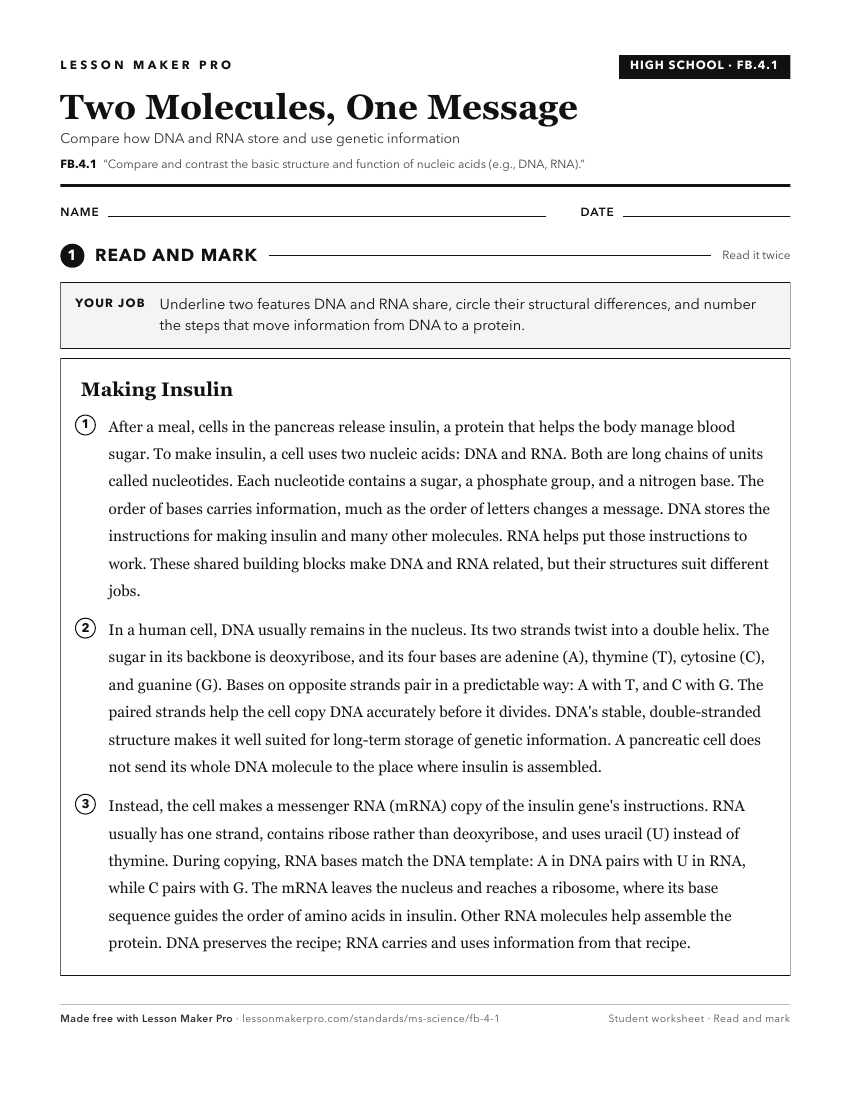
A ready-to-print activity worksheet aligned to FB.4.1, with an answer key for the teacher on its own page. No account needed.
PDF, US Letter, prints cleanly in black and white.
Download the worksheetKeep exploring
Related Standards
- BIO.1B.1
Develop and use models to compare and contrast the structure and function of carbohydrates, lipids, proteins, and nucleic acids (DNA and RNA) in organisms.
- GEN.2A.1
Compare and contrast the structures of RNA and DNA and relate this structure to the different functions of each molecule.
- BIO.3C
Students will construct an explanation based on evidence to describe how the structure and nucleotide base sequence of DNA determines the structure of proteins ...
- GEN.1A.3
Relate the structure of DNA to its specific functions within the cell.
Turn this exact standard into a lesson
Grade, subject, topic, and the complete standard are prefilled. Create one free, no account needed.
Also for this standard:Make a WorksheetMake a QuizMake a Sub Lesson