Mississippi Science GEN.2A.1
The Standard
- GEN.2A
- Students will analyze and explain the processes of transcription and translation in protein production.
Compare and contrast the structures of RNA and DNA and relate this structure to the different functions of each molecule.
2026 Mississippi College- and Career-Readiness Standards for Science · Transcription, Translation, and Mutations
Teacher's field guide
What This Standard Means
What Students Need to Do
- Students identify the sugars, bases, and usual strand arrangements of DNA and RNA. They explain how DNA stores genetic instructions and how RNA helps use those instructions to make proteins.
What Mastery Looks Like
- Given two unlabeled diagrams, a student identifies DNA by its double strands, deoxyribose, and thymine. They identify RNA by its usual single strand, ribose, and uracil, then explain that messenger RNA carries a copy of instructions to a ribosome.
Common Misconceptions
- Students may think RNA is a strand pulled off DNA, rather than a new molecule made using DNA as a template. They may put thymine in RNA or uracil in DNA. Some think RNA turns into protein, rather than being read to build one.
How to Assess It
- Exit ticket: Given DNA template 3′-TACG-5′, write the RNA sequence and name two structural differences between RNA and DNA. Explain how one difference fits each molecule’s job.
Lesson moves
Ways to Teach It
Use colored paper nucleotides to build a paired DNA segment, then transcribe one strand into RNA and label each sugar and base.
Ask partners: Why does double-stranded DNA suit long-term storage while a single-stranded RNA copy can carry a message?
Sort cards labeled ribose, deoxyribose, thymine, uracil, paired strands, single strand, storage, and message into DNA and RNA columns.
Show an mRNA vaccine fact sheet and ask why its RNA provides short-lived instructions rather than permanent genetic storage.
Free download
Printable GEN.2A.1 Worksheet
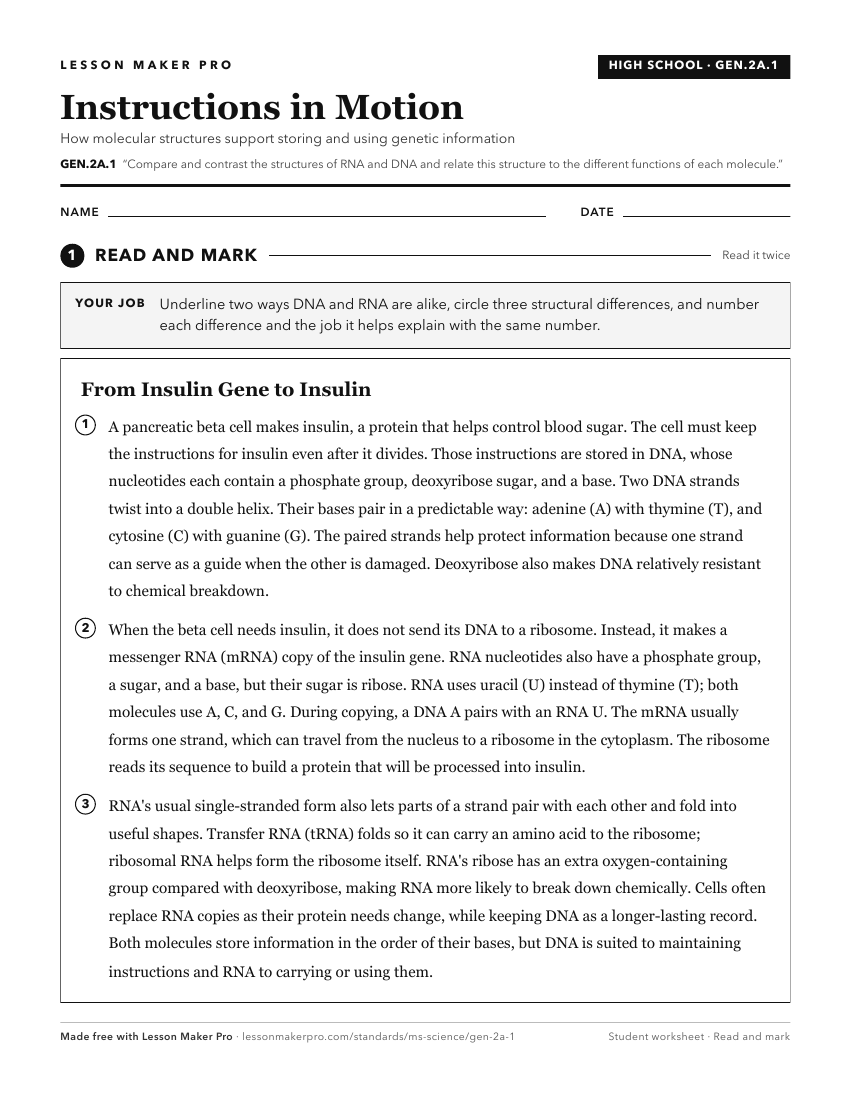
A ready-to-print activity worksheet aligned to GEN.2A.1, with an answer key for the teacher on its own page. No account needed.
PDF, US Letter, prints cleanly in black and white.
Download the worksheetKeep exploring
Related Standards
- BIO.1B.1
Develop and use models to compare and contrast the structure and function of carbohydrates, lipids, proteins, and nucleic acids (DNA and RNA) in organisms.
- GEN.2A.4
Analyze the multiple roles of RNA in translation. Compare the structure and function of tRNA, rRNA, mRNA, and snRNA.
- FB.4.1
Compare and contrast the basic structure and function of nucleic acids (e.g., DNA, RNA).
- GEN.1A.3
Relate the structure of DNA to its specific functions within the cell.
Turn this exact standard into a lesson
Grade, subject, topic, and the complete standard are prefilled. Create one free, no account needed.
Also for this standard:Make a WorksheetMake a QuizMake a Sub Lesson