Mississippi Science BIO.3C
Standard Cluster
Students will construct an explanation based on evidence to describe how the structure and nucleotide base sequence of DNA determines the structure of proteins or RNA that carry out essential functions of life. Develop and use models to explain the relationship between DNA, genes, and chromosomes in coding the instructions for the traits transferred from parent to offspring. Evaluate the mechanisms of transcription and translation in protein synthesis. Use models to predict how various changes in the nucleotide sequence (e.g., point mutations, and frameshift mutations) will affect the resulting protein product and the subsequent inherited trait. Research and identify how DNA technology benefits society. Engage in scientific argument from evidence over the ethical issues surrounding the use of DNA technology (e.g., cloning, transgenic organisms, stem cell research, the Human Genome Project, and gel electrophoresis). Enrichment: Investigate current biotechnological applications in the study of the genome (e.g., transcriptome, proteome, individualized sequencing, and individualized gene therapy).
2026 Mississippi College- and Career-Readiness Standards for Science · Reproduction and Heredity
Cluster contents
Standards in This Cluster
BIO.3C is a cluster heading. These are the individual standards under it.
- BIO.3C.1
Develop and use models to explain the relationship between DNA, genes, and chromosomes in coding the instructions for the traits transferred from parent to offs...
- BIO.3C.2
Evaluate the mechanisms of transcription and translation in protein synthesis.
- BIO.3C.3
Use models to predict how various changes in the nucleotide sequence (e.g., point mutations, and frameshift mutations) will affect the resulting protein product...
- BIO.3C.4
Research and identify how DNA technology benefits society. Engage in scientific argument from evidence over the ethical issues surrounding the use of DNA techno...
- BIO.3C.5
Enrichment: Investigate current biotechnological applications in the study of the genome (e.g., transcriptome, proteome, individualized sequencing, and individu...
Teacher's field guide
What This Cluster Means
What Students Need to Do
- Students place genes on chromosomes and trace how DNA bases are transcribed into RNA and translated into proteins. They explain that some RNA works without being translated, then predict how base changes might affect a protein and an inherited trait. They use evidence to weigh a benefit and an ethical concern of DNA technology.
What Mastery Looks Like
- Given a labeled DNA template strand, a student writes the matching mRNA and uses a codon chart to find the amino acids. They compare original and mutated sequences, explain a possible effect on a trait, and recognize when an RNA molecule works without becoming a protein. They cite evidence when weighing a benefit of genetic testing against a privacy risk.
Common Misconceptions
- Students may treat a gene as a whole chromosome or think DNA turns directly into protein without an RNA step. They may read codons from the DNA template as if it were mRNA. They may assume every mutation changes a trait or that every mutation is harmful.
How to Assess It
- Exit ticket: Give students coding DNA 5′-ATG GAA TTT TAA-3′ and the same sequence with an A inserted after ATG. Have them write both mRNA sequences and amino acid chains using a codon chart, then explain what the insertion changes.
Lesson moves
Ways to Teach It
Give pairs paper DNA strips, RNA base tiles, and amino acid cards to build a gene, transcribe it, and translate its mRNA.
Ask: Should schools keep students' genetic test results? Have students cite one privacy risk and one medical benefit from two short source excerpts.
Run mutation bingo: call out a base substitution or insertion, then students use codon charts to mark unchanged amino acid, changed amino acid, or frameshift.
Show a mock forensic DNA gel with two suspects and a crime-scene sample; students compare bands and explain why a match alone cannot prove guilt.
Free download
Printable BIO.3C Worksheet
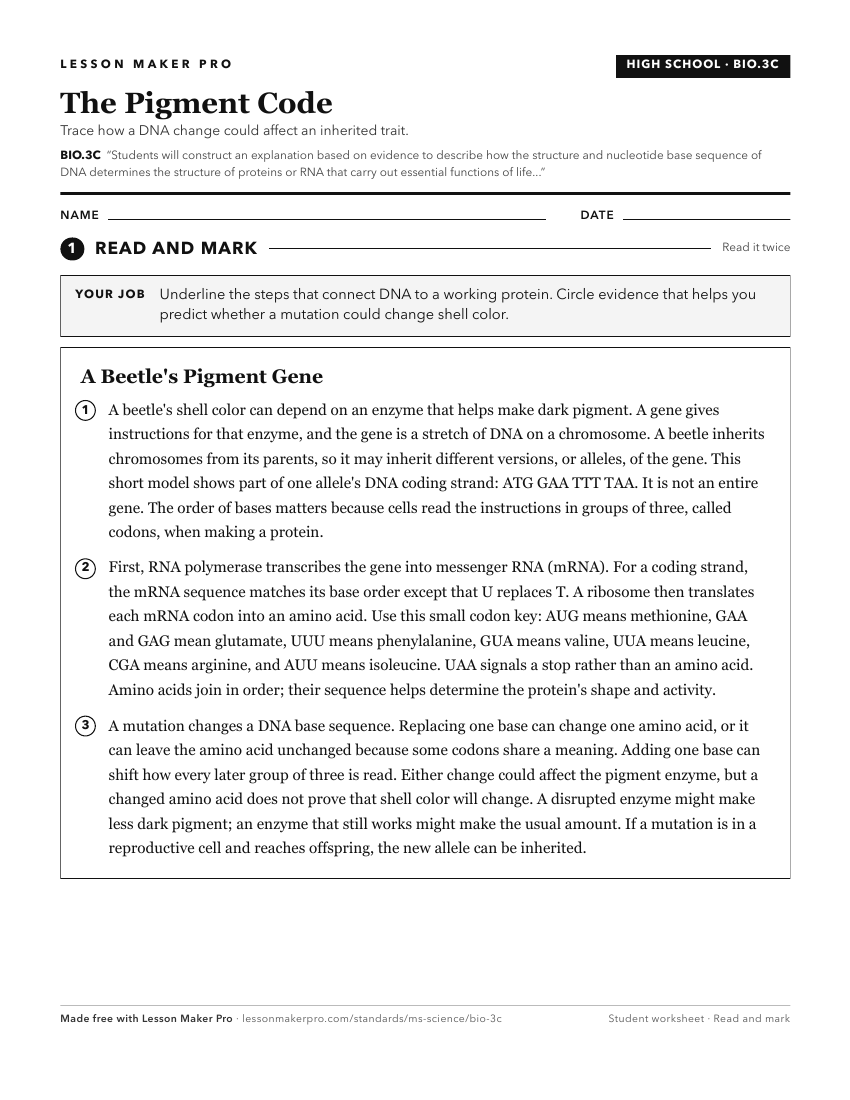
A ready-to-print activity worksheet aligned to BIO.3C, with an answer key for the teacher on its own page. No account needed.
PDF, US Letter, prints cleanly in black and white.
Download the worksheetKeep exploring
Related Standards
- FB.3
Students will demonstrate an understanding of how the structure of living organisms supports the essential functions of life.
- GEN.1B
Students will analyze how the DNA sequence is copied and transmitted to new cells.
- L.8.2C
Students will demonstrate an understanding that chromosomes contain many distinct genes and that each gene holds the instructions for the production of a specif...
- GEN.2B
Students will determine the causes and effects of mutations in DNA.
Turn this cluster into a lesson
Grade, subject, topic, and the complete cluster are prefilled. Create one free, no account needed.
Also for this cluster:Make a WorksheetMake a QuizMake a Sub Lesson