Mississippi Science BIO.3C.4
The Standard
- BIO.3C
- Students will construct an explanation based on evidence to describe how the structure and nucleotide base sequence of DNA determines the structure of proteins or RNA that carry out essential functions of life.
Research and identify how DNA technology benefits society. Engage in scientific argument from evidence over the ethical issues surrounding the use of DNA technology (e.g., cloning, transgenic organisms, stem cell research, the Human Genome Project, and gel electrophoresis).
2026 Mississippi College- and Career-Readiness Standards for Science · Reproduction and Heredity
Teacher's field guide
What This Standard Means
What Students Need to Do
- Students research how DNA tools, such as genetic testing or DNA profiling, help people. They use evidence to argue whether a tool should be used in a particular situation. They consider concerns such as privacy, consent, or access.
What Mastery Looks Like
- A student can explain how a named tool leads to a specific benefit. They cite evidence for their position and respond to a reasonable concern about its use.
Common Misconceptions
- Students may think a DNA test can predict with certainty whether someone will develop a disease. They may treat a personal opinion as evidence or assume that a useful technology has no ethical risks.
How to Assess It
- Exit ticket: A clinic offers testing for an inherited disease. Name one benefit and one ethical concern, then use a fact from a provided article to defend whether patients should be offered the test.
Lesson moves
Ways to Teach It
Cut paper DNA strips of different lengths, place shorter strips farther down drawn gel lanes, and compare two sample patterns.
Give students a clinic consent form and a genetic testing article; ask, 'Should a clinic share results with relatives without permission? Why?'
Give pairs a short article and six claims about transgenic crops; sort claims into supported, contradicted, or not addressed.
Read a news report on DNA evidence used to clear a wrongful conviction; list the benefit and one risk of storing DNA profiles.
Free download
Printable BIO.3C.4 Worksheet
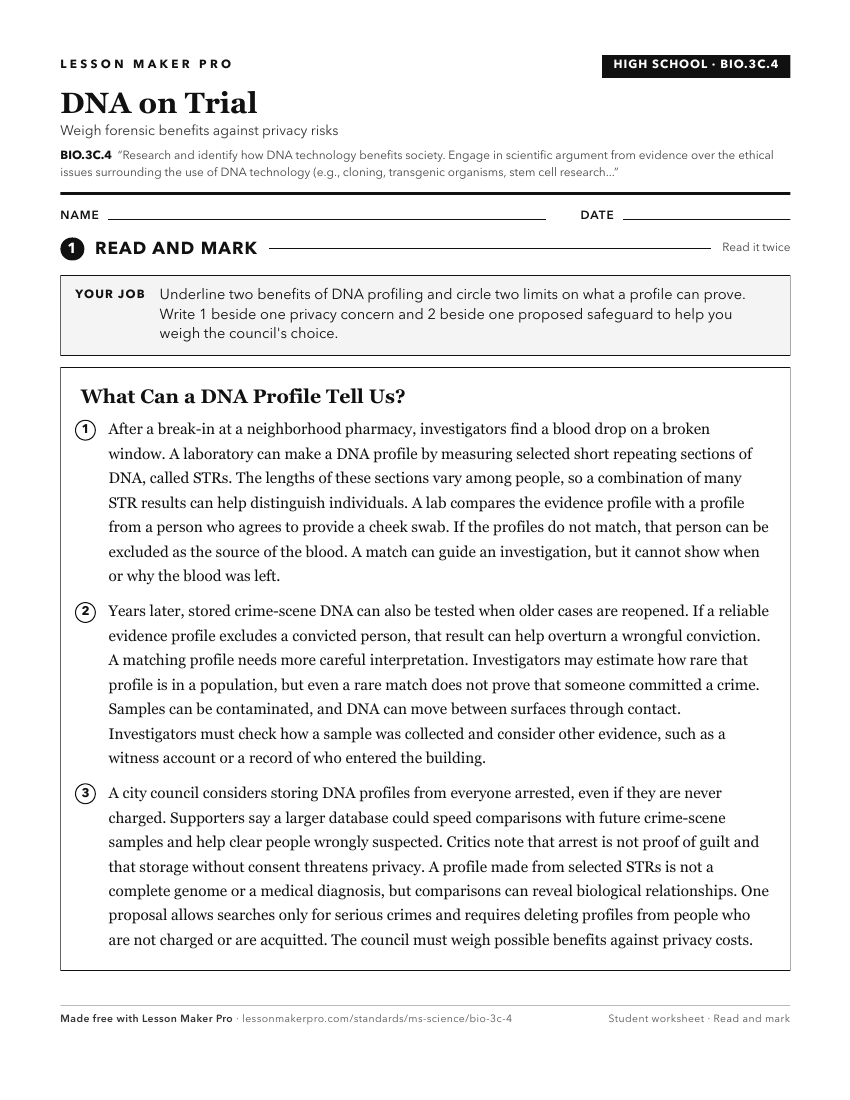
A ready-to-print activity worksheet aligned to BIO.3C.4, with an answer key for the teacher on its own page. No account needed.
PDF, US Letter, prints cleanly in black and white.
Download the worksheetKeep exploring
Related Standards
- FB.4.5
Research and report on genetic technologies that may improve the quality of life (e.g., genetic engineering, cloning, gene splicing, DNA testing).
- GEN.3.4
Enrichment: Develop logical arguments based on scientific evidence for and against ethical concerns regarding biotechnology/bioengineering.
- FB.4.6
Enrichment: Debate the pros and cons of using biotechnology to manipulate genetic information for human purposes (society).
- GEN.3.1
Explain and demonstrate the use of various tools and techniques of DNA manipulation and their applications in forensics (e.g., paternity and victim/suspect iden...
Turn this exact standard into a lesson
Grade, subject, topic, and the complete standard are prefilled. Create one free, no account needed.
Also for this standard:Make a WorksheetMake a QuizMake a Sub Lesson