Mississippi Science L.8.2C
Standard Cluster
Students will demonstrate an understanding that chromosomes contain many distinct genes and that each gene holds the instructions for the production of a specific protein, which in turn affects the traits of an individual. Communicate through diagrams that chromosomes contain many distinct genes and that each gene holds the instructions for the production of specific proteins, which in turn affects the traits of the individual (not to include transcription or translation). Construct scientific arguments from evidence to support claims about the potentially harmful, beneficial, or neutral effects of genetic mutations on organisms.
2026 Mississippi College- and Career-Readiness Standards for Science · Reproduction and Heredity
Cluster contents
Standards in This Cluster
L.8.2C is a cluster heading. These are the individual standards under it.
- L.8.2C.1
Communicate through diagrams that chromosomes contain many distinct genes and that each gene holds the instructions for the production of specific proteins, whi...
- L.8.2C.2
Construct scientific arguments from evidence to support claims about the potentially harmful, beneficial, or neutral effects of genetic mutations on organisms.
Teacher's field guide
What This Cluster Means
What Students Need to Do
- Students draw a chromosome with several genes and link a gene to a protein and a trait. They use evidence to explain when a change in a gene helps, harms, or has no noticeable effect on an organism.
What Mastery Looks Like
- A student labels several genes on one chromosome and traces a gene to its protein and a trait. They use data to support a claim about a mutation's effect in a stated setting.
Common Misconceptions
- Students may draw one gene per chromosome or think a gene is a trait, rather than instructions for a protein. They may assume every mutation is harmful, even when evidence shows a benefit or no noticeable change.
How to Assess It
- Exit ticket: Draw a chromosome with two genes, then show one gene leading to a protein and a trait. After antibiotics, 80 of 100 resistant bacteria survive, versus 2 of 100 without resistance. Use those numbers to explain whether the resistance mutation helps or harms in this setting.
Lesson moves
Ways to Teach It
Build a paper chromosome with three gene stickers, then draw arrows to protein and trait cards, including pigment-making protein and fur color.
Ask: 'After antibiotics, 80 of 100 resistant bacteria survive, versus 2 of 100 without resistance. What claim do these numbers support?'
Deal three scenario cards: antibiotic resistance during treatment, reduced oxygen delivery from altered hemoglobin, and an unchanged protein. Teams sort the mutation effects.
Show photos of a sickle-shaped red blood cell and a normal cell; students connect altered hemoglobin to cell shape and oxygen delivery.
Free download
Printable L.8.2C Worksheet
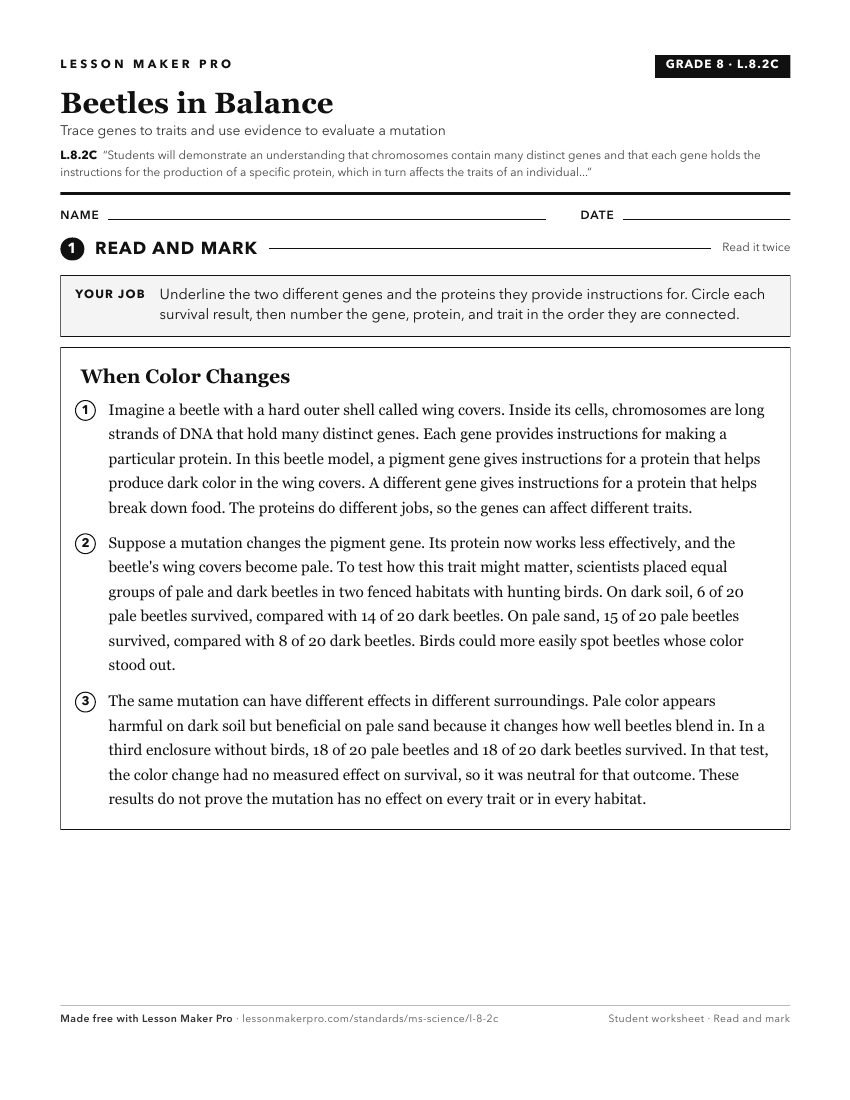
A ready-to-print activity worksheet aligned to L.8.2C, with an answer key for the teacher on its own page. No account needed.
PDF, US Letter, prints cleanly in black and white.
Download the worksheetKeep exploring
Related Standards
- GEN.1A
Students will demonstrate that all cells contain genetic material in the form of DNA.
- L.8.2B
Students will demonstrate an understanding of the differences in inherited and acquired characteristics and how environmental factors (natural selection) and th...
- FB.4
Students will demonstrate an understanding of how genetic information is transferred from parent to offspring.
Turn this cluster into a lesson
Grade, subject, topic, and the complete cluster are prefilled. Create one free, no account needed.
Also for this cluster:Make a WorksheetMake a QuizMake a Sub Lesson