Mississippi Science GEN.1A
Standard Cluster
Students will demonstrate that all cells contain genetic material in the form of DNA. Model the biochemical structure, either 3-D or computer-based, of DNA based on the experimental evidence available to Watson and Crick (Chargaff, 1950; Franklin, 1951). Explain the importance of the historical experiments that determined that DNA is the heritable material of the cell (Griffith, 1928; Avery, McCarty & MacLeod, 1944; Hershey & Chase, 1952). Relate the structure of DNA to its specific functions within the cell. Conduct a standard DNA extraction protocol using salt, detergent, and ethanol from various cell types (e.g., plant, animal, fungus). Compare and contrast the consistency and quantity of DNA extracted from various cell types. Enrichment: Use an engineering design process to refine the methodology to optimize the DNA-extraction process for various cell types. * Investigate the structural differences between the genomes (i.e., circular/linear chromosomes and plasmids) found in prokaryotes and eukaryotes.
2026 Mississippi College- and Career-Readiness Standards for Science · Structure and Function of DNA
Cluster contents
Standards in This Cluster
GEN.1A is a cluster heading. These are the individual standards under it.
- GEN.1A.1
Model the biochemical structure, either 3-D or computer-based, of DNA based on the experimental evidence available to Watson and Crick (Chargaff, 1950; Franklin...
- GEN.1A.2
Explain the importance of the historical experiments that determined that DNA is the heritable material of the cell (Griffith, 1928; Avery, McCarty & MacLeod, 1...
- GEN.1A.3
Relate the structure of DNA to its specific functions within the cell.
- GEN.1A.4
Conduct a standard DNA extraction protocol using salt, detergent, and ethanol from various cell types (e.g., plant, animal, fungus). Compare and contrast the co...
- GEN.1A.5
Enrichment: Use an engineering design process to refine the methodology to optimize the DNA-extraction process for various cell types. *
- GEN.1A.6
Investigate the structural differences between the genomes (i.e., circular/linear chromosomes and plasmids) found in prokaryotes and eukaryotes.
Teacher's field guide
What This Cluster Means
What Students Need to Do
- Students use Chargaff’s base ratios and Franklin’s X-ray evidence to build a DNA model. They explain how Griffith, Avery and colleagues, and Hershey and Chase showed that DNA carries inherited information. They extract DNA with salt, detergent, and ethanol, then compare the amount and texture collected from two cell types.
What Mastery Looks Like
- A student puts A opposite T and C opposite G, with the bases between two sugar-phosphate strands. They explain how each strand guides copying and what each historical experiment showed. They compare DNA extracts without assuming a bigger clump means more DNA per cell.
Common Misconceptions
- Students may pair A with C or put the sugar-phosphate strands in the center of the model. They may think Griffith identified DNA, when his experiment showed that bacteria could pass on a trait. They may mistake differences in extraction yield for differences in DNA per cell.
How to Assess It
- Exit ticket: Give students the DNA strand A-C-T-G and tell them that phage DNA, not protein, entered bacteria and appeared in new phages. Ask for the matching strand and what each clue shows about inheritance.
Lesson moves
Ways to Teach It
Grind equal masses of strawberry and baker’s yeast separately with sand, salt, and detergent; add cold ethanol, then compare DNA clumps.
Give pairs summaries of Griffith’s mice, Avery’s enzyme tests, and Hershey and Chase’s phages; ask which results identify DNA as hereditary material.
Run a base-pair relay: teams match A with T and C with G, then use each strand to complete a copied sequence.
Show a plasmid map used to make insulin; compare its circular DNA with a human chromosome and ask why scientists put genes into plasmids.
Free download
Printable GEN.1A Worksheet
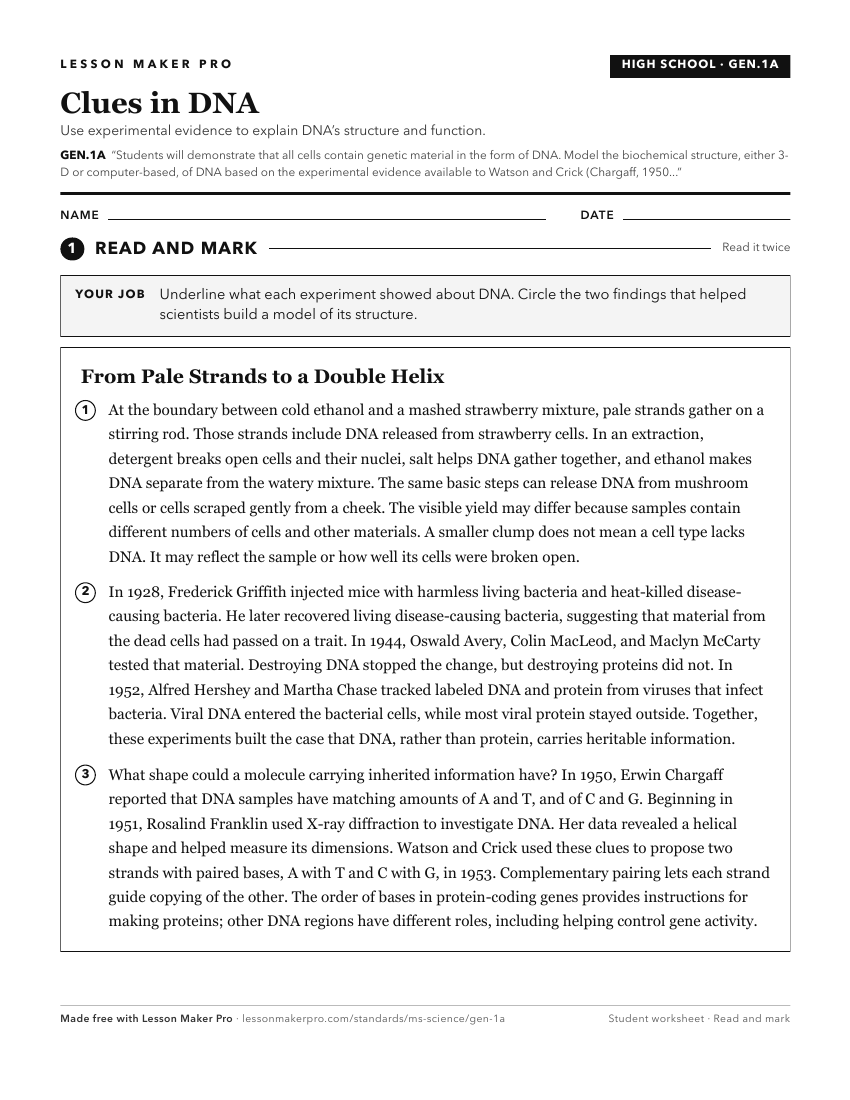
A ready-to-print activity worksheet aligned to GEN.1A, with an answer key for the teacher on its own page. No account needed.
PDF, US Letter, prints cleanly in black and white.
Download the worksheetKeep exploring
Related Standards
- GEN.1B
Students will analyze how the DNA sequence is copied and transmitted to new cells.
- L.8.2C
Students will demonstrate an understanding that chromosomes contain many distinct genes and that each gene holds the instructions for the production of a specif...
- GEN.2B
Students will determine the causes and effects of mutations in DNA.
- FB.4
Students will demonstrate an understanding of how genetic information is transferred from parent to offspring.
Turn this cluster into a lesson
Grade, subject, topic, and the complete cluster are prefilled. Create one free, no account needed.
Also for this cluster:Make a WorksheetMake a QuizMake a Sub Lesson