Mississippi Science GEN.1A.4
The Standard
- GEN.1A
- Students will demonstrate that all cells contain genetic material in the form of DNA.
Conduct a standard DNA extraction protocol using salt, detergent, and ethanol from various cell types (e.g., plant, animal, fungus). Compare and contrast the consistency and quantity of DNA extracted from various cell types.
2026 Mississippi College- and Career-Readiness Standards for Science · Structure and Function of DNA
Teacher's field guide
What This Standard Means
What Students Need to Do
- Students use detergent to break open plant, animal, and fungal cells. They add salt and cold ethanol to collect DNA, then compare the visible amount and texture from each sample.
What Mastery Looks Like
- Students keep starting amounts and liquid volumes alike. They record how much material appears and whether it is stringy or cloudy. They do not treat every white clump as pure DNA.
Common Misconceptions
- Students may think a bigger white clump always means more DNA, even though it may contain cell debris. Some think detergent breaks the DNA rather than the cells. Others think ethanol dissolves DNA instead of making it collect.
How to Assess It
- Exit ticket: Strawberry makes a thick white clump; yeast makes faint wisps. Compare their visible yields and textures, then state why cold ethanol is added.
Lesson moves
Ways to Teach It
Using separate tubes and approved personal cheek swabs, extract DNA from strawberry, baker's yeast, and cheek cells with salt, detergent, and cold ethanol.
Ask students to compare strawberry and yeast tubes in writing, naming one texture difference and one reason the yields may differ.
Give pairs three mock lab cards with starting masses, ethanol volumes, and photos; have them flag unfair comparisons and rank visible yields.
Show a seed packet labeled disease resistant; ask students how extracting plant DNA could help a breeder check that label.
Free download
Printable GEN.1A.4 Worksheet
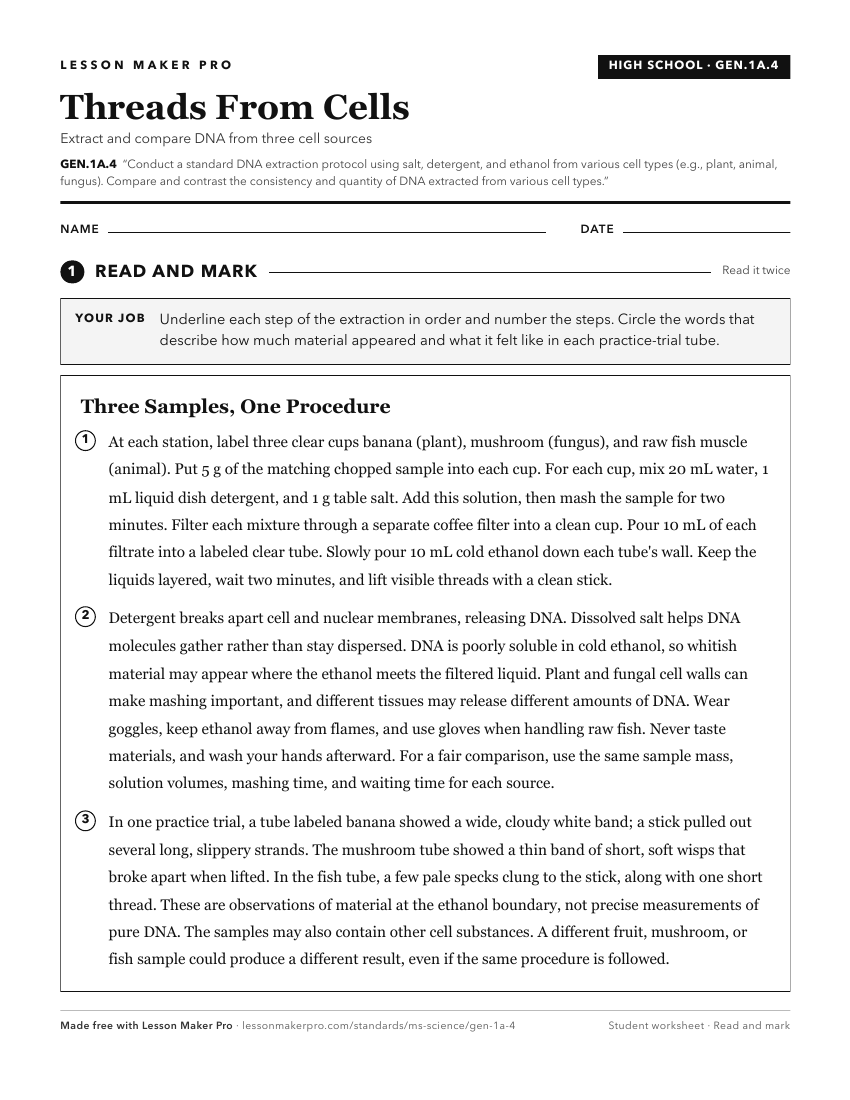
A ready-to-print activity worksheet aligned to GEN.1A.4, with an answer key for the teacher on its own page. No account needed.
PDF, US Letter, prints cleanly in black and white.
Download the worksheetKeep exploring
Related Standards
- BIO.3C.4
Research and identify how DNA technology benefits society. Engage in scientific argument from evidence over the ethical issues surrounding the use of DNA techno...
- GEN.3.2
Experimentally demonstrate genetic transformation, protein purification, and/or gel electrophoresis.
- BIO.1C.2
Investigate to compare and contrast prokaryotic cells and eukaryotic cells, and plant, animal, and fungal cells.
- GEN.1A.5
Enrichment: Use an engineering design process to refine the methodology to optimize the DNA-extraction process for various cell types. *
Turn this exact standard into a lesson
Grade, subject, topic, and the complete standard are prefilled. Create one free, no account needed.
Also for this standard:Make a WorksheetMake a QuizMake a Sub Lesson