Mississippi Science BIO.1C.2
The Standard
- BIO.1C
- Students will relate the diversity of organelles to a variety of specialized cellular functions.
Investigate to compare and contrast prokaryotic cells and eukaryotic cells, and plant, animal, and fungal cells.
2026 Mississippi College- and Career-Readiness Standards for Science · Cells as a System
Teacher's field guide
What This Standard Means
What Students Need to Do
- Students examine slides of bacteria, plant, animal, and fungal cells. They record what they can see, then use cell diagrams to compare nuclei, cell walls, and chloroplasts. They sort bacteria as prokaryotes and the other cells as eukaryotes.
What Mastery Looks Like
- Given an unfamiliar cell diagram, students use the nucleus to tell a eukaryote from a bacterium. They use cell walls and chloroplasts to distinguish plant, animal, and fungal cells, and explain why a fungus is not a plant.
Common Misconceptions
- Students may call yeast a bacterium because both can be single-celled. They may think every cell with a wall is a plant cell, or that every plant cell has visible chloroplasts.
How to Assess It
- Show four unlabeled diagrams: a bacterium, an Elodea cell, a cheek cell, and a yeast cell. Mark the structures present, then ask students to name each type and give two features that support their choices.
Lesson moves
Ways to Teach It
Examine prepared slides of bacteria, Elodea, cheek cells, and yeast; sketch each and label structures students can see.
Ask: Why is yeast neither a bacterium nor a plant? Have students support both answers with a labeled cell diagram.
Give pairs four cell cards with labeled structures; have them sort the cards and defend one tricky choice.
Compare labeled diagrams of yogurt bacteria and bread yeast, then explain why yeast has a nucleus and the bacteria do not.
Free download
Printable BIO.1C.2 Worksheet
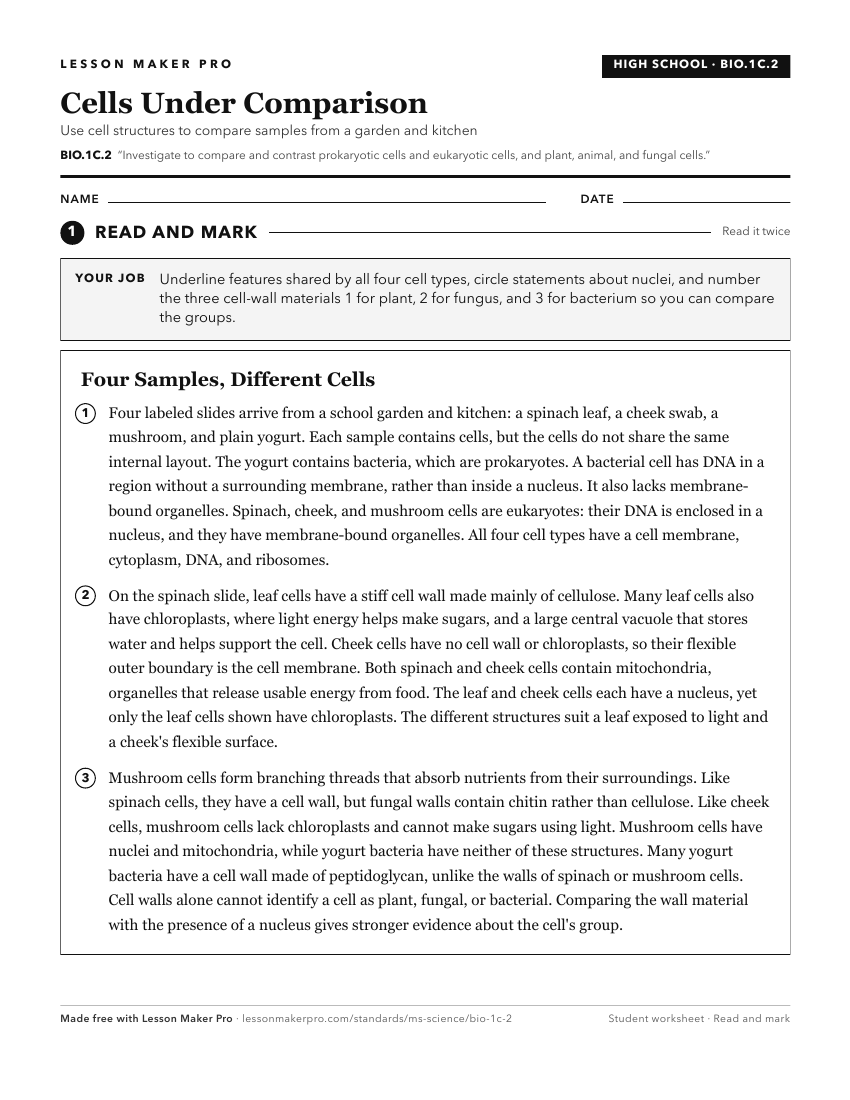
A ready-to-print activity worksheet aligned to BIO.1C.2, with an answer key for the teacher on its own page. No account needed.
PDF, US Letter, prints cleanly in black and white.
Download the worksheetKeep exploring
Related Standards
- GEN.1A.6
Investigate the structural differences between the genomes (i.e., circular/linear chromosomes and plasmids) found in prokaryotes and eukaryotes.
- FB.3.1
Compare and contrast prokaryotic/eukaryotic and plant/animal/bacteria cells.
- L.6.1.4
Compare and contrast different cells in order to classify them as a protist, fungus, plant, or animal.
- BOT.1.2
Using microscopes, observe, identify, record, and analyze (e.g., see and draw) cells and cell structures unique to plants. Use data measurements obtained from m...
Turn this exact standard into a lesson
Grade, subject, topic, and the complete standard are prefilled. Create one free, no account needed.
Also for this standard:Make a WorksheetMake a QuizMake a Sub Lesson