Mississippi Science FB.3.1
The Standard
- FB.3
- Students will demonstrate an understanding of how the structure of living organisms supports the essential functions of life.
Compare and contrast prokaryotic/eukaryotic and plant/animal/bacteria cells.
2026 Mississippi College- and Career-Readiness Standards for Science · Organization and Energy in Living Systems
Teacher's field guide
What This Standard Means
What Students Need to Do
- Students compare diagrams of plant, animal, and bacterial cells. They identify parts shared by all three and explain which cells have a nucleus, cell wall, or chloroplasts.
What Mastery Looks Like
- A student can label DNA, ribosomes, cytoplasm, and a membrane in all three cell types. They can explain that plant and animal cells have nuclei, while bacterial cells do not. They know a cell wall alone does not prove a cell is from a plant.
Common Misconceptions
- Students may think bacteria are tiny animal cells. They may think only plant cells have walls, though bacteria have them too. Some assume every plant cell has chloroplasts, including onion bulb cells.
How to Assess It
- Ask: “A cell has DNA, a membrane, a cell wall, and no nucleus. Is it plant, animal, or bacterial? Name one feature it shares with plant cells and one difference.”
Lesson moves
Ways to Teach It
Give pairs colored clay to build plant, animal, and bacterial cells, then label membranes, walls, nuclei, and chloroplasts where present.
Ask students to write a reply to: “A cell wall proves this is a plant cell.” What evidence would correct that claim?
Give teams cell feature cards to place on every matching plant, animal, or bacteria diagram, then have them explain one choice.
Show onion skin, cheek cell, and yogurt bacteria micrographs with scale bars; ask students to identify each using visible clues.
Free download
Printable FB.3.1 Worksheet
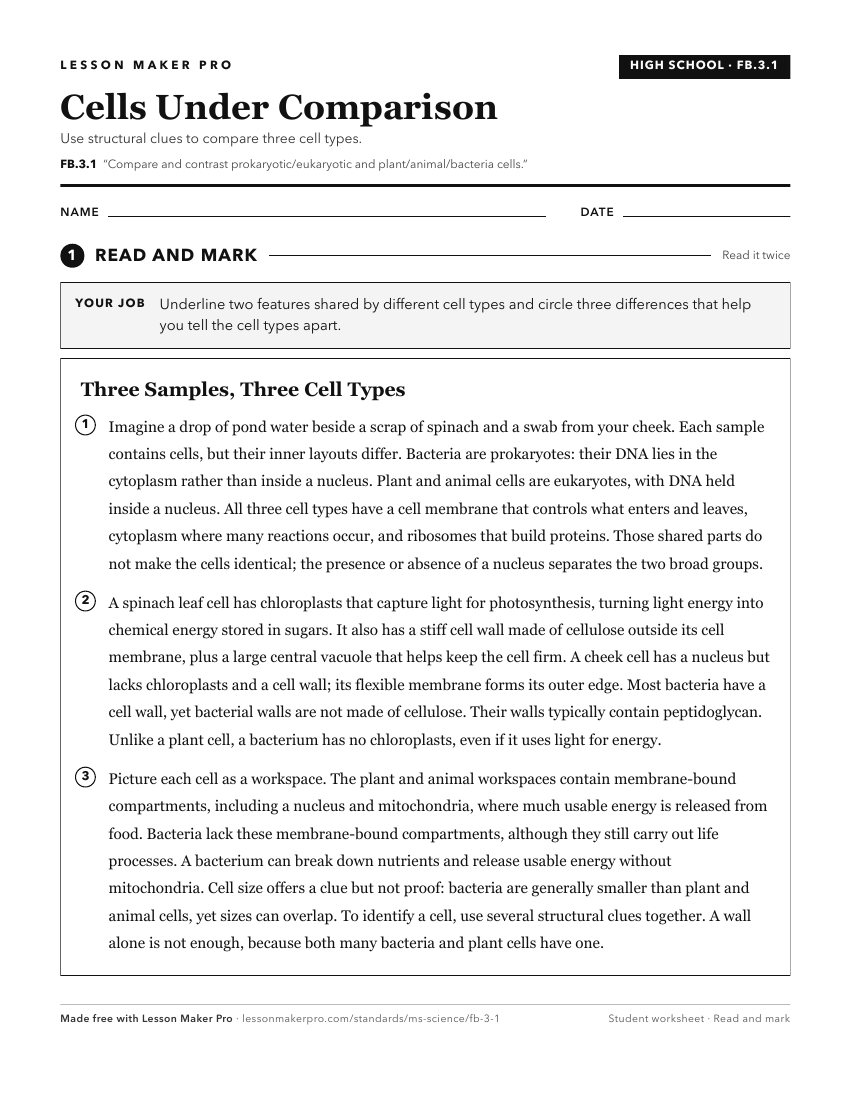
A ready-to-print activity worksheet aligned to FB.3.1, with an answer key for the teacher on its own page. No account needed.
PDF, US Letter, prints cleanly in black and white.
Download the worksheetKeep exploring
Related Standards
- GEN.1A.6
Investigate the structural differences between the genomes (i.e., circular/linear chromosomes and plasmids) found in prokaryotes and eukaryotes.
- L.6.1.3
Develop and use models to explain how specific cellular components (cell wall, cell membrane, nucleus, chloroplast, vacuole, and mitochondria) function together...
- BIO.1C.2
Investigate to compare and contrast prokaryotic cells and eukaryotic cells, and plant, animal, and fungal cells.
- L.6.1.4
Compare and contrast different cells in order to classify them as a protist, fungus, plant, or animal.
Turn this exact standard into a lesson
Grade, subject, topic, and the complete standard are prefilled. Create one free, no account needed.
Also for this standard:Make a WorksheetMake a QuizMake a Sub Lesson