Mississippi Science GEN.1A.6
The Standard
- GEN.1A
- Students will demonstrate that all cells contain genetic material in the form of DNA.
Investigate the structural differences between the genomes (i.e., circular/linear chromosomes and plasmids) found in prokaryotes and eukaryotes.
2026 Mississippi College- and Career-Readiness Standards for Science · Structure and Function of DNA
Teacher's field guide
What This Standard Means
What Students Need to Do
- Students compare how DNA is arranged in prokaryotic and eukaryotic cells. They tell a main chromosome from a plasmid and show the difference in a sketch.
What Mastery Looks Like
- A student can draw a typical bacterium with one circular chromosome and a separate, smaller plasmid. They can draw a eukaryotic nucleus with several linear chromosomes and explain what the shapes show.
Common Misconceptions
- Students may call every circular DNA molecule a plasmid or think a plasmid replaces the main chromosome. They may think every prokaryote has plasmids or that all cells keep chromosomes in a nucleus.
How to Assess It
- Ask students to draw the DNA in a typical bacterium and an animal cell. Have them label the chromosomes and add a possible plasmid to the bacterium.
Lesson moves
Ways to Teach It
Give pairs one long yarn loop, two short loops, and three yarn strips; have them model bacterial and animal DNA and label each part.
Ask, "If a bacterium has two DNA loops, why might only one be called its chromosome?" Have students write two sentences.
Hand out cards showing a bacterial chromosome, a bacterial plasmid, and a human chromosome; students sort them by shape, size, and cell type.
Show a sketch of an antibiotic resistance plasmid beside a bacterial chromosome; students circle the plasmid and explain the difference.
Free download
Printable GEN.1A.6 Worksheet
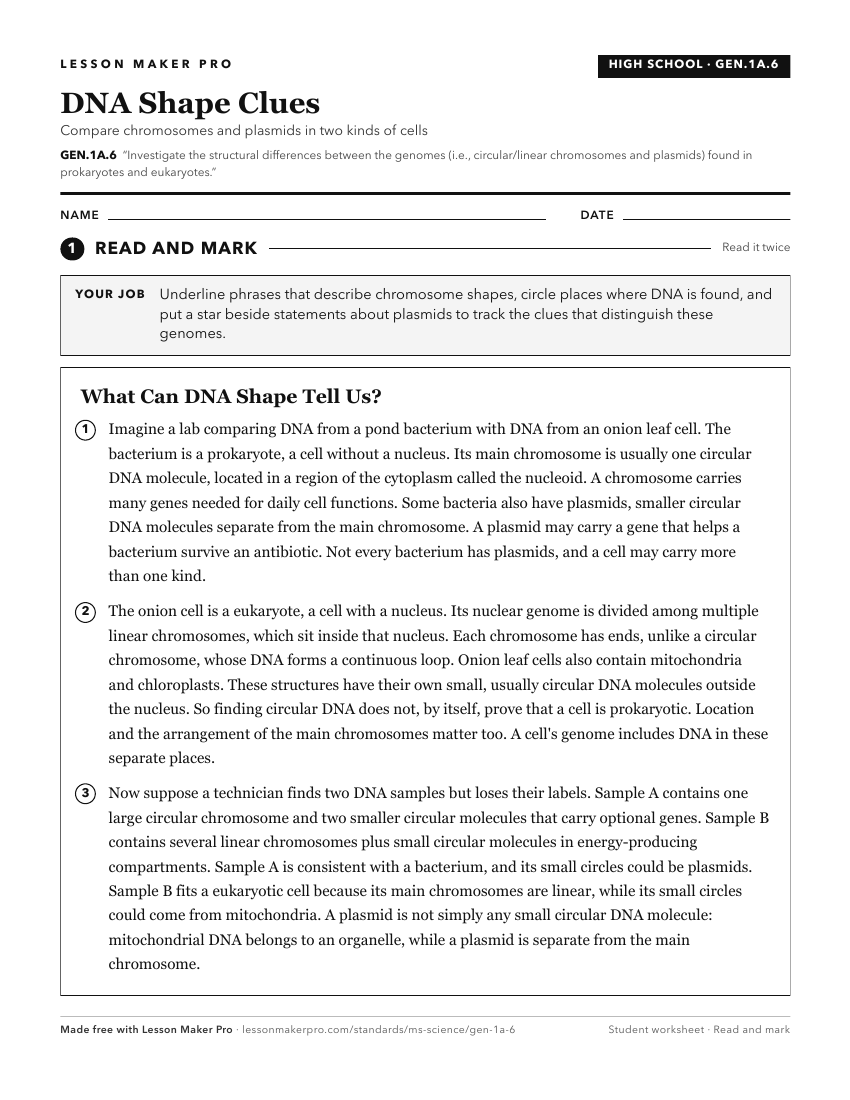
A ready-to-print activity worksheet aligned to GEN.1A.6, with an answer key for the teacher on its own page. No account needed.
PDF, US Letter, prints cleanly in black and white.
Download the worksheetKeep exploring
Related Standards
- L.6.4.4
Conduct investigations using a microscope or multimedia source to compare the characteristics of protists (euglena, paramecium, amoeba) and the methods they use...
- BIO.1B.1
Develop and use models to compare and contrast the structure and function of carbohydrates, lipids, proteins, and nucleic acids (DNA and RNA) in organisms.
- FB.3.1
Compare and contrast prokaryotic/eukaryotic and plant/animal/bacteria cells.
- BIO.1C.2
Investigate to compare and contrast prokaryotic cells and eukaryotic cells, and plant, animal, and fungal cells.
Turn this exact standard into a lesson
Grade, subject, topic, and the complete standard are prefilled. Create one free, no account needed.
Also for this standard:Make a WorksheetMake a QuizMake a Sub Lesson