Mississippi Science L.6.4.4
The Standard
- L.6.4
- Students will demonstrate an understanding of classification tools and models such as dichotomous keys to classify representative organisms based on the characteristics of the kingdoms: Archaebacteria, Eubacteria, Protists, Fungi, Plants, and Animals.
Conduct investigations using a microscope or multimedia source to compare the characteristics of protists (euglena, paramecium, amoeba) and the methods they use to obtain energy and move through their environment (e.g., pond water).
2026 Mississippi College- and Career-Readiness Standards for Science · Adaptations and Diversity
Teacher's field guide
What This Standard Means
What Students Need to Do
- Observe euglena, paramecia, and amoebas through a microscope or in video clips. Compare how each moves and gets energy, using what they see as evidence.
What Mastery Looks Like
- Students identify euglena's flagellum and chloroplasts, paramecium's cilia and oral groove, and amoeba's pseudopods. They explain that euglena can use light or take in food, while paramecia and amoebas eat other organisms.
Common Misconceptions
- Students may think all three move the same way or get energy from sunlight. Some think euglena can only use sunlight. Others mistake an amoeba's changing shape for damage rather than movement.
How to Assess It
- Show labeled images of all three organisms. Ask students to name how each moves and gets energy, using one visible clue for each.
Lesson moves
Ways to Teach It
View a pond-water wet mount, sketch moving cells, then compare the sketches with labeled clips of euglena, paramecium, and amoeba.
Ask, 'Why can euglena use sunlight while an amoeba eats other organisms?' Have students point to chloroplasts and pseudopods in images.
Give pairs cards showing flagella, cilia, pseudopods, chloroplasts, and feeding clues; have them sort the cards by organism.
Show a photo of a sunlit pond and ask where euglena could use sunlight and how paramecia and amoebas find food.
Free download
Printable L.6.4.4 Worksheet
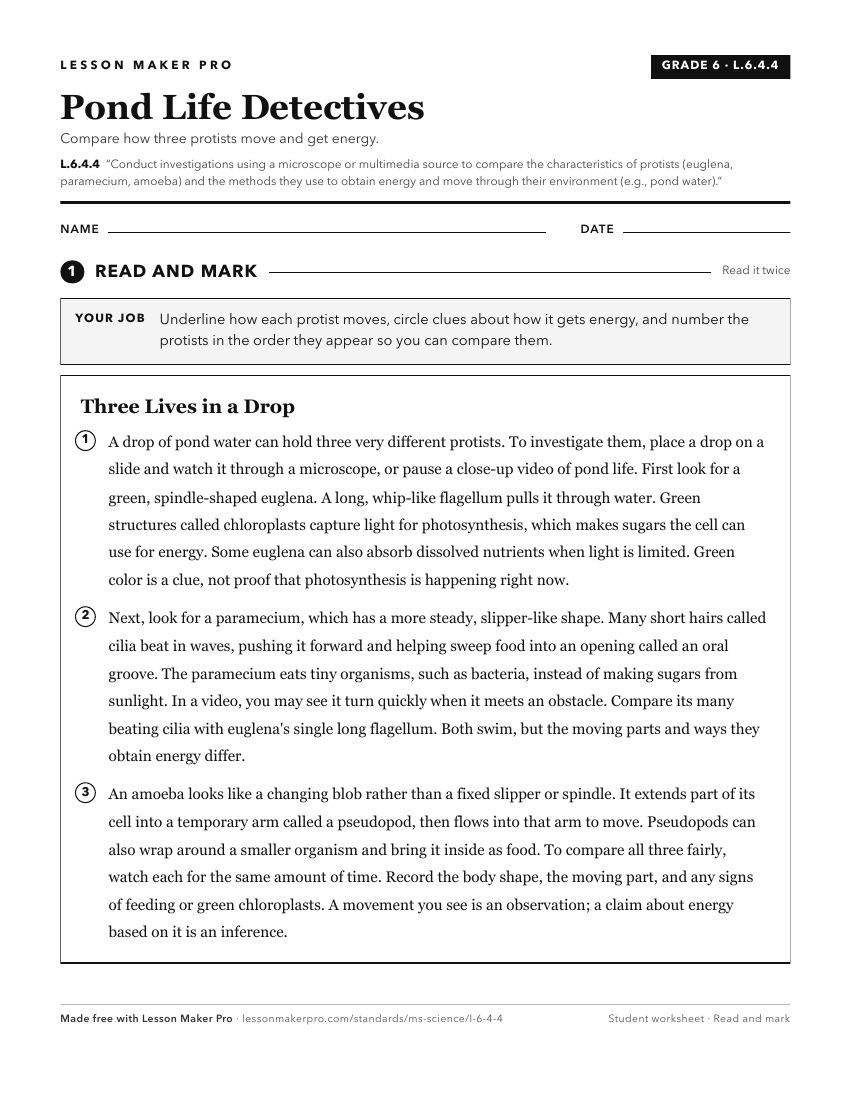
A ready-to-print activity worksheet aligned to L.6.4.4, with an answer key for the teacher on its own page. No account needed.
PDF, US Letter, prints cleanly in black and white.
Download the worksheetKeep exploring
Related Standards
- L.K.1A.1
With teacher guidance, conduct an investigation of living organisms and non-living objects in various real-world environments to define characteristics of livin...
- BIO.1C.2
Investigate to compare and contrast prokaryotic cells and eukaryotic cells, and plant, animal, and fungal cells.
- L.6.1.4
Compare and contrast different cells in order to classify them as a protist, fungus, plant, or animal.
- BOT.1.2
Using microscopes, observe, identify, record, and analyze (e.g., see and draw) cells and cell structures unique to plants. Use data measurements obtained from m...
Turn this exact standard into a lesson
Grade, subject, topic, and the complete standard are prefilled. Create one free, no account needed.
Also for this standard:Make a WorksheetMake a QuizMake a Sub Lesson