Mississippi Science BOT.1.2
The Standard
- BOT.1
- Students will investigate the morphology, anatomy, and physiology of plants.
Using microscopes, observe, identify, record, and analyze (e.g., see and draw) cells and cell structures unique to plants. Use data measurements obtained from microscopy to compare the plant cells and organelle sizes between various examples (e.g., elodea, onion, or algae).
2026 Mississippi College- and Career-Readiness Standards for Science · Plant Morphology, Cell Structure, and Function
Teacher's field guide
What This Standard Means
What Students Need to Do
- Students use a microscope to observe, draw, and label plant cells. They measure cell widths and visible chloroplasts, then compare sizes across samples.
What Mastery Looks Like
- A student draws cell walls in onion and Elodea cells without adding chloroplasts to the onion bulb cells. They use a scale bar to estimate cell widths in micrometers and support a size comparison with their measurements.
Common Misconceptions
- Students may draw chloroplasts in onion bulb cells because they expect every plant cell to have them. They may also mistake a larger microscope image for a larger cell without checking the scale.
How to Assess It
- Give students onion and Elodea micrographs with scale bars. Ask them to mark a cell wall and any visible chloroplasts, estimate one cell width in each image, and compare the widths.
Lesson moves
Ways to Teach It
Prepare onion skin and Elodea leaf wet mounts, sketch three cells from each, and estimate cell widths using the microscope's field diameter.
Show onion and Elodea cell sketches and ask, 'Why are chloroplasts visible in the leaf cells but not the bulb cells?'
Give pairs labeled micrographs with scale bars; have them calculate three cell widths and check each other's measurements.
Place an aquarium Elodea sprig beside a grocery onion; ask students to explain why leaf cells have visible chloroplasts but bulb cells do not.
Free download
Printable BOT.1.2 Worksheet
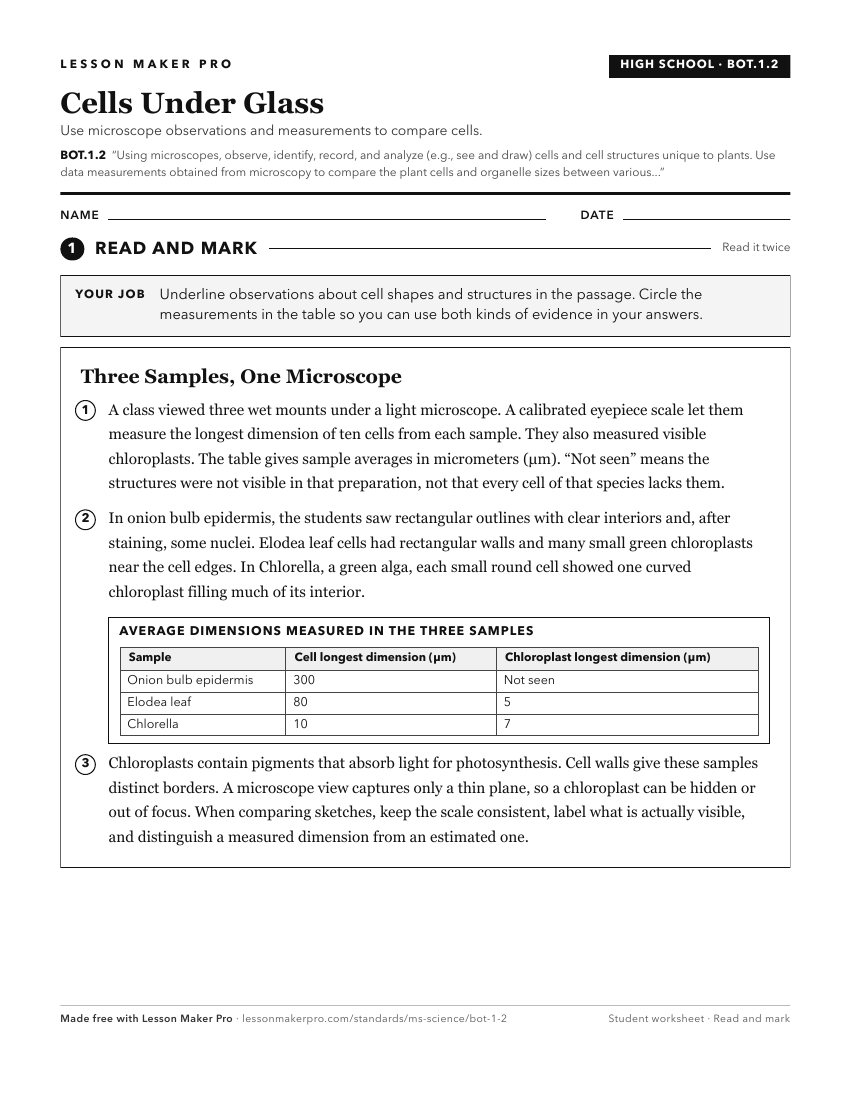
A ready-to-print activity worksheet aligned to BOT.1.2, with an answer key for the teacher on its own page. No account needed.
PDF, US Letter, prints cleanly in black and white.
Download the worksheetKeep exploring
Related Standards
- L.6.4.4
Conduct investigations using a microscope or multimedia source to compare the characteristics of protists (euglena, paramecium, amoeba) and the methods they use...
- L.K.2.3
With teacher guidance, conduct a structured investigation to observe and measure (comparison of lengths) the changes in various individuals of a single plant sp...
- BOT.1.10
Identify and compare various live plant examples to explore plant morphological diversity, including leaf number, structure, and arrangement; root modifications...
- BIO.1C.2
Investigate to compare and contrast prokaryotic cells and eukaryotic cells, and plant, animal, and fungal cells.
Turn this exact standard into a lesson
Grade, subject, topic, and the complete standard are prefilled. Create one free, no account needed.
Also for this standard:Make a WorksheetMake a QuizMake a Sub Lesson