Mississippi Science L.6.1.4
The Standard
- L.6.1
- Students will demonstrate an understanding that living things range from simple to complex organisms, are organized hierarchically, and function as whole living systems.
Compare and contrast different cells in order to classify them as a protist, fungus, plant, or animal.
2026 Mississippi College- and Career-Readiness Standards for Science · Hierarchical Organization
Teacher's field guide
What This Standard Means
What Students Need to Do
- Students inspect pictures of leaf, cheek, yeast, and Euglena cells. They compare cell walls, chloroplasts, budding, and flagella to sort the cells into groups and explain their choices.
What Mastery Looks Like
- A student can identify all four cells from their features and give a reason for each choice. They know a cell wall alone does not make yeast a plant.
Common Misconceptions
- Students may call Euglena a plant because it has chloroplasts. They may call yeast a plant because it has a cell wall, or assume every single-celled organism is a bacterium.
How to Assess It
- On an exit ticket, show drawings of a leaf cell, cheek cell, budding yeast cell, and Euglena with a flagellum. Ask students to name each group and circle one supporting feature.
Lesson moves
Ways to Teach It
Have pairs cut out twelve printed cell photos, sort them into four groups, and circle the features they used.
Ask students to write why Euglena is not a plant, even though it has chloroplasts.
Play four corners with cell drawings; students move to a group label and name one feature that supports their choice.
Pair a yeast packet and pond-water photo with micrographs of budding yeast and Euglena; students identify each group using visible features.
Free download
Printable L.6.1.4 Worksheet
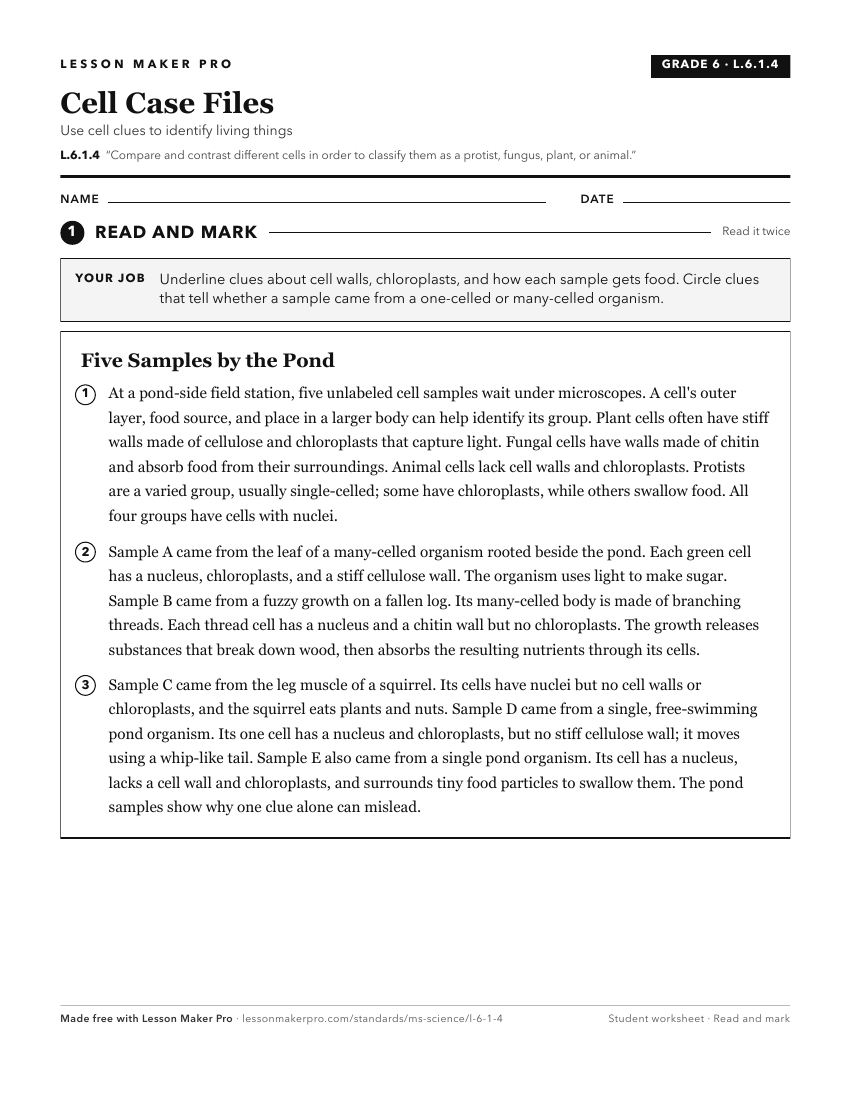
A ready-to-print activity worksheet aligned to L.6.1.4, with an answer key for the teacher on its own page. No account needed.
PDF, US Letter, prints cleanly in black and white.
Download the worksheetKeep exploring
Related Standards
- FB.3.1
Compare and contrast prokaryotic/eukaryotic and plant/animal/bacteria cells.
- L.6.4
Students will demonstrate an understanding of classification tools and models such as dichotomous keys to classify representative organisms based on the charact...
- ZOO.1.1
Develop and use dichotomous keys to distinguish animals from protists, plants, and fungi.
- BIO.1C.2
Investigate to compare and contrast prokaryotic cells and eukaryotic cells, and plant, animal, and fungal cells.
Turn this exact standard into a lesson
Grade, subject, topic, and the complete standard are prefilled. Create one free, no account needed.
Also for this standard:Make a WorksheetMake a QuizMake a Sub Lesson