Mississippi Science FB.4
Standard Cluster
Students will demonstrate an understanding of how genetic information is transferred from parent to offspring. Compare and contrast the basic structure and function of nucleic acids (e.g., DNA, RNA). Obtain and communicate information illustrating the relationships among DNA, genes, chromosomes, and proteins to the basis of life. Use models (e.g., Punnett squares) and mathematical reasoning to describe and predict patterns of inheritance of single genetic traits from parents to offspring (e.g., dominant, and recessive traits, incomplete dominance, codominance, multiple alleles, sex- linkage). Obtain and communicate information to describe how mutations may affect genetic expression and provide examples. Research and report on genetic technologies that may improve the quality of life (e.g., genetic engineering, cloning, gene splicing, DNA testing). Enrichment: Debate the pros and cons of using biotechnology to manipulate genetic information for human purposes (society).
2026 Mississippi College- and Career-Readiness Standards for Science · Molecular Basis of Heredity
Cluster contents
Standards in This Cluster
FB.4 is a cluster heading. These are the individual standards under it.
- FB.4.1
Compare and contrast the basic structure and function of nucleic acids (e.g., DNA, RNA).
- FB.4.2
Obtain and communicate information illustrating the relationships among DNA, genes, chromosomes, and proteins to the basis of life.
- FB.4.3
Use models (e.g., Punnett squares) and mathematical reasoning to describe and predict patterns of inheritance of single genetic traits from parents to offspring...
- FB.4.4
Obtain and communicate information to describe how mutations may affect genetic expression and provide examples.
- FB.4.5
Research and report on genetic technologies that may improve the quality of life (e.g., genetic engineering, cloning, gene splicing, DNA testing).
- FB.4.6
Enrichment: Debate the pros and cons of using biotechnology to manipulate genetic information for human purposes (society).
Teacher's field guide
What This Cluster Means
What Students Need to Do
- Students compare DNA and RNA and trace how genes on chromosomes provide instructions for proteins. They use Punnett squares to predict how traits pass from parents to offspring. They explain possible effects of mutations and report on a genetic technology.
What Mastery Looks Like
- A student can tell DNA from RNA and explain how a gene relates to a protein. They can calculate offspring probabilities for dominant, recessive, incomplete dominance, codominance, multiple-allele, and sex-linked traits. They can explain why a mutation may change a protein or have no effect, then weigh evidence about a genetic technology.
Common Misconceptions
- Students may treat genes, chromosomes, and proteins as the same thing. They may think dominant means common, or that a 25% chance guarantees exactly one affected child in every four. They may assume every mutation is harmful and every positive genetic test guarantees disease.
How to Assess It
- Exit ticket: Two parents are Aa for a recessive condition. Draw a Punnett square, give the chance of an affected child, and explain how a DNA change could alter the related protein.
Lesson moves
Ways to Teach It
Build a DNA gene with colored paper bases, transcribe an RNA strand, and use a codon chart to identify the resulting amino acids.
Ask: If one DNA base changes, must the protein change? Have students use a codon chart to defend their answers.
Give pairs parent genotype cards for ABO blood type; have them draw Punnett squares and compare offspring probabilities.
Hand out two short articles on sickle cell gene therapy; have students report one benefit, one risk, and one limitation.
Free download
Printable FB.4 Worksheet
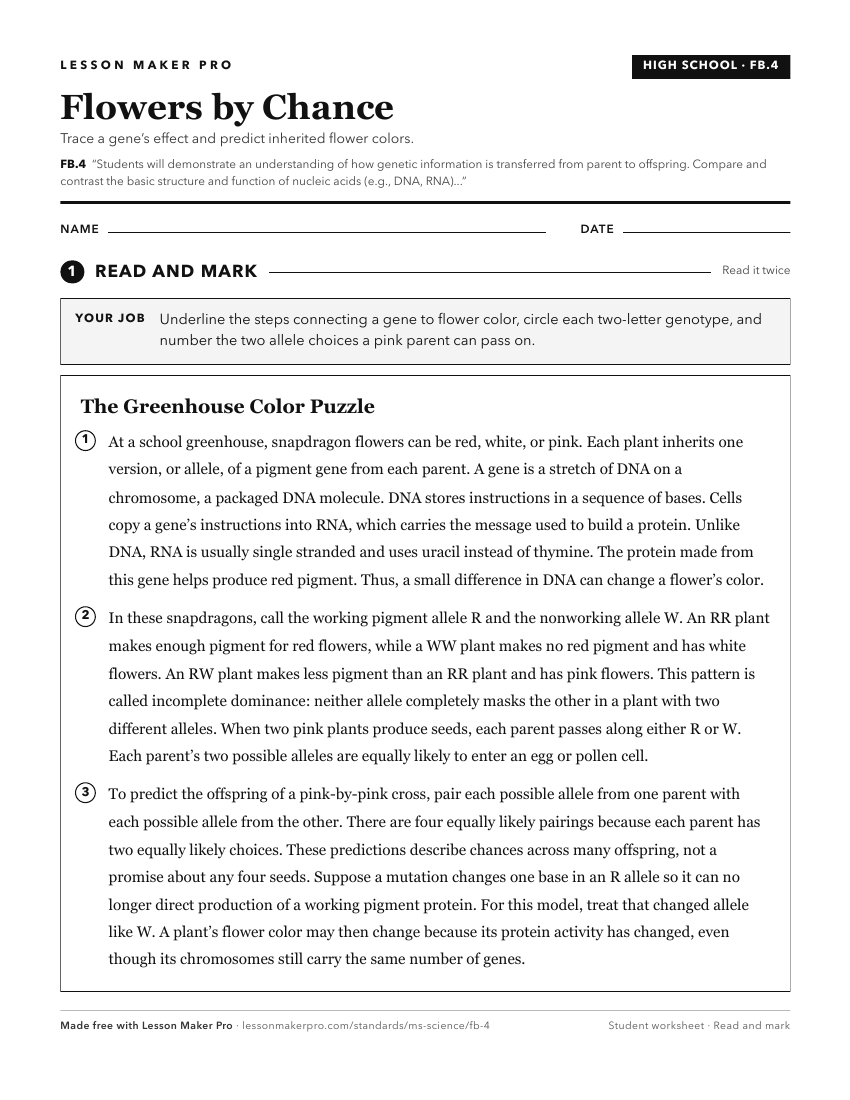
A ready-to-print activity worksheet aligned to FB.4, with an answer key for the teacher on its own page. No account needed.
PDF, US Letter, prints cleanly in black and white.
Download the worksheetKeep exploring
Related Standards
- L.8.2A
Students will demonstrate an understanding of how sexual reproduction results in offspring with genetic variation while asexual reproduction results in offsprin...
- GEN.1B
Students will analyze how the DNA sequence is copied and transmitted to new cells.
- L.8.2B
Students will demonstrate an understanding of the differences in inherited and acquired characteristics and how environmental factors (natural selection) and th...
- L.3.2
Students will demonstrate an understanding that through reproduction, the survival and physical features of plants and animals are inherited traits from parent ...
Turn this cluster into a lesson
Grade, subject, topic, and the complete cluster are prefilled. Create one free, no account needed.
Also for this cluster:Make a WorksheetMake a QuizMake a Sub Lesson