Mississippi Science L.8.2B
Standard Cluster
Students will demonstrate an understanding of the differences in inherited and acquired characteristics and how environmental factors (natural selection) and the use of technologies (selective breeding, genetic engineering) influence the transfer of genetic information. Construct an argument based on evidence for how environmental and genetic factors influence the growth of organisms. Use various scientific resources to research and support the historical findings of Gregor Mendel to explain the basic principles of heredity. Use mathematical and computational thinking to analyze data and make predictions about the outcome of specific genetic crosses (monohybrid Punnett Squares) involving simple dominant/recessive traits. Debate the ethics of artificial selection (selective breeding, genetic engineering) and the societal impacts of humans changing the inheritance of desired traits in organisms.
2026 Mississippi College- and Career-Readiness Standards for Science · Reproduction and Heredity
Cluster contents
Standards in This Cluster
L.8.2B is a cluster heading. These are the individual standards under it.
- L.8.2B.1
Construct an argument based on evidence for how environmental and genetic factors influence the growth of organisms.
- L.8.2B.2
Use various scientific resources to research and support the historical findings of Gregor Mendel to explain the basic principles of heredity.
- L.8.2B.3
Use mathematical and computational thinking to analyze data and make predictions about the outcome of specific genetic crosses (monohybrid Punnett Squares) invo...
- L.8.2B.4
Debate the ethics of artificial selection (selective breeding, genetic engineering) and the societal impacts of humans changing the inheritance of desired trait...
Teacher's field guide
What This Cluster Means
What Students Need to Do
- Students tell inherited traits from changes caused by experience or surroundings. They use Mendel's pea plant data and Punnett squares to predict offspring traits. They explain how genes and surroundings affect growth, and how selection and gene editing affect later generations.
What Mastery Looks Like
- Given two Pp pea plants, a student predicts a 3-in-4 chance of purple flowers. They use growth data to explain why plants with the same genes can grow differently in different light. They tell a suntan from an inherited trait and explain that breeding chooses parents while gene editing changes DNA.
Common Misconceptions
- Students may think a scar or suntan gets passed to offspring. They may read a 3:1 Punnett square as a promise about every group of four offspring. They may think natural selection changes an individual to meet its needs, or that selective breeding and gene editing work the same way.
How to Assess It
- Exit ticket: Cross two pea plants with genotypes Pp and Pp, where P means purple flowers and p means white. Show the offspring genotypes, give the chance of purple flowers, and explain whether poor soil making one parent shorter changes the genes it passes on.
Lesson moves
Ways to Teach It
Put two pothos cuttings from one plant in water, place one by a window and one in shade, and chart their growth.
Give pairs two source cards on gene-edited corn, then ask them to debate one benefit and one risk for farmers and consumers.
Hand out Mendel's pea counts and Pp parent cards; have pairs draw Punnett squares and compare predicted ratios with the recorded counts.
Show light and dark peppered moths on two tree trunks, then ask which color is more likely to survive in each habitat.
Free download
Printable L.8.2B Worksheet
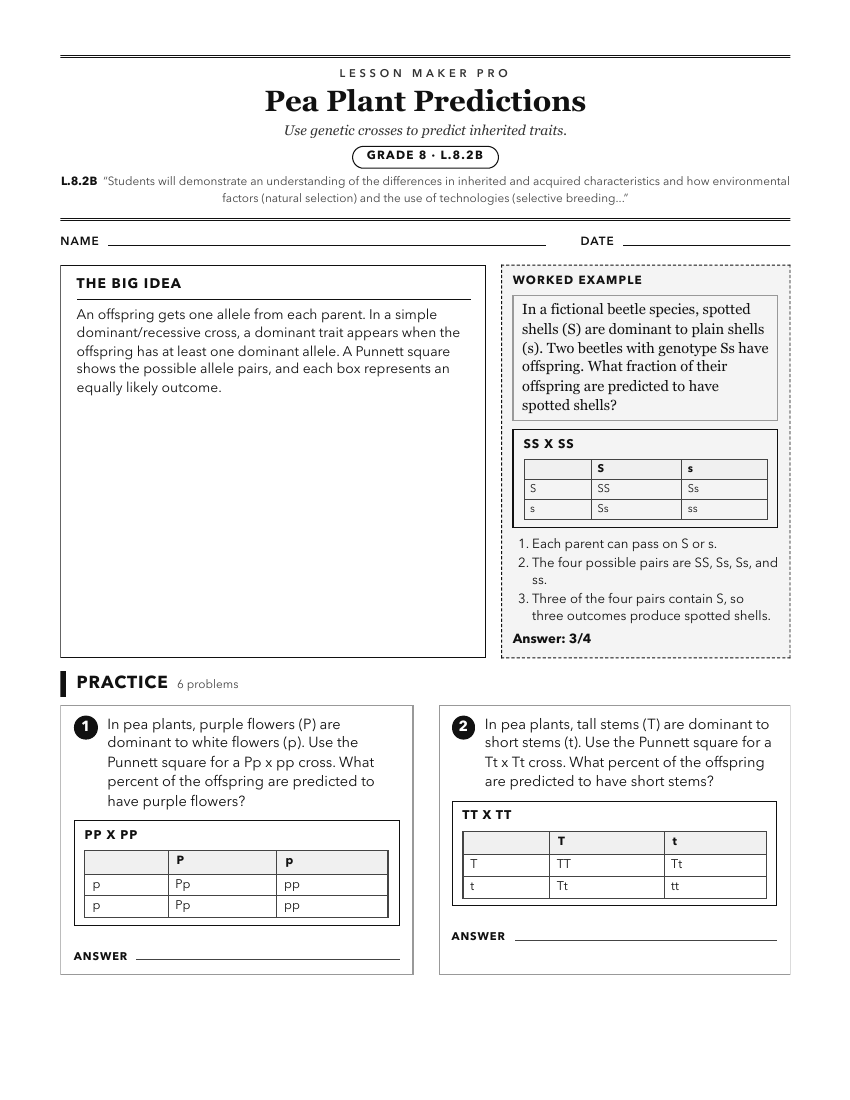
A ready-to-print activity worksheet aligned to L.8.2B, with an answer key for the teacher on its own page. No account needed.
PDF, US Letter, prints cleanly in black and white.
Download the worksheetKeep exploring
Related Standards
- L.8.2A
Students will demonstrate an understanding of how sexual reproduction results in offspring with genetic variation while asexual reproduction results in offsprin...
- L.8.4A
Students will demonstrate an understanding of the process of natural selection, in which variations in a population increase some individuals' likelihood of sur...
- L.3.2
Students will demonstrate an understanding that through reproduction, the survival and physical features of plants and animals are inherited traits from parent ...
- FB.4
Students will demonstrate an understanding of how genetic information is transferred from parent to offspring.
Turn this cluster into a lesson
Grade, subject, topic, and the complete cluster are prefilled. Create one free, no account needed.
Also for this cluster:Make a WorksheetMake a QuizMake a Sub Lesson