Mississippi Science L.8.2B.4
The Standard
- L.8.2B
- Students will demonstrate an understanding of the differences in inherited and acquired characteristics and how environmental factors (natural selection) and the use of technologies (selective breeding, genetic engineering) influence the transfer of genetic information.
Debate the ethics of artificial selection (selective breeding, genetic engineering) and the societal impacts of humans changing the inheritance of desired traits in organisms.
2026 Mississippi College- and Career-Readiness Standards for Science · Reproduction and Heredity
Teacher's field guide
What This Standard Means
What Students Need to Do
- Students compare breeding organisms for a trait with directly editing their DNA. They use evidence to debate who benefits, who might be harmed, and how the change could affect future generations.
What Mastery Looks Like
- Given a case such as pest-resistant corn, a student explains how the trait could reach offspring. They defend a position with a specific benefit and risk, consider who bears the costs, and answer a counterargument.
Common Misconceptions
- Students may think selective breeding and gene editing work the same way, or that a diet change passes to an animal's offspring. They may call pest-resistant crops safe or dangerous without considering pesticide use, seed costs, or effects on other plants.
How to Assess It
- Exit ticket: A farmer can breed pest-resistant corn or plant gene-edited corn. Choose one option, explain how the trait could reach offspring, and name one benefit, one possible harm, and who faces it.
Lesson moves
Ways to Teach It
Give pairs 10 red and 10 blue paper squares; discard half the blue squares, duplicate survivors, and chart three generations.
Debate whether breeding short-nosed dogs is fair to the dogs; use breathing problems and owner preferences as evidence.
Run a card sort with selectively bred dogs, gene-edited corn, and pesticide-sprayed corn; teams identify inherited changes and explain each choice.
Show a seed catalog page for disease-resistant tomatoes; have students compare fewer pesticide sprays with seed costs for a local grower.
Free download
Printable L.8.2B.4 Worksheet
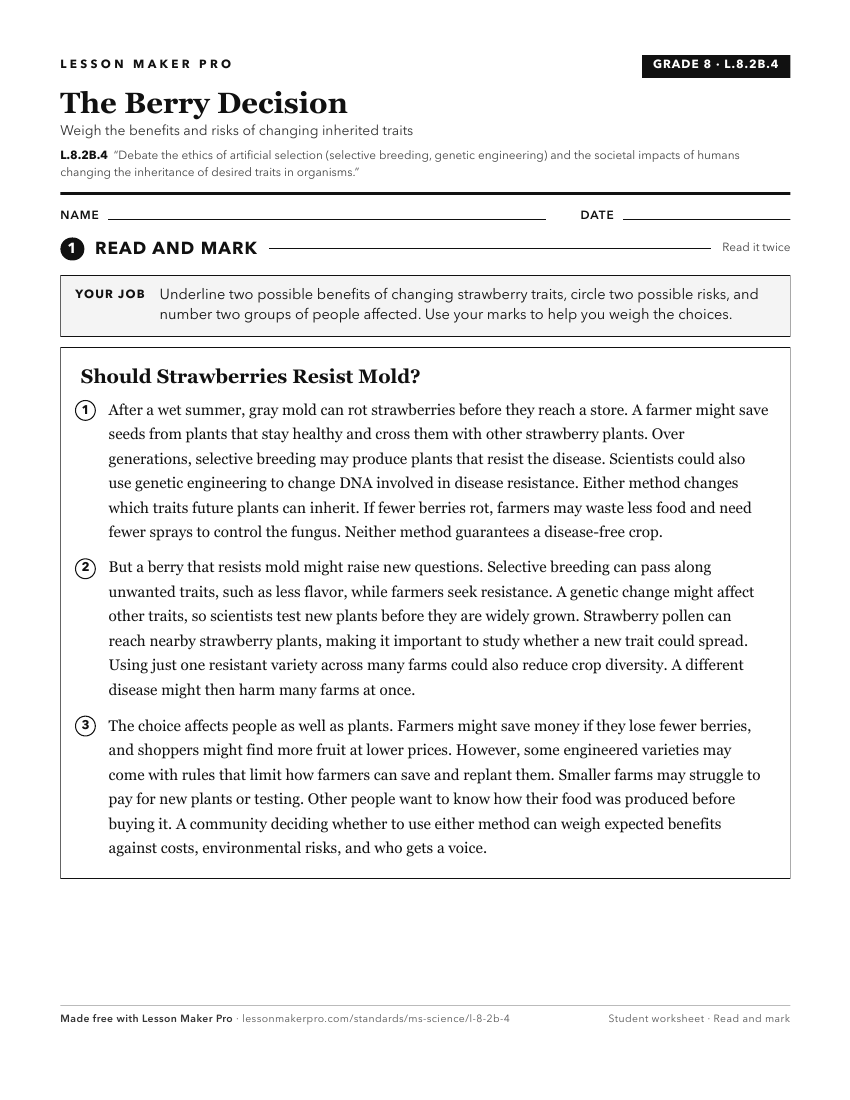
A ready-to-print activity worksheet aligned to L.8.2B.4, with an answer key for the teacher on its own page. No account needed.
PDF, US Letter, prints cleanly in black and white.
Download the worksheetKeep exploring
Related Standards
- FB.4.5
Research and report on genetic technologies that may improve the quality of life (e.g., genetic engineering, cloning, gene splicing, DNA testing).
- GEN.3.4
Enrichment: Develop logical arguments based on scientific evidence for and against ethical concerns regarding biotechnology/bioengineering.
- FB.4.6
Enrichment: Debate the pros and cons of using biotechnology to manipulate genetic information for human purposes (society).
- L.8.2B
Students will demonstrate an understanding of the differences in inherited and acquired characteristics and how environmental factors (natural selection) and th...
Turn this exact standard into a lesson
Grade, subject, topic, and the complete standard are prefilled. Create one free, no account needed.
Also for this standard:Make a WorksheetMake a QuizMake a Sub Lesson