Mississippi Science L.8.2A
Standard Cluster
Students will demonstrate an understanding of how sexual reproduction results in offspring with genetic variation while asexual reproduction results in offspring with identical genetic information. Use a model to show the relationship of genes, chromosomes, and DNA, and construct explanations comparing their relationship to inherited characteristics. Create a diagram of mitosis and explain its role in asexual reproduction, which results in offspring with identical genetic information. Construct explanations of how genetic information is transferred during meiosis through crossing over and independent assortment. Construct a model of meiosis to explain its role in sexual reproduction, which results in offspring that have a new combination of genetic information different from either parent. Compare and contrast advantages and disadvantages of asexual and sexual reproduction.
2026 Mississippi College- and Career-Readiness Standards for Science · Reproduction and Heredity
Cluster contents
Standards in This Cluster
L.8.2A is a cluster heading. These are the individual standards under it.
- L.8.2A.1
Use a model to show the relationship of genes, chromosomes, and DNA, and construct explanations comparing their relationship to inherited characteristics.
- L.8.2A.2
Create a diagram of mitosis and explain its role in asexual reproduction, which results in offspring with identical genetic information.
- L.8.2A.3
Construct explanations of how genetic information is transferred during meiosis through crossing over and independent assortment.
- L.8.2A.4
Construct a model of meiosis to explain its role in sexual reproduction, which results in offspring that have a new combination of genetic information different...
- L.8.2A.5
Compare and contrast advantages and disadvantages of asexual and sexual reproduction.
Teacher's field guide
What This Cluster Means
What Students Need to Do
- Students show how genes are pieces of DNA carried on chromosomes and can affect traits. They model mitosis and meiosis to explain why asexual offspring usually match one parent, while sexual offspring inherit a new mix of genetic information. They compare the benefits and drawbacks of each way of reproducing.
What Mastery Looks Like
- A student labels a gene on a chromosome and explains that the gene is made of DNA. Their mitosis diagram shows matching cells. Their meiosis model shows DNA swapping between matching chromosomes and two ways chromosome pairs can separate, producing different sex cells.
Common Misconceptions
- Students may draw genes outside chromosomes or think chromosomes are made of something other than DNA. They may think mitosis makes sex cells or that crossing over swaps DNA between unrelated chromosomes. They may mistake differences caused by growing conditions for differences in inherited DNA.
How to Assess It
- Exit ticket: Draw two chromosome pairs, show one crossover and two ways the pairs can separate. Explain why meiosis can make different sex cells while mitosis makes matching cells.
Lesson moves
Ways to Teach It
Give students two pairs of paper chromosomes with colored strips; have them swap strips between matching chromosomes and sort the pairs two ways.
Ask, "Why can two siblings look different when both have the same parents?" Require the words gene, meiosis, and fertilization.
Students order mitosis and meiosis diagram cards, then mark which process makes matching cells and which makes varied sex cells.
Compare a potato sprouting from an eye with a puppy from two parents; list one benefit and one drawback of each reproduction method.
Free download
Printable L.8.2A Worksheet
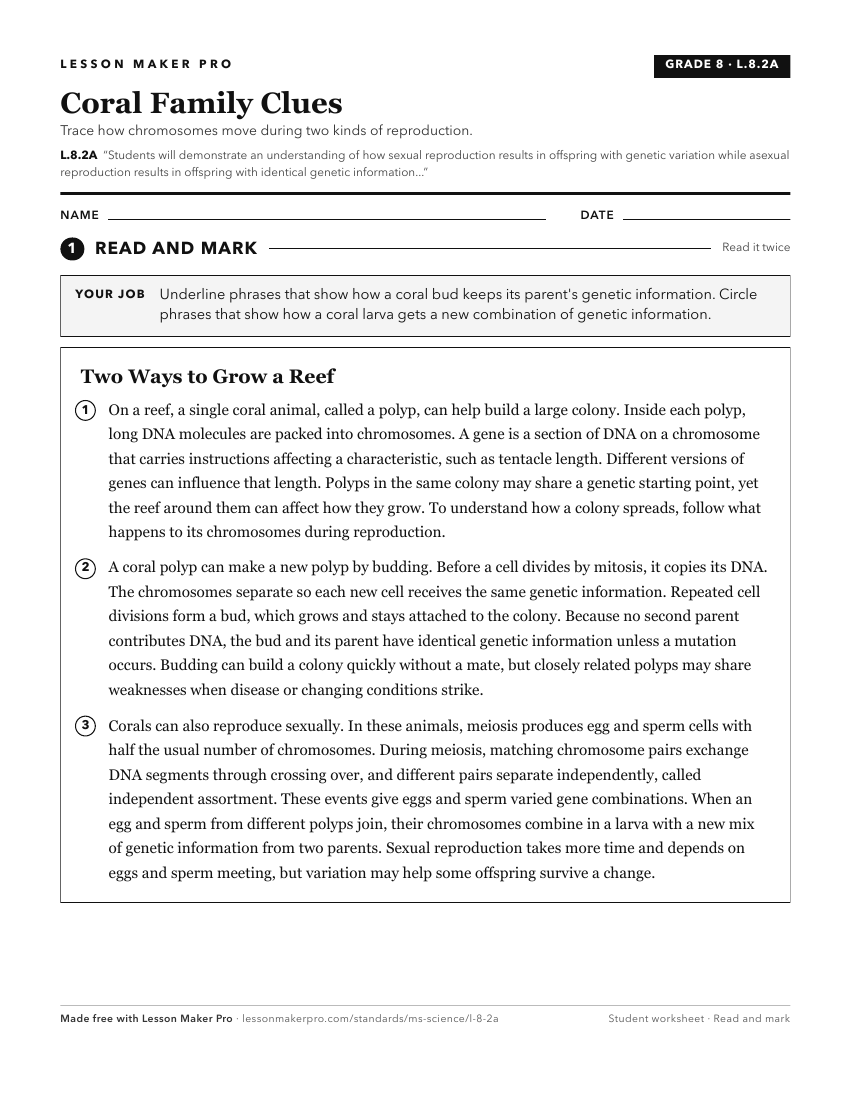
A ready-to-print activity worksheet aligned to L.8.2A, with an answer key for the teacher on its own page. No account needed.
PDF, US Letter, prints cleanly in black and white.
Download the worksheetKeep exploring
Related Standards
- BIO.3A
Students will develop and use models to explain the role of meiosis in the production of haploid gametes required for sexual reproduction.
- L.8.2B
Students will demonstrate an understanding of the differences in inherited and acquired characteristics and how environmental factors (natural selection) and th...
- L.3.2
Students will demonstrate an understanding that through reproduction, the survival and physical features of plants and animals are inherited traits from parent ...
- FB.4
Students will demonstrate an understanding of how genetic information is transferred from parent to offspring.
Turn this cluster into a lesson
Grade, subject, topic, and the complete cluster are prefilled. Create one free, no account needed.
Also for this cluster:Make a WorksheetMake a QuizMake a Sub Lesson