Mississippi Science L.3.2
Standard Cluster
Students will demonstrate an understanding that through reproduction, the survival and physical features of plants and animals are inherited traits from parent organisms but can also be influenced by the environment. Identify traits and describe how traits are passed from parent organism(s) to offspring in plants and animals. Describe and provide examples of plant and animal offspring from a single parent organism (e.g., bamboo, fern, or starfish) as being an exact replica with identical traits as the parent organism. Describe and provide examples of offspring from two parent organisms as containing a combination of inherited traits from both parent organisms. Obtain and communicate data to provide evidence that plants and animals have traits inherited from both parent organisms and that variations of these traits exist in groups of similar organisms (e.g., flower colors in pea plants or fur color and pattern in animal offspring). Research to justify the concept that traits can be influenced by the environment (e.g., stunted growth in normally tall plants due to insufficient water, changes in an arctic fox’s fur color due to light and/or temperature, or flamingo plumage).
2026 Mississippi College- and Career-Readiness Standards for Science · Reproduction and Heredity
Cluster contents
Standards in This Cluster
L.3.2 is a cluster heading. These are the individual standards under it.
- L.3.2.1
Identify traits and describe how traits are passed from parent organism(s) to offspring in plants and animals.
- L.3.2.2
Describe and provide examples of plant and animal offspring from a single parent organism (e.g., bamboo, fern, or starfish) as being an exact replica with ident...
- L.3.2.3
Describe and provide examples of offspring from two parent organisms as containing a combination of inherited traits from both parent organisms.
- L.3.2.4
Obtain and communicate data to provide evidence that plants and animals have traits inherited from both parent organisms and that variations of these traits exi...
- L.3.2.5
Research to justify the concept that traits can be influenced by the environment (e.g., stunted growth in normally tall plants due to insufficient water, change...
Teacher's field guide
What This Cluster Means
What Students Need to Do
- Students compare parent plants and animals with their offspring and name inherited traits. They explain why bamboo shoots from a runner inherit traits from one parent, while puppies can show traits from two parents. They use observations to tell inherited traits from the effects of water or food.
What Mastery Looks Like
- A student can point to traits a puppy shares with each parent and notice differences among puppies. They can explain why bamboo shoots from one runner inherit the same traits, even if one grows shorter because it gets less water.
Common Misconceptions
- Students may think a puppy must look exactly like one parent, or that every puppy in a litter looks alike. They may assume a short plant had short parents, even when it got little water. Some think bamboo shoots from a runner have two parents.
How to Assess It
- Exit ticket: Two bamboo shoots grow from one runner, but one gets little water; a puppy has two parents. Write where each offspring gets its inherited traits and why one bamboo shoot might be shorter.
Lesson moves
Ways to Teach It
Use pipe cleaners to model a bamboo runner and its shoots, then clip matching leaf-shape cards to the parent and shoots.
Show pictures of a well-watered and a drought-stressed bean plant; ask, 'Does a short plant always have short parents? Why not?'
Play a trait-match game with dog parent and puppy photos; students find traits shared with each parent and differences among puppies.
Draw two cuttings from one nursery basil plant, give them different watering schedules, and predict their heights.
Free download
Printable L.3.2 Worksheet
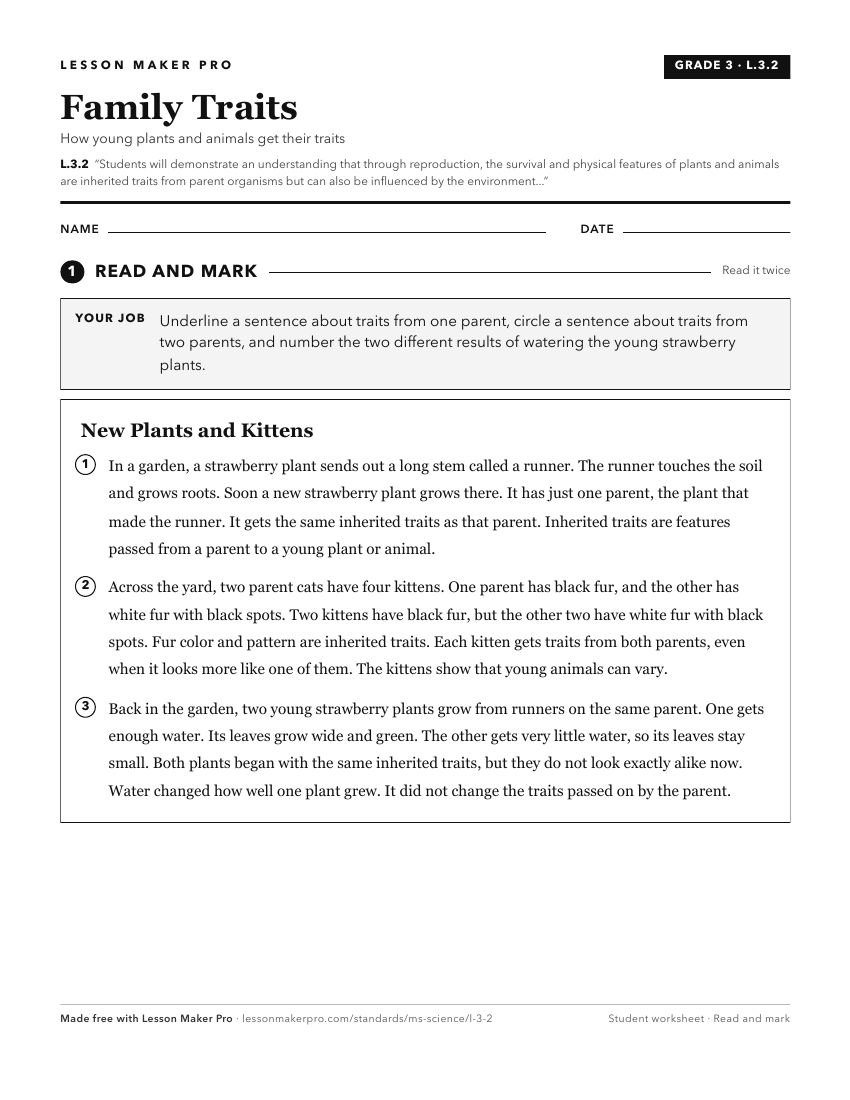
A ready-to-print activity worksheet aligned to L.3.2, with an answer key for the teacher on its own page. No account needed.
PDF, US Letter, prints cleanly in black and white.
Download the worksheetKeep exploring
Related Standards
- L.1.4
Students will demonstrate an understanding of the ways plants adapt to their environment in order to survive.
- L.8.2B
Students will demonstrate an understanding of the differences in inherited and acquired characteristics and how environmental factors (natural selection) and th...
- L.3.1
Students will demonstrate an understanding of internal and external structures in plants and animals and how they relate to their growth, survival, behavior, an...
- L.2.3B
Students will demonstrate an understanding of the interdependence of living things.
Turn this cluster into a lesson
Grade, subject, topic, and the complete cluster are prefilled. Create one free, no account needed.
Also for this cluster:Make a WorksheetMake a QuizMake a Sub Lesson