Mississippi Science L.3.2.4
The Standard
- L.3.2
- Students will demonstrate an understanding that through reproduction, the survival and physical features of plants and animals are inherited traits from parent organisms but can also be influenced by the environment.
Obtain and communicate data to provide evidence that plants and animals have traits inherited from both parent organisms and that variations of these traits exist in groups of similar organisms (e.g., flower colors in pea plants or fur color and pattern in animal offspring).
2026 Mississippi College- and Career-Readiness Standards for Science · Reproduction and Heredity
Teacher's field guide
What This Standard Means
What Students Need to Do
- Students compare parents and offspring using visible traits, such as coat color or flower color. They record similarities and differences, then use those observations to explain that offspring inherit traits from both parents and can differ from their siblings.
What Mastery Looks Like
- A student can use a chart to name traits an offspring shares with each parent. They can point to differences among siblings and use their recorded observations as evidence.
Common Misconceptions
- Students may think an offspring must look exactly like one parent, or that all siblings must look alike. They may also call a learned behavior, such as sitting on command, an inherited trait.
How to Assess It
- Give students a drawing of two parent rabbits and four kits with different coat colors and ear lengths. Ask them to tally the kits’ coat colors, name a trait shared with each parent, and describe one difference among the kits.
Lesson moves
Ways to Teach It
Give pairs labeled picture cards of two parent rabbits and four kits; have them sort the cards and tally coat colors.
Ask, 'Why might kits from the same parents look different?' Have students support an answer with two observations from their tally.
Play trait-match with parent-and-offspring picture cards; students match families and check their choices using coat color and ear shape.
Show photos of a farm’s parent sheep and lambs; students record wool colors and compare the lambs with both parents.
Free download
Printable L.3.2.4 Worksheet
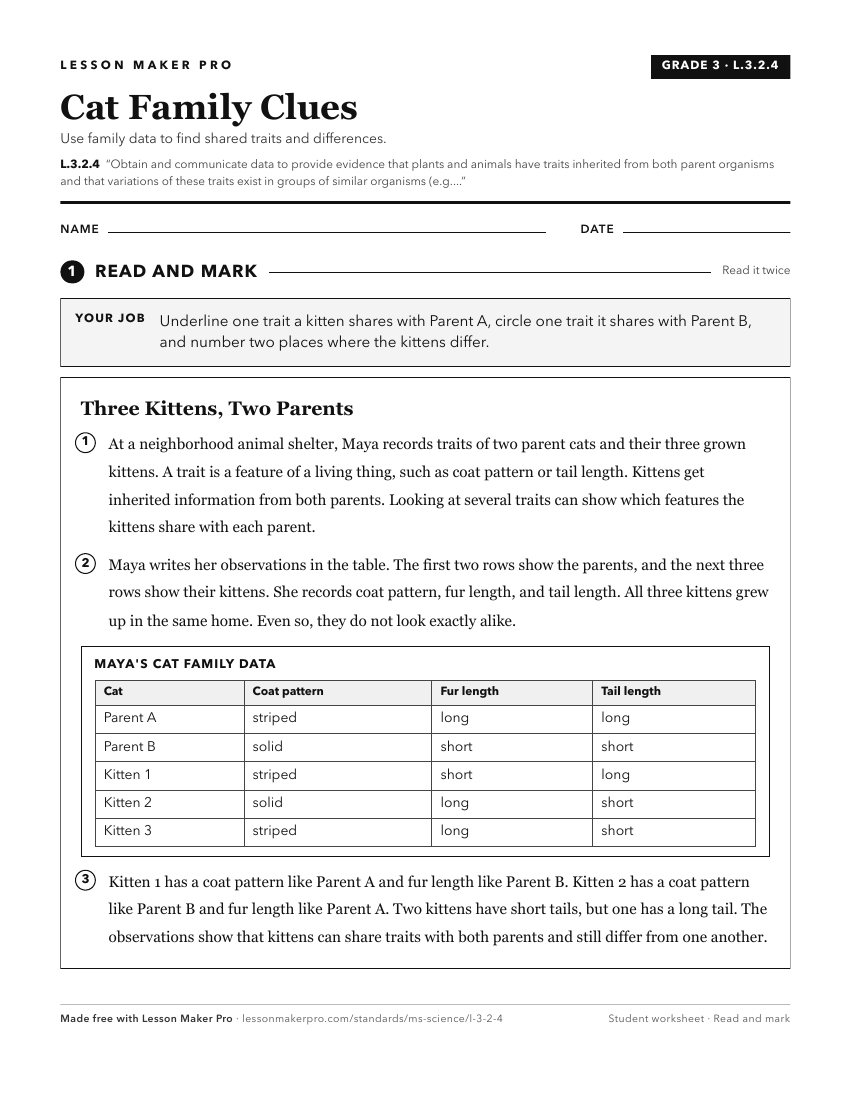
A ready-to-print activity worksheet aligned to L.3.2.4, with an answer key for the teacher on its own page. No account needed.
PDF, US Letter, prints cleanly in black and white.
Download the worksheetKeep exploring
Related Standards
- L.3.4.3
Analyze and interpret data to explain how variations in characteristics among organisms of the same species may provide advantages in surviving, finding mates, ...
- L.3.1.2
Examine evidence to communicate information that the internal and external structures of plants (e.g., thorns, leaves, stems, roots, or colored petals) function...
- L.8.4B
Students will demonstrate an understanding of how similarities and differences among living and extinct species provide evidence that changes have occurred in o...
- L.3.2.1
Identify traits and describe how traits are passed from parent organism(s) to offspring in plants and animals.
Turn this exact standard into a lesson
Grade, subject, topic, and the complete standard are prefilled. Create one free, no account needed.
Also for this standard:Make a WorksheetMake a QuizMake a Sub Lesson