Mississippi Science L.8.4B
Standard Cluster
Students will demonstrate an understanding of how similarities and differences among living and extinct species provide evidence that changes have occurred in organisms over time and that similarity of characteristics provides evidence of common ancestry. Analyze and interpret data (e.g., pictures, graphs) to explain how natural selection may lead to increases and decreases in specific traits in populations over time. Construct written and verbal explanations to describe how genetic variations of traits in a population increase some organisms’ probability of surviving and reproducing in a specific environment. Obtain and evaluate scientific information to explain that separated populations, which remain separated, can evolve through mutations to become a new species (speciation). Analyze displays of pictorial data to compare and contrast embryological and homologous/analogous structures across multiple species to identify evolutionary relationships.
2026 Mississippi College- and Career-Readiness Standards for Science · Adaptation and Diversity
Cluster contents
Standards in This Cluster
L.8.4B is a cluster heading. These are the individual standards under it.
- L.8.4B.1
Analyze and interpret data (e.g., pictures, graphs) to explain how natural selection may lead to increases and decreases in specific traits in populations over ...
- L.8.4B.2
Construct written and verbal explanations to describe how genetic variations of traits in a population increase some organisms' probability of surviving and rep...
- L.8.4B.3
Obtain and evaluate scientific information to explain that separated populations, which remain separated, can evolve through mutations to become a new species (...
- L.8.4B.4
Analyze displays of pictorial data to compare and contrast embryological and homologous/analogous structures across multiple species to identify evolutionary re...
Teacher's field guide
What This Cluster Means
What Students Need to Do
- Students read graphs and explain why some inherited traits become more common when their bearers survive and reproduce. They compare fossils, limb bones, and embryo pictures for clues about shared ancestry. They explain how separated populations can become different species over many generations.
What Mastery Looks Like
- Given trait data, students name which trait increased and explain how its bearers had more offspring in that environment. They use fossil bones, limb patterns, or embryo images to support a claim about ancestry. They explain how mutations can build up in separated populations until the groups become different species.
Common Misconceptions
- Students may say a moth changes color because it needs to, rather than recognizing inherited colors already in the population. They may treat any two wings as proof of close ancestry, even when their structures differ. They may think separation alone makes new species.
How to Assess It
- Give students a graph showing light and dark moth counts over four generations and diagrams of bat and human forelimbs. Ask which moth trait increased, why its bearers might have had more offspring, and what the matching forelimb bones suggest.
Lesson moves
Ways to Teach It
Place light and dark paper moths on dark paper; have students collect visible moths, double the survivors, and graph each color.
Show fossil and modern whale skeletons beside bat and whale forelimbs; ask students to write which bone patterns support shared ancestry.
Give pairs embryo cards and bat, whale, and butterfly wing diagrams; have them match shared features and flag wings with different structures.
Show photos of finches from separate islands; ask how random mutations and different seeds could change beak traits over generations.
Free download
Printable L.8.4B Worksheet
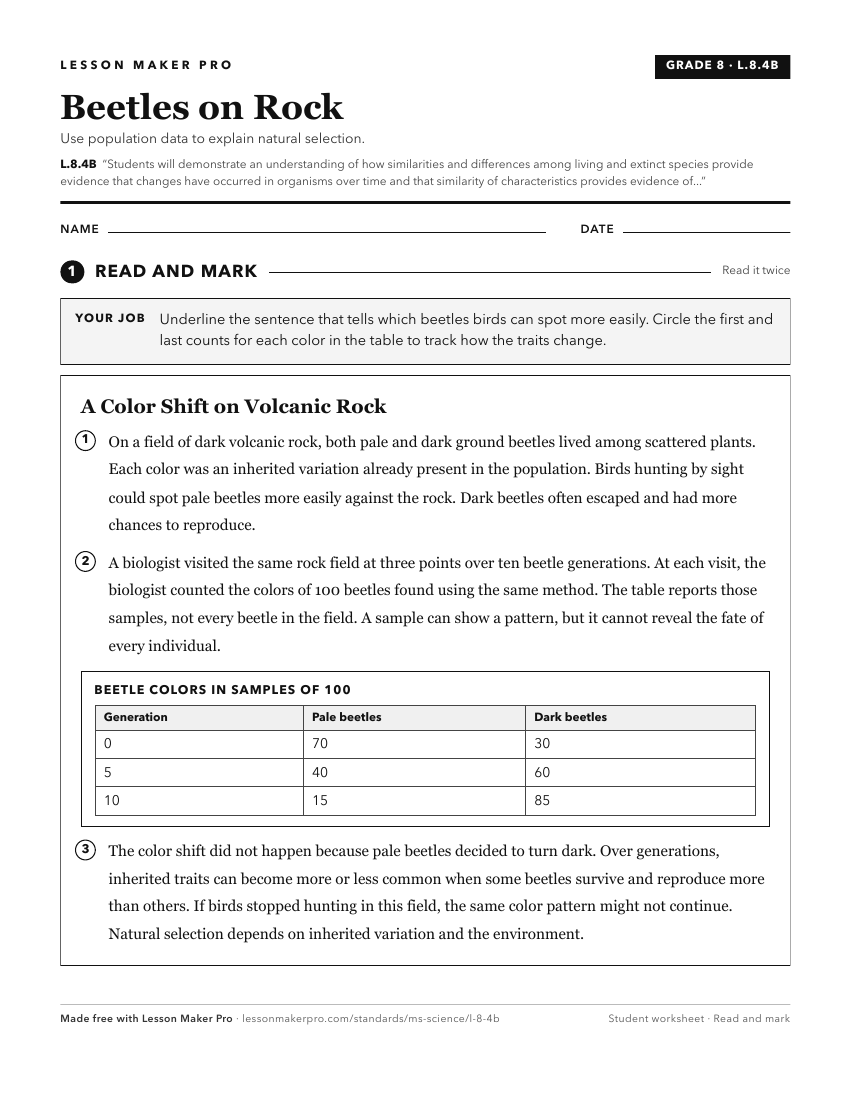
A ready-to-print activity worksheet aligned to L.8.4B, with an answer key for the teacher on its own page. No account needed.
PDF, US Letter, prints cleanly in black and white.
Download the worksheetKeep exploring
Related Standards
- BIO.4
Students will analyze and interpret evidence to explain the unity and diversity of life.
- BIO.4.2
Evaluate empirical evidence of common ancestry and biological evolution, including comparative anatomy (e.g., homologous structures and embryological similariti...
- L.2.3B
Students will demonstrate an understanding of the interdependence of living things.
- FB.5
Students will demonstrate an understanding of Earth’s fossil record and its indication of the diversity of life over time.
Turn this cluster into a lesson
Grade, subject, topic, and the complete cluster are prefilled. Create one free, no account needed.
Also for this cluster:Make a WorksheetMake a QuizMake a Sub Lesson