Mississippi Science BIO.4.2
The Standard
- BIO.4
- Students will analyze and interpret evidence to explain the unity and diversity of life.
Evaluate empirical evidence of common ancestry and biological evolution, including comparative anatomy (e.g., homologous structures and embryological similarities), fossil record, molecular/biochemical similarities (e.g., gene and protein homology), and biogeographic distribution.
2026 Mississippi College- and Career-Readiness Standards for Science · Adaptations and Evolution
Teacher's field guide
What This Standard Means
What Students Need to Do
- Students compare body structures, embryos, fossils, DNA or protein sequences, and species maps. They decide which patterns support common ancestry and what each source cannot show on its own.
What Mastery Looks Like
- A student can match the same bones in a bat wing and a whale flipper despite their different uses. They can compare DNA sequences and fossil ages, then explain how those findings support a claim about shared ancestry.
Common Misconceptions
- Students may think animals with similar-looking parts must be close relatives, even when those parts have different underlying structures. They may also think a gap in the fossil record means evolution did not happen, or that one fossil proves a direct ancestor.
How to Assess It
- Show students diagrams of bat, whale, and human forelimb bones and a sample gene table with 2 differences between bat and human and 10 between whale and human. Ask which pair likely shares a more recent common ancestor and what each source shows.
Lesson moves
Ways to Teach It
Give pairs paper cutouts of bat, whale, and human forelimb bones; have them line up matching bones and label them.
Ask students to write why a bat wing and whale flipper suggest shared ancestry, using one matching bone as evidence.
Give teams cards with fossil ages, short DNA sequences, and habitat maps; have them sort the cards by the claim each supports.
Show a map of the Galápagos Islands and finch beak photos; ask students why nearby islands have related but different finches.
Free download
Printable BIO.4.2 Worksheet
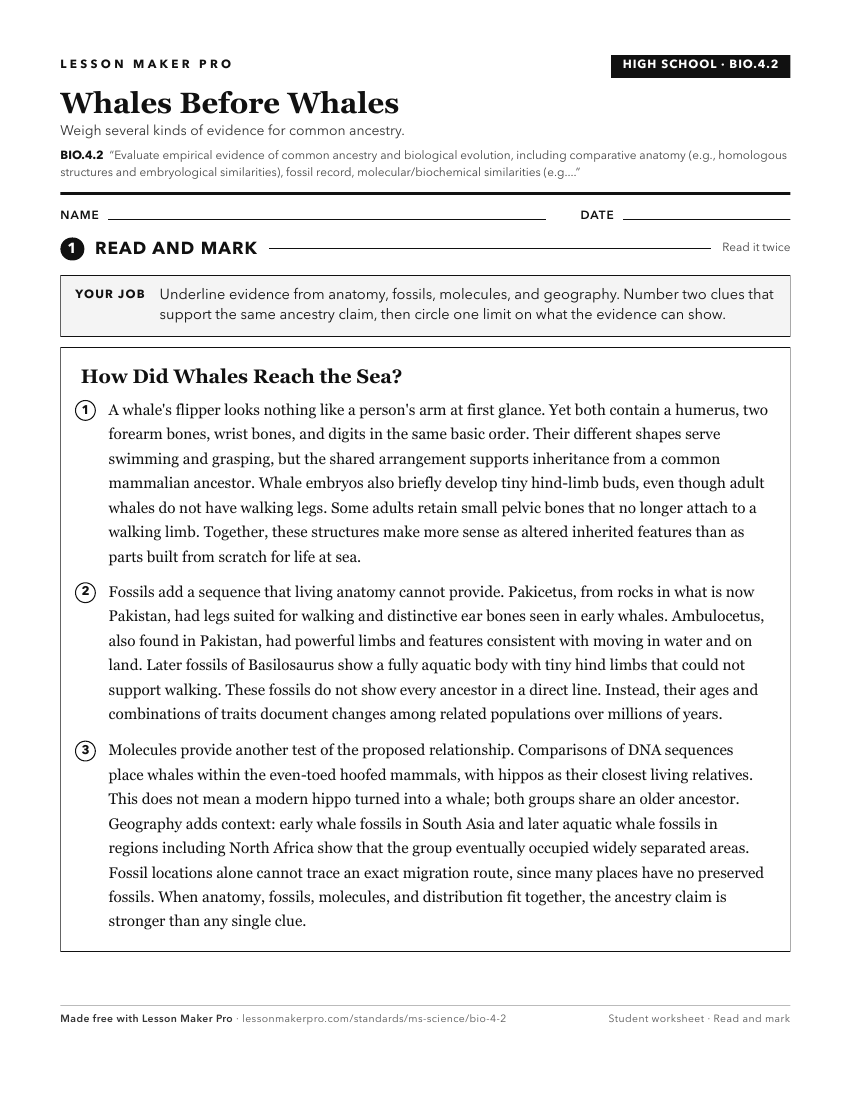
A ready-to-print activity worksheet aligned to BIO.4.2, with an answer key for the teacher on its own page. No account needed.
PDF, US Letter, prints cleanly in black and white.
Download the worksheetKeep exploring
Related Standards
- MAQ.7.2
Identify characteristics that are shared and derived using graphical representations of animal evolution and develop cladograms/phylogenetic trees.
- L.8.4B
Students will demonstrate an understanding of how similarities and differences among living and extinct species provide evidence that changes have occurred in o...
- L.8.4B.4
Analyze displays of pictorial data to compare and contrast embryological and homologous/analogous structures across multiple species to identify evolutionary re...
- ESS.3.8
Analyze and interpret the record of shared ancestry, evolution, and extinction as related to natural selection using fossils.
Turn this exact standard into a lesson
Grade, subject, topic, and the complete standard are prefilled. Create one free, no account needed.
Also for this standard:Make a WorksheetMake a QuizMake a Sub Lesson