Mississippi Science MAQ.7.2
The Standard
- MAQ.7
- Students will investigate characteristics of aquatic chordates.
Identify characteristics that are shared and derived using graphical representations of animal evolution and develop cladograms/phylogenetic trees.
2026 Mississippi College- and Career-Readiness Standards for Science · Vertebrate Consumers
Teacher's field guide
What This Standard Means
What Students Need to Do
- Students read branching diagrams to find traits shared through a common ancestor. They use a trait chart to place marine vertebrates on a tree and mark where traits first appeared.
What Mastery Looks Like
- A student places a shark, tuna, sea turtle, and dolphin on branches using backbone, bony skeleton, lungs, and mammary glands. They explain why the dolphin and sea turtle share a more recent ancestor than the dolphin and shark.
Common Misconceptions
- Students may group sharks and dolphins because both have fins, ignoring differences in their skeletons and breathing. They may also think one living animal on the tree evolved from another living animal on the tree.
How to Assess It
- Give students four animal names and four traits: shark, tuna, sea turtle, dolphin, backbone, bony skeleton, lungs, and mammary glands. Ask them to draw a branching tree and mark where each trait first appeared.
Lesson moves
Ways to Teach It
Give pairs animal cards and trait strips, then have them build a branching tree on paper for shark, tuna, sea turtle, and dolphin.
Ask students to write why a dolphin shares a more recent ancestor with a sea turtle than with a shark, despite their similar fins.
Show a tree with lungs marked before the tuna branch, and have students move the label to the correct branch.
Compare photos of a shark fin and dolphin flipper, then use skeleton diagrams to explain why the animals sit on different branches.
Free download
Printable MAQ.7.2 Worksheet
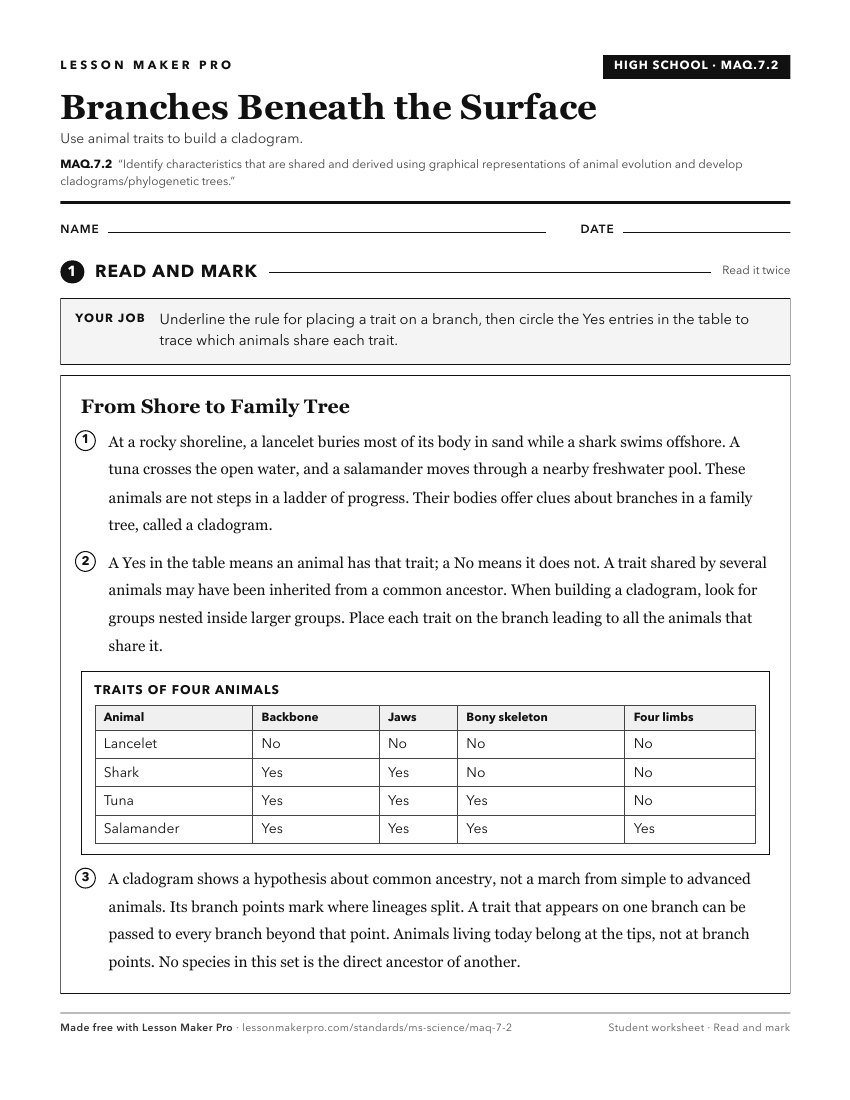
A ready-to-print activity worksheet aligned to MAQ.7.2, with an answer key for the teacher on its own page. No account needed.
PDF, US Letter, prints cleanly in black and white.
Download the worksheetKeep exploring
Related Standards
- ZOO.1.4
Construct cladograms or phylogenetic trees to show the evolutionary branches of an ancestral species and its descendants.
- BIO.4.3
Analyze cladograms/phylogenetic trees to illustrate relatedness between species.
- MAQ.5.3
Recognize characteristics that are shared and derived using graphical representations of primary-producer evolution and develop cladograms/phylogenetic trees.
- MAQ.6.2
Identify characteristics that are shared and derived using graphical representations of animal evolution (i.e., cladograms and phylogenetic trees) and develop c...
Turn this exact standard into a lesson
Grade, subject, topic, and the complete standard are prefilled. Create one free, no account needed.
Also for this standard:Make a WorksheetMake a QuizMake a Sub Lesson