Mississippi Science ZOO.1.4
The Standard
- ZOO.1
- Students will develop a model of evolutionary change over time.
Construct cladograms or phylogenetic trees to show the evolutionary branches of an ancestral species and its descendants.
2026 Mississippi College- and Career-Readiness Standards for Science · Evolution
Teacher's field guide
What This Standard Means
What Students Need to Do
- Students use animal traits to draw a branching tree. They place animals at the branch tips and mark where shared traits appeared.
What Mastery Looks Like
- Given a trait table, a student groups animals by shared inherited traits and labels their common ancestors. They can explain why two animals share a branch without claiming that one living animal became the other.
Common Misconceptions
- Students may draw a straight line from shark to frog to lizard to mouse, as if living animals turned into one another. They may group animals by looks alone or assume the tip farthest right is the most evolved.
How to Assess It
- Exit ticket: Draw a tree for shark, frog, lizard, and mouse using four limbs (all but shark), an amniotic egg (lizard and mouse), and hair (mouse). Circle the common ancestor of lizard and mouse.
Lesson moves
Ways to Teach It
Give pairs animal cards and a trait checklist; have them place the cards at the tips of a paper tree and label trait changes.
Ask, 'Did modern lizards turn into modern mice?' Have students point to a branch and explain their answer.
Show three trees for shark, frog, lizard, and mouse; teams use a trait table to choose and defend the one that fits.
Have students design a zoo sign with a branching tree for lions, house cats, and wolves, showing which two share a recent ancestor.
Free download
Printable ZOO.1.4 Worksheet
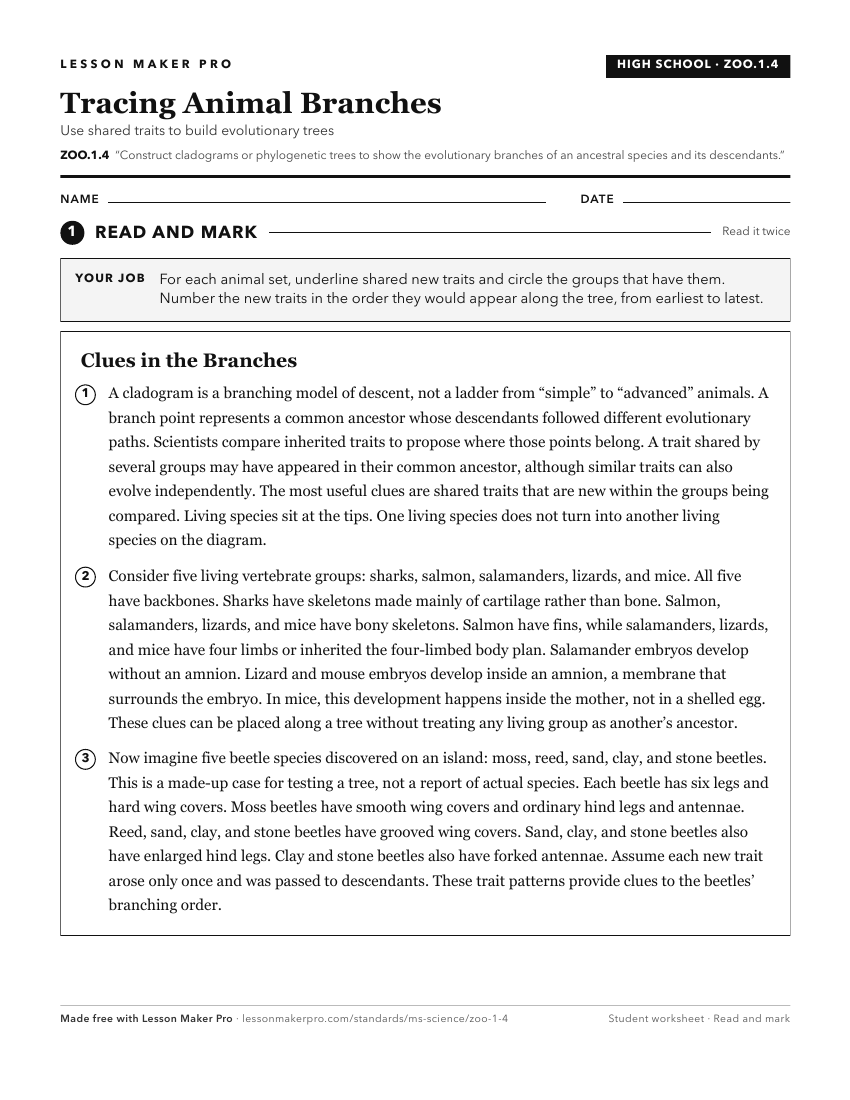
A ready-to-print activity worksheet aligned to ZOO.1.4, with an answer key for the teacher on its own page. No account needed.
PDF, US Letter, prints cleanly in black and white.
Download the worksheetKeep exploring
Related Standards
- MAQ.7.2
Identify characteristics that are shared and derived using graphical representations of animal evolution and develop cladograms/phylogenetic trees.
- BIO.4.3
Analyze cladograms/phylogenetic trees to illustrate relatedness between species.
- MAQ.5.3
Recognize characteristics that are shared and derived using graphical representations of primary-producer evolution and develop cladograms/phylogenetic trees.
- MAQ.6.2
Identify characteristics that are shared and derived using graphical representations of animal evolution (i.e., cladograms and phylogenetic trees) and develop c...
Turn this exact standard into a lesson
Grade, subject, topic, and the complete standard are prefilled. Create one free, no account needed.
Also for this standard:Make a WorksheetMake a QuizMake a Sub Lesson