Mississippi Science L.8.4B.2
The Standard
- L.8.4B
- Students will demonstrate an understanding of how similarities and differences among living and extinct species provide evidence that changes have occurred in organisms over time and that similarity of characteristics provides evidence of common ancestry.
Construct written and verbal explanations to describe how genetic variations of traits in a population increase some organisms’ probability of surviving and reproducing in a specific environment.
2026 Mississippi College- and Career-Readiness Standards for Science · Adaptation and Diversity
Teacher's field guide
What This Standard Means
What Students Need to Do
- Students explain, in writing and aloud, how inherited differences within a population affect survival in a particular place. They connect survival and reproduction to the traits passed to offspring.
What Mastery Looks Like
- A student uses survivor counts to explain why dark moths are more likely to survive on dark bark and leave offspring. They predict how moth colors may shift over generations without claiming every dark moth survives.
Common Misconceptions
- Students may think moths turn dark because they need to hide, rather than being born with different colors. They may think a helpful trait guarantees survival or helps in every habitat. Some forget that an organism must reproduce for its traits to become more common.
How to Assess It
- Exit ticket: On dark bark, 8 of 10 dark moths and 2 of 10 light moths survive and reproduce. Write two sentences explaining what might happen to moth colors over generations, then explain your answer to a partner.
Lesson moves
Ways to Teach It
Scatter dark and light paper moths on dark paper, pick visible moths, then give each survivor one paper offspring and recount colors.
Ask why dark fur might help mice on black lava but not pale sand; have students write two sentences and tell a partner.
Deal dark-fur and light-fur mouse cards with black-rock and pale-sand habitat cards; partners predict which mice leave more offspring and defend predictions.
Show a hospital notice about antibiotic-resistant bacteria; ask why resistant bacteria leave more offspring when an antibiotic kills other bacteria.
Free download
Printable L.8.4B.2 Worksheet
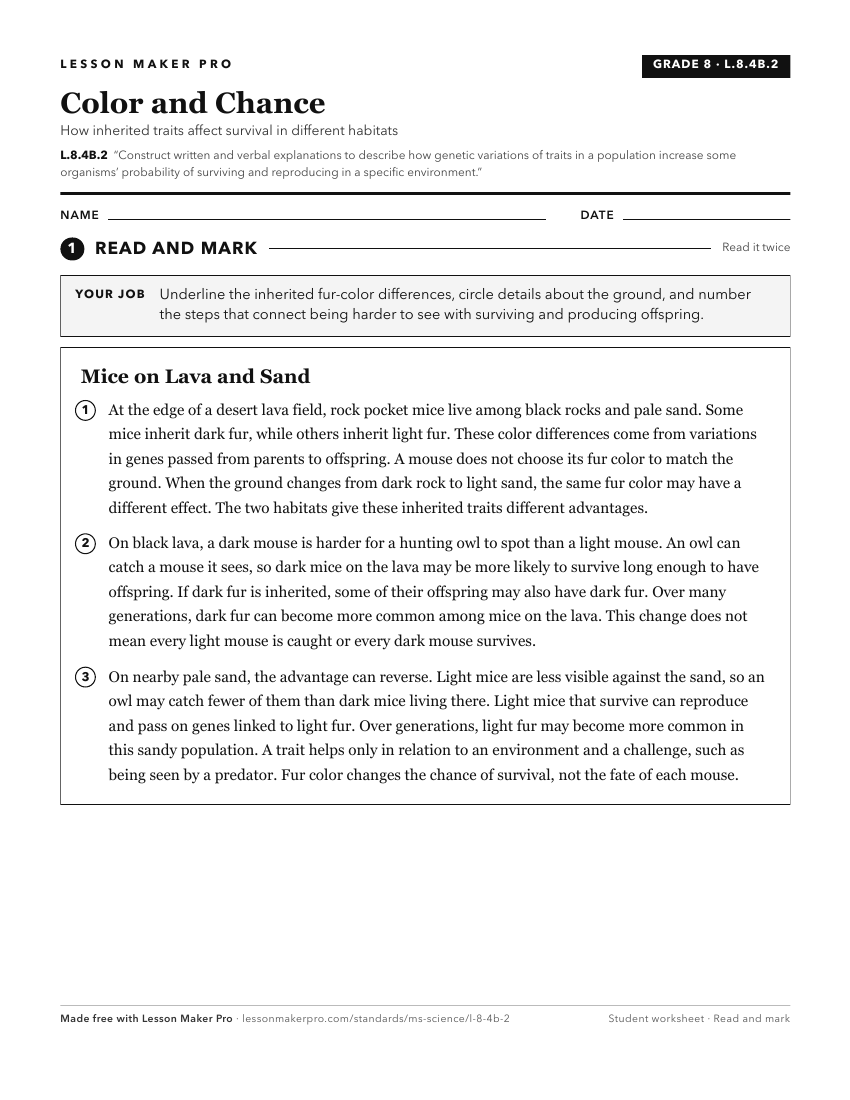
A ready-to-print activity worksheet aligned to L.8.4B.2, with an answer key for the teacher on its own page. No account needed.
PDF, US Letter, prints cleanly in black and white.
Download the worksheetKeep exploring
Related Standards
- FB.5.4
Investigate how biological adaptations and genetic variations of traits in a population enhance the probability of survival in an environment (natural selection...
- L.3.4.3
Analyze and interpret data to explain how variations in characteristics among organisms of the same species may provide advantages in surviving, finding mates, ...
- L.8.4A.2
Construct explanations about how genetic factors and environmental factors (e.g., food intake, interactions with other organisms, etc.) lead to the growth, surv...
- ZOO.1.5
Design models to illustrate the interaction between changing environments and genetic variation in natural selection leading to adaptations in populations and d...
Turn this exact standard into a lesson
Grade, subject, topic, and the complete standard are prefilled. Create one free, no account needed.
Also for this standard:Make a WorksheetMake a QuizMake a Sub Lesson