Mississippi Science L.3.4.3
The Standard
- L.3.4
- Students will demonstrate an understanding of how adaptations allow animals to satisfy life needs and respond both physically and behaviorally to their environment.
Analyze and interpret data to explain how variations in characteristics among organisms of the same species may provide advantages in surviving, finding mates, and reproducing (e.g., plants with larger thorns being less likely to be eaten by predators or animals with better camouflage colorations being more likely to survive and bear offspring).
2026 Mississippi College- and Career-Readiness Standards for Science · Adaptation and Diversity
Teacher's field guide
What This Standard Means
What Students Need to Do
- Students compare counts for members of one species that have different traits. They use the numbers to explain how a trait may help an organism survive, find a mate, or have young.
What Mastery Looks Like
- A student can compare groups that started with the same number of organisms and point to survival or offspring counts. They can explain why a trait may help in one setting but not another.
Common Misconceptions
- Students may think all members of one species look alike. Some think an animal changes color because it needs to hide. Others assume a helpful trait guarantees survival or offspring.
How to Assess It
- Give this exit ticket: On green leaves, 20 green beetles started and 12 survived; 20 brown beetles started and 5 survived. Which color may help beetles survive there? Use both counts in your answer.
Lesson moves
Ways to Teach It
Place 10 green and 10 brown paper beetles on green paper, have a partner pick five quickly, then count survivors by color.
Show bird data: 8 of 10 blue-tailed birds paired, and 3 of 10 brown-tailed birds paired. Ask which trait may help find mates.
Deal beetle cards: spotted, 8 young in grass, 2 on sand; plain, 3 in grass, 9 on sand. Match each to a habitat.
Show photos of light and dark peppered moths on sooty tree bark, tally which classmates spot first, and discuss which birds might catch.
Free download
Printable L.3.4.3 Worksheet
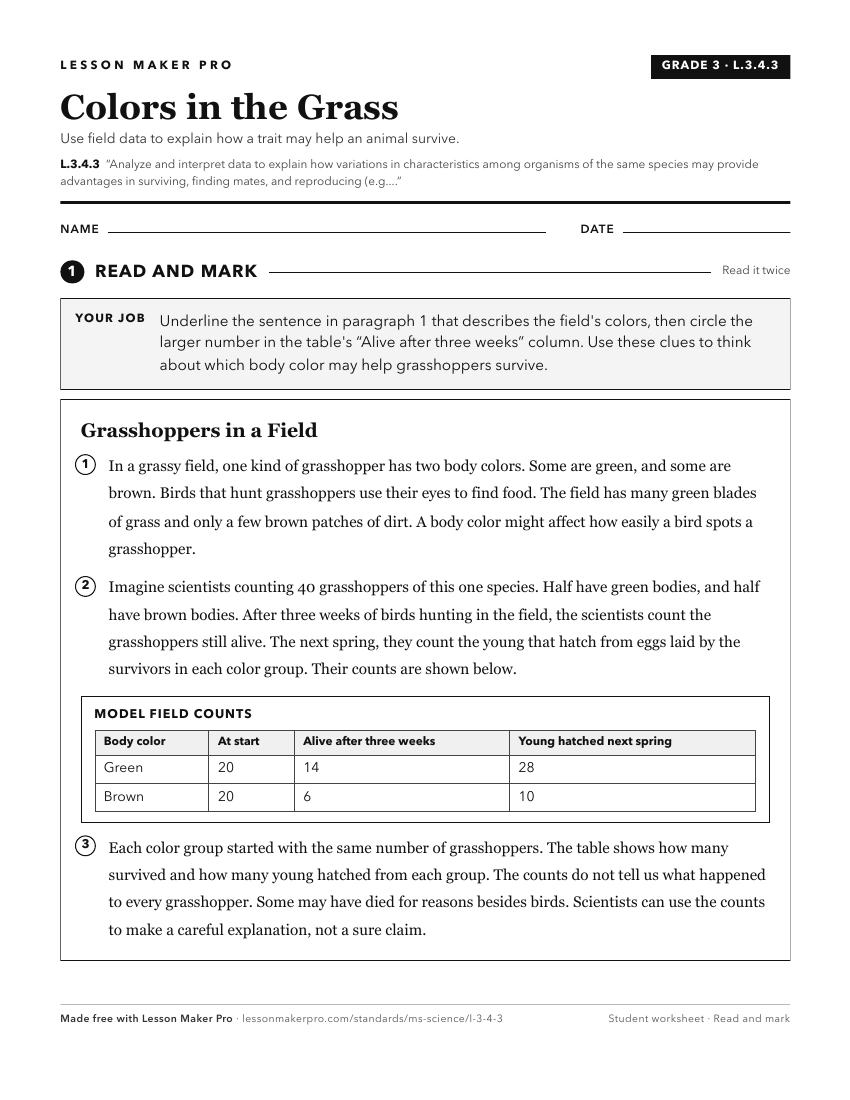
A ready-to-print activity worksheet aligned to L.3.4.3, with an answer key for the teacher on its own page. No account needed.
PDF, US Letter, prints cleanly in black and white.
Download the worksheetKeep exploring
Related Standards
- L.8.4B.1
Analyze and interpret data (e.g., pictures, graphs) to explain how natural selection may lead to increases and decreases in specific traits in populations over ...
- L.8.4B.2
Construct written and verbal explanations to describe how genetic variations of traits in a population increase some organisms' probability of surviving and rep...
- FB.5.4
Investigate how biological adaptations and genetic variations of traits in a population enhance the probability of survival in an environment (natural selection...
- L.3.2.4
Obtain and communicate data to provide evidence that plants and animals have traits inherited from both parent organisms and that variations of these traits exi...
Turn this exact standard into a lesson
Grade, subject, topic, and the complete standard are prefilled. Create one free, no account needed.
Also for this standard:Make a WorksheetMake a QuizMake a Sub Lesson