Mississippi Science FB.5
Standard Cluster
Students will demonstrate an understanding of Earth’s fossil record and its indication of the diversity of life over time. Investigate through research the contributions of scientists to the theory of evolution and evolutionary processes (e.g., Needham, Spallanzani, Redi, Pasteur, Lyell, Lamarck, Malthus, Wallace, Darwin). Analyze and interpret data to support claims that different types of fossils provide evidence of the diversity of life that has existed on Earth and of the relationships between past and existing life on Earth. Obtain and communicate information to explain how DNA evidence and fossil records support Darwin’s theory of evolution. Investigate how biological adaptations and genetic variations of traits in a population enhance the probability of survival in an environment (natural selection). Enrichment: Create and analyze models that illustrate the relatedness between all living things (cladograms/phylogenic trees).
2026 Mississippi College- and Career-Readiness Standards for Science · Biological Evolution
Cluster contents
Standards in This Cluster
FB.5 is a cluster heading. These are the individual standards under it.
- FB.5.1
Investigate through research the contributions of scientists to the theory of evolution and evolutionary processes (e.g., Needham, Spallanzani, Redi, Pasteur, L...
- FB.5.2
Analyze and interpret data to support claims that different types of fossils provide evidence of the diversity of life that has existed on Earth and of the rela...
- FB.5.3
Obtain and communicate information to explain how DNA evidence and fossil records support Darwin’s theory of evolution.
- FB.5.4
Investigate how biological adaptations and genetic variations of traits in a population enhance the probability of survival in an environment (natural selection...
- FB.5.5
Enrichment: Create and analyze models that illustrate the relatedness between all living things (cladograms/phylogenic trees).
Teacher's field guide
What This Cluster Means
What Students Need to Do
- Students use fossils to track how life on Earth changed over time. They compare fossil and DNA evidence for shared ancestry. They also research scientists' ideas and examine how inherited traits affect survival.
What Mastery Looks Like
- Students can use fossil ages and features to support a claim about past life and its relationship to living species. They can explain how DNA similarities support common ancestry and how a helpful inherited trait can become more common over generations.
Common Misconceptions
- Students may think deeper fossils are younger or that a footprint fossil contains the animal's body. Some think an animal changes its genes because it needs to survive. Similar DNA does not mean one living species evolved from another living species.
How to Assess It
- Exit ticket: A shell fossil lies below a fish fossil in undisturbed rock. Two living fish share 18 of 20 DNA bases; a fish and a snail share 8. Which fossil is older, and which living pair is more closely related? Explain both answers.
Lesson moves
Ways to Teach It
Give groups dated shell, fish bone, and footprint fossil cards to place on a paper timeline; have them mark changes in diversity.
Give pairs short source cards on Lyell, Wallace, and Darwin; ask how each person's ideas helped explain evolution.
Scatter light and dark paper moths on dark paper; remove visible moths, double the survivors each round, and graph color counts.
Use a museum photo of a fossil whale hind limb and a whale-hippo DNA comparison to write a whale exhibit caption.
Free download
Printable FB.5 Worksheet
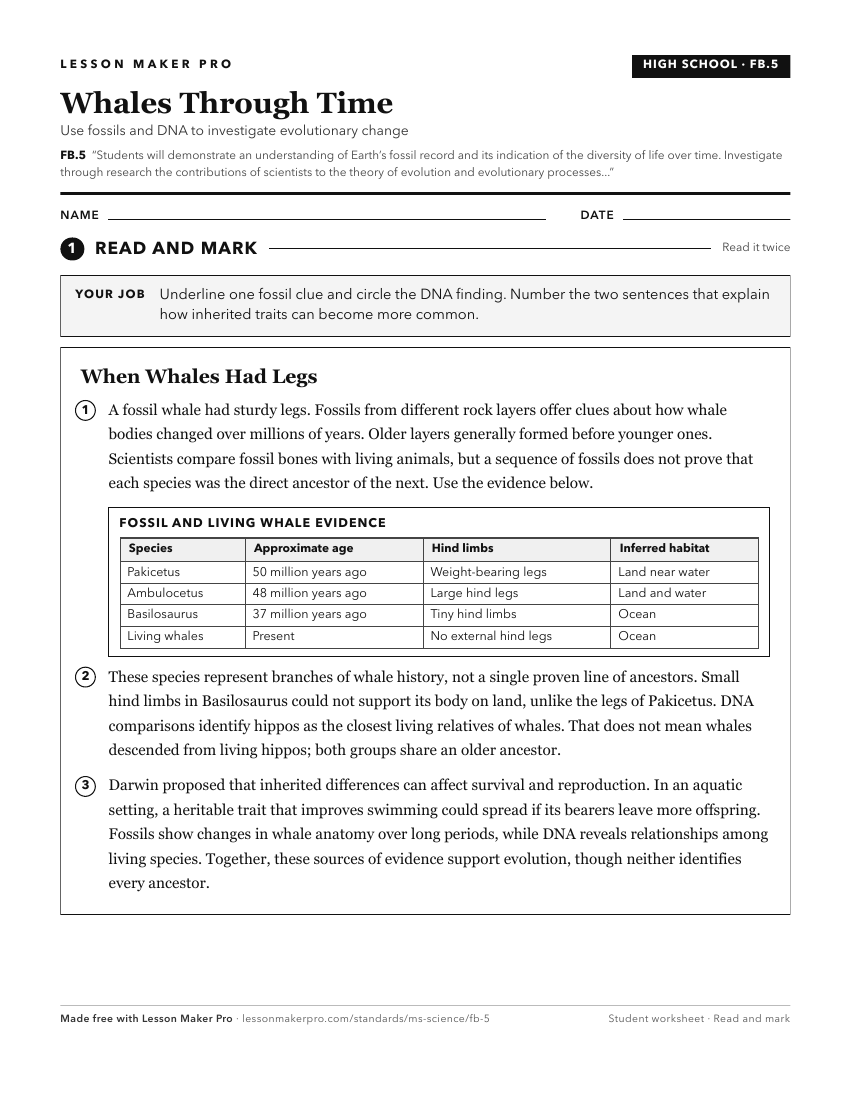
A ready-to-print activity worksheet aligned to FB.5, with an answer key for the teacher on its own page. No account needed.
PDF, US Letter, prints cleanly in black and white.
Download the worksheetKeep exploring
Related Standards
- ESS.2B
Students will develop an understanding of the history and evolution of the earth.
- E.8.7
Students will demonstrate an understanding of geological evidence to analyze patterns in Earth’s major events, processes, and evolution in history.
- L.8.4B
Students will demonstrate an understanding of how similarities and differences among living and extinct species provide evidence that changes have occurred in o...
- E.3.7A
Students will demonstrate an understanding of the various processes involved in the rock cycle, superposition of rock layers, and fossil formation.
Turn this cluster into a lesson
Grade, subject, topic, and the complete cluster are prefilled. Create one free, no account needed.
Also for this cluster:Make a WorksheetMake a QuizMake a Sub Lesson