Mississippi Science FB.5.5
The Standard
- FB.5
- Students will demonstrate an understanding of Earth’s fossil record and its indication of the diversity of life over time.
Enrichment: Create and analyze models that illustrate the relatedness between all living things (cladograms/phylogenic trees).
2026 Mississippi College- and Career-Readiness Standards for Science · Biological Evolution
Teacher's field guide
What This Standard Means
What Students Need to Do
- Students build branching trees for major groups of living things using shared traits and DNA clues. They read branch points to compare how recently groups shared an ancestor.
What Mastery Looks Like
- A student can place bacteria, archaea, plants, fungi, and animals on a tree using evidence. They can point to a branch point and explain why fungi and animals share a more recent ancestor than either does with plants.
Common Misconceptions
- Students may read the tree as a ladder with humans at the top. They may assume nearby names are closest relatives without tracing branches, or think a living bacterium is an ancestor of modern animals.
How to Assess It
- Exit ticket: Draw a tree for a bacterium, oak, mushroom, and human. Use these clues: the last three have nuclei, and mushroom and human DNA is most alike. Circle the most recent common ancestor of mushroom and human.
Lesson moves
Ways to Teach It
Pairs build paper trees from bacteria, archaea, oak, mushroom, and human cards, using nucleus, fungi-animal DNA, and archaea-eukaryote gene clues.
On the class tree, ask, 'Which shares a more recent ancestor with humans, mushrooms or oaks? Show the branch point.'
Draw two trees with oak, mushroom, and human; flip mushroom and human around their shared node, then ask pairs if relatedness changed.
Show a mock hospital outbreak tree of bacterial samples from four rooms; ask which two samples share the most recent ancestor.
Free download
Printable FB.5.5 Worksheet
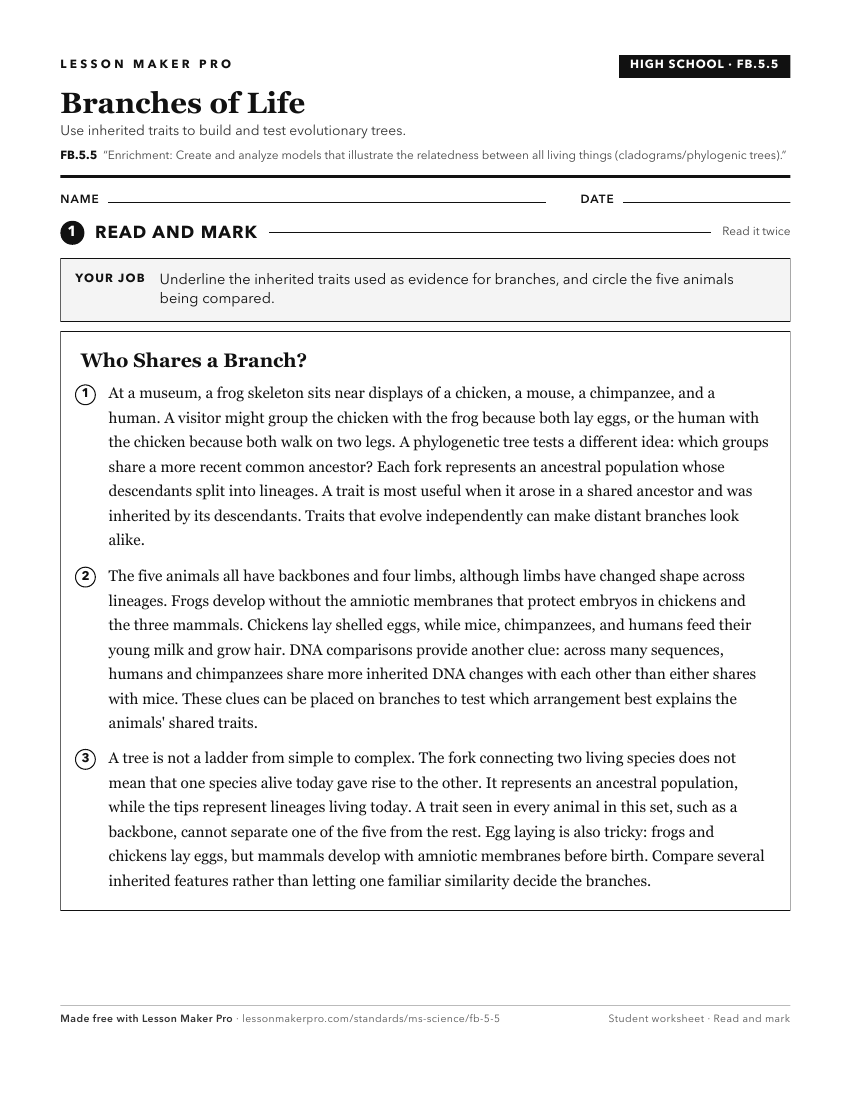
A ready-to-print activity worksheet aligned to FB.5.5, with an answer key for the teacher on its own page. No account needed.
PDF, US Letter, prints cleanly in black and white.
Download the worksheetKeep exploring
Related Standards
- MAQ.7.2
Identify characteristics that are shared and derived using graphical representations of animal evolution and develop cladograms/phylogenetic trees.
- BIO.4.3
Analyze cladograms/phylogenetic trees to illustrate relatedness between species.
- MAQ.5.3
Recognize characteristics that are shared and derived using graphical representations of primary-producer evolution and develop cladograms/phylogenetic trees.
- BOT.2.5
Enrichment: Referencing the National Center for Biotechnology Information’s gene/protein databases, propose and design a scientifically supportable cladogram or...
Turn this exact standard into a lesson
Grade, subject, topic, and the complete standard are prefilled. Create one free, no account needed.
Also for this standard:Make a WorksheetMake a QuizMake a Sub Lesson