Mississippi Science BIO.4
Standard Cluster
Students will analyze and interpret evidence to explain the unity and diversity of life. Use models to differentiate between organic and chemical evolution, illustrating the steps leading to aerobic heterotrophs and photosynthetic autotrophs. Evaluate empirical evidence of common ancestry and biological evolution, including comparative anatomy (e.g., homologous structures and embryological similarities), fossil record, molecular/biochemical similarities (e.g., gene and protein homology), and biogeographic distribution. Analyze cladograms/phylogenetic trees to illustrate relatedness between species. Design models and/or use simulations to investigate the interaction between changing environments and genetic variation in natural selection leading to adaptations in populations and differential success of populations. Use Darwin's Theory to explain how genetic variation, competition, overproduction, and unequal reproductive success acts as driving forces of natural selection and evolution. Construct explanations for the mechanisms of speciation (e.g., geographic, and reproductive isolation). Enrichment: Construct explanations for how various disease agents (bacteria, viruses, chemicals) can influence natural selection.
2026 Mississippi College- and Career-Readiness Standards for Science · Adaptations and Evolution
Cluster contents
Standards in This Cluster
BIO.4 is a cluster heading. These are the individual standards under it.
- BIO.4.1
Use models to differentiate between organic and chemical evolution, illustrating the steps leading to aerobic heterotrophs and photosynthetic autotrophs.
- BIO.4.2
Evaluate empirical evidence of common ancestry and biological evolution, including comparative anatomy (e.g., homologous structures and embryological similariti...
- BIO.4.3
Analyze cladograms/phylogenetic trees to illustrate relatedness between species.
- BIO.4.4
Design models and/or use simulations to investigate the interaction between changing environments and genetic variation in natural selection leading to adaptati...
- BIO.4.5
Use Darwin's Theory to explain how genetic variation, competition, overproduction, and unequal reproductive success acts as driving forces of natural selection ...
- BIO.4.6
Construct explanations for the mechanisms of speciation (e.g., geographic, and reproductive isolation).
- BIO.4.7
Enrichment: Construct explanations for how various disease agents (bacteria, viruses, chemicals) can influence natural selection.
Teacher's field guide
What This Cluster Means
What Students Need to Do
- Students use fossils, body structures, DNA, and species locations to infer ancestry and read branching trees. They distinguish chemical changes before life from evolution in living populations. They model early cells and track how inherited differences and changing environments affect populations.
What Mastery Looks Like
- Given a branching tree and DNA data, students identify the closest relatives and cite evidence. They show how competition and unequal reproduction change inherited traits in a population. They place anaerobic cells, photosynthetic autotrophs, and aerobic heterotrophs in order, and explain how isolation can lead to new species.
Common Misconceptions
- Students may think organisms grow useful traits because they need them, then pass those changes to offspring. They may read a branching tree as a ladder of progress. They may put oxygen-using cells before oxygen-producing cells or confuse chemical changes before life with natural selection.
How to Assess It
- Exit ticket: On dark bark, birds eat 15 of 20 light moths and 5 of 20 dark moths. Which inherited color should become more common after survivors reproduce, and why?
Lesson moves
Ways to Teach It
Use spoons, tweezers, and clothespins to collect beans, then rice; award two matching offspring tokens to the top tool each round.
Show diagrams of a human arm, bat wing, and whale flipper; ask students to name matching bones and explain what the matches suggest.
Write AACT, AACC, AATC, and GGGT on cards; have pairs find the closest DNA match and draw a branching tree.
Show a chart of bacterial survival before and after antibiotic treatment; ask why resistant bacteria become more common.
Free download
Printable BIO.4 Worksheet
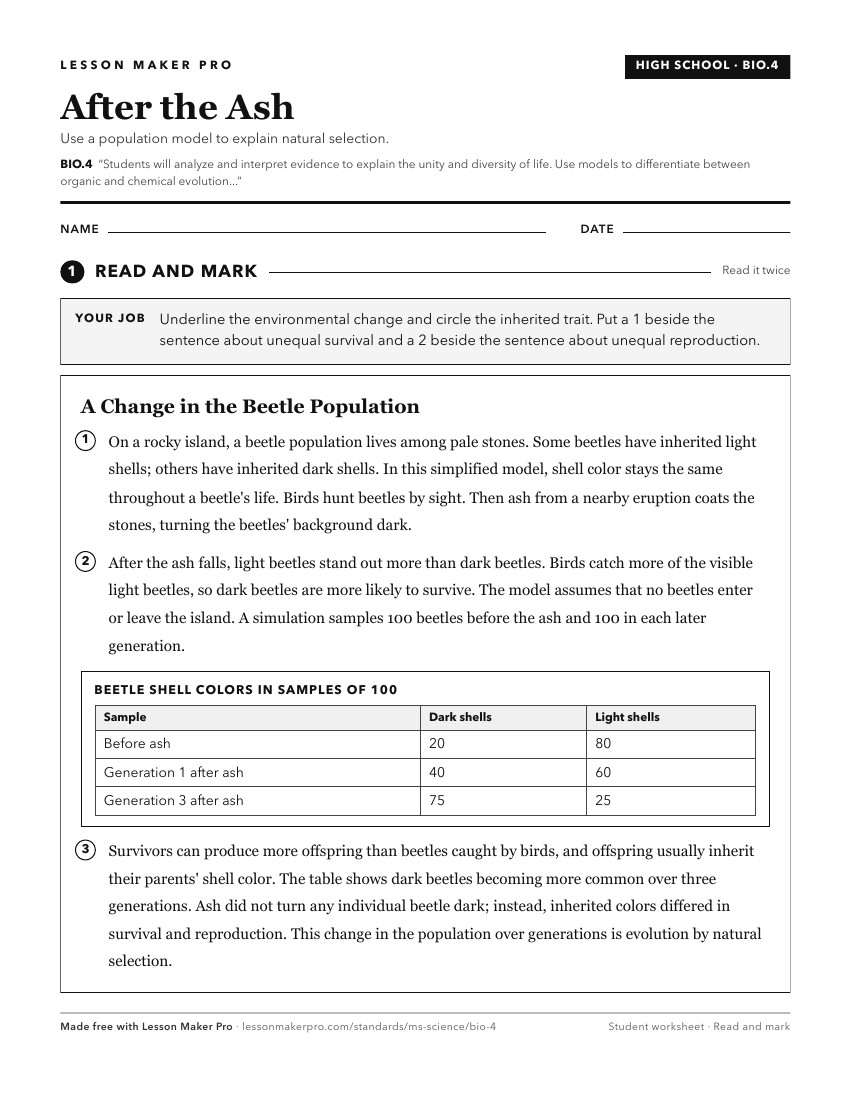
A ready-to-print activity worksheet aligned to BIO.4, with an answer key for the teacher on its own page. No account needed.
PDF, US Letter, prints cleanly in black and white.
Download the worksheetKeep exploring
Related Standards
- L.8.4B
Students will demonstrate an understanding of how similarities and differences among living and extinct species provide evidence that changes have occurred in o...
- BIO.1A
Students will demonstrate an understanding of the characteristics of life and biological organization.
- ENV.1
Students will investigate the interdependence of diverse living organisms and their interactions with the components of the biosphere.
- BIO.5
Students will Investigate and evaluate the interdependence of living organisms and their environment.
Turn this cluster into a lesson
Grade, subject, topic, and the complete cluster are prefilled. Create one free, no account needed.
Also for this cluster:Make a WorksheetMake a QuizMake a Sub Lesson