Mississippi Science ENV.1
Standard Cluster
Students will investigate the interdependence of diverse living organisms and their interactions with the components of the biosphere. Identify, investigate, and evaluate the interactions of the abiotic and biotic factors that determine the types of organisms that live in major biomes. Evaluate evidence in nonfiction text to explain how biological or physical changes within biomes affect populations and communities and how changing conditions may result in altered ecosystems. Use models to explain why the flow of energy through an ecosystem can be illustrated by a pyramid with less energy available at the higher trophic levels compared to lower levels. Describe symbiotic relationships (e.g., mutualism, parasitism, and commensalism) and other co-evolutionary (e.g., predator-prey, cooperation, competition, and mimicry) relationships within specific environments. Develop and use models to diagram the flow of nitrogen, carbon, and phosphorus through the environment. Use mathematics, graphics, and informational text to determine how population density-dependent and density-independent limiting factors affect populations and diversity within ecosystems. Use technology to illustrate and compare a variety of population-growth curves. Analyze and interpret quantitative data to construct explanations of how the carrying capacity of an ecosystem may change as the availability of resources changes. Utilize data to communicate changes within a given population and the environmental factors that may have impacted these changes (e.g., weather patterns, natural disasters) Evaluate and communicate data that explains how human activity may impact biodiversity (e.g., introduction, removal, and reintroduction of an organism within an ecosystem; land usage) and genetic variations of organisms, including endangered and threatened species. Enrichment: Engage in scientific argument from evidence the benefits versus harm of genetically modified organisms.
2026 Mississippi College- and Career-Readiness Standards for Science · Biosphere and Biodiversity
Cluster contents
Standards in This Cluster
ENV.1 is a cluster heading. These are the individual standards under it.
- ENV.1.1
Identify, investigate, and evaluate the interactions of the abiotic and biotic factors that determine the types of organisms that live in major biomes.
- ENV.1.2
Evaluate evidence in nonfiction text to explain how biological or physical changes within biomes affect populations and communities and how changing conditions ...
- ENV.1.3
Use models to explain why the flow of energy through an ecosystem can be illustrated by a pyramid with less energy available at the higher trophic levels compar...
- ENV.1.4
Describe symbiotic relationships (e.g., mutualism, parasitism, and commensalism) and other co-evolutionary (e.g., predator-prey, cooperation, competition, and m...
- ENV.1.5
Develop and use models to diagram the flow of nitrogen, carbon, and phosphorus through the environment.
- ENV.1.6
Use mathematics, graphics, and informational text to determine how population density-dependent and density-independent limiting factors affect populations and ...
- ENV.1.7
Analyze and interpret quantitative data to construct explanations of how the carrying capacity of an ecosystem may change as the availability of resources chang...
- ENV.1.8
Utilize data to communicate changes within a given population and the environmental factors that may have impacted these changes (e.g., weather patterns, natura...
- ENV.1.9
Evaluate and communicate data that explains how human activity may impact biodiversity (e.g., introduction, removal, and reintroduction of an organism within an...
- ENV.1.10
Enrichment: Engage in scientific argument from evidence the benefits versus harm of genetically modified organisms.
Teacher's field guide
What This Cluster Means
What Students Need to Do
- Students use climate, soil, and species data to explain what lives in a biome and how changes affect it. They model energy flow, nutrient cycles, and relationships between organisms. They graph population changes and use evidence to predict how limiting factors and human actions affect biodiversity and genetic variation.
What Mastery Looks Like
- A student can use rainfall and temperature to justify where a species could live and describe its relationship with another species. They can draw an energy pyramid and carbon, nitrogen, and phosphorus cycles without showing energy as recycled. They can read a growth curve, estimate carrying capacity, and use data to explain a population change.
Common Misconceptions
- Students may think energy cycles back to producers or that phosphorus moves mainly through the air. They may label a population peak as carrying capacity and mistake drought for a density-dependent limit. They may call parasitism mutualism or assume one large population means high biodiversity.
How to Assess It
- Before a drought, a pond had 200 frogs and 1,000 insects; afterward, it had 80 frogs and 300 insects. Ask students to identify the density-independent change, explain what likely happened to the pond's carrying capacity for frogs, and predict one effect on herons.
Lesson moves
Ways to Teach It
Use beads and arrow cards to model carbon, nitrogen, and phosphorus cycles, checking each movement against a labeled reference diagram.
Read a short article about invasive zebra mussels; cite two details to explain effects on native mussels and the food web.
Give teams 1,000 energy counters for producers; pass 10% to each higher feeding level and compare the number of counters left.
Compare photos of a meadow before and after paving; predict effects on bird habitat, species diversity, and movement between populations.
Free download
Printable ENV.1 Worksheet
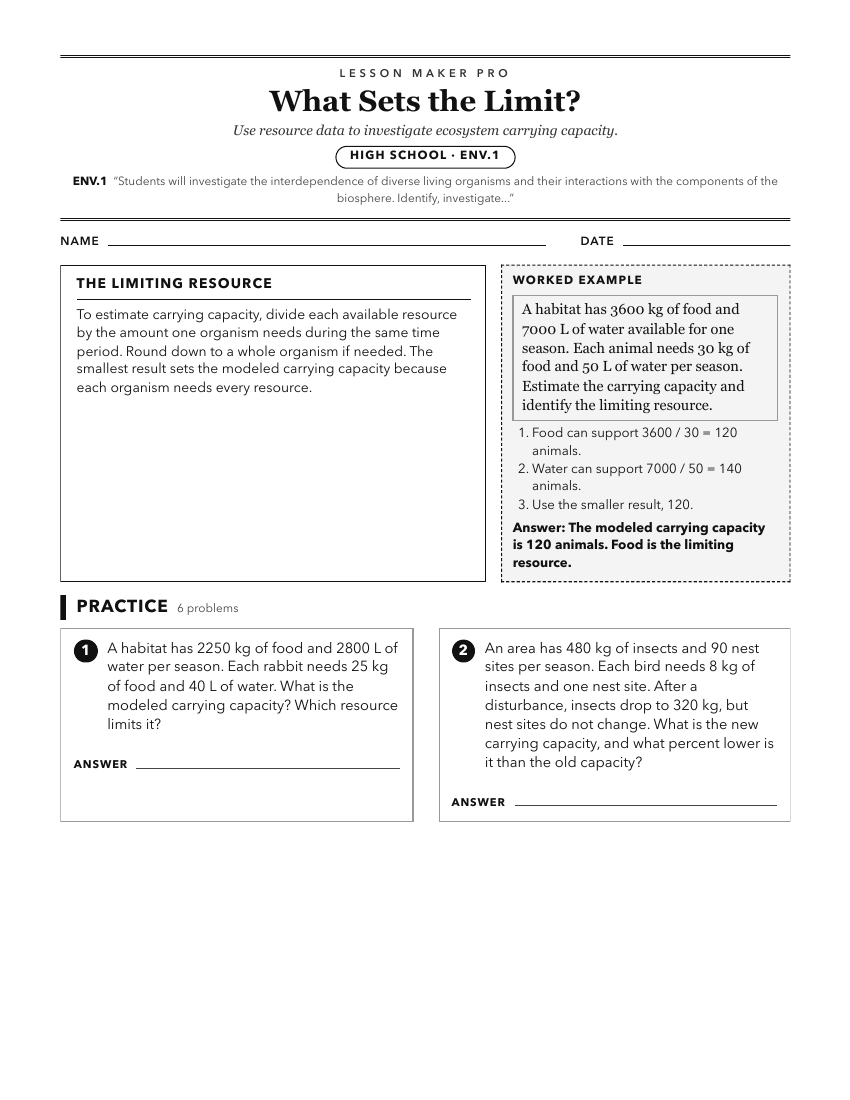
A ready-to-print activity worksheet aligned to ENV.1, with an answer key for the teacher on its own page. No account needed.
PDF, US Letter, prints cleanly in black and white.
Download the worksheetKeep exploring
Related Standards
- L.2.3A
Students will demonstrate an understanding of the interdependence of living things and the environment in which they live.
- BIO.5
Students will Investigate and evaluate the interdependence of living organisms and their environment.
- FB.6
Students will understand the interdependence of living organisms and their environment.
- L.2.3B
Students will demonstrate an understanding of the interdependence of living things.
Turn this cluster into a lesson
Grade, subject, topic, and the complete cluster are prefilled. Create one free, no account needed.
Also for this cluster:Make a WorksheetMake a QuizMake a Sub Lesson