Mississippi Science L.2.3A
Standard Cluster
Students will demonstrate an understanding of the interdependence of living things and the environment in which they live. Evaluate and communicate findings from informational text or other media to describe how animals change and respond to rapid or slow changes in their environment (fire, pollution, changes in tide, availability of food/water). Construct scientific arguments to explain how animals can make major changes (e.g., beaver dams obstruct streams, or large deer populations destroying crops) and minor changes to their environments (e.g., ant hills, crawfish burrows, mole tunnels). Communicate findings.
2026 Mississippi College- and Career-Readiness Standards for Science · Ecology and Interdependence
Cluster contents
Standards in This Cluster
L.2.3A is a cluster heading. These are the individual standards under it.
- L.2.3A.1
Evaluate and communicate findings from informational text or other media to describe how animals change and respond to rapid or slow changes in their environmen...
- L.2.3A.2
Construct scientific arguments to explain how animals can make major changes (e.g., beaver dams obstruct streams, or large deer populations destroying crops) an...
Teacher's field guide
What This Cluster Means
What Students Need to Do
- Students use books, pictures, or videos to explain how animals respond when their surroundings change quickly or slowly. They also explain how animals change a place, from small ant hills to large beaver dams.
What Mastery Looks Like
- A student explains how a rabbit might respond to a fire or a crab to a changing tide, using a detail from a text or picture. They explain how a beaver dam changes a stream and how an ant hill changes the ground.
Common Misconceptions
- Students may think all animals respond to a fire in the same way. They may mistake a beaver dam for a natural pile of sticks or think an ant hill changes an entire forest.
How to Assess It
- Show pictures of a burned meadow and a beaver dam. Ask, 'How might a rabbit respond to the fire, and what did the beaver change? Point to a clue in each picture.'
Lesson moves
Ways to Teach It
Shape a stream in a sand tray, block it with twigs, then pour water and sketch where it collects.
Show high- and low-tide photos, then ask students to write where a crab could hide at low tide and cite a photo clue.
Deal pairs cards showing fire, a shrinking pond, ant hills, and beaver dams; sort them into sudden, slow, and animal-made changes.
Check the schoolyard for ant hills, spiderwebs, or bird nests; sketch one and label what the animal changed.
Free download
Printable L.2.3A Worksheet
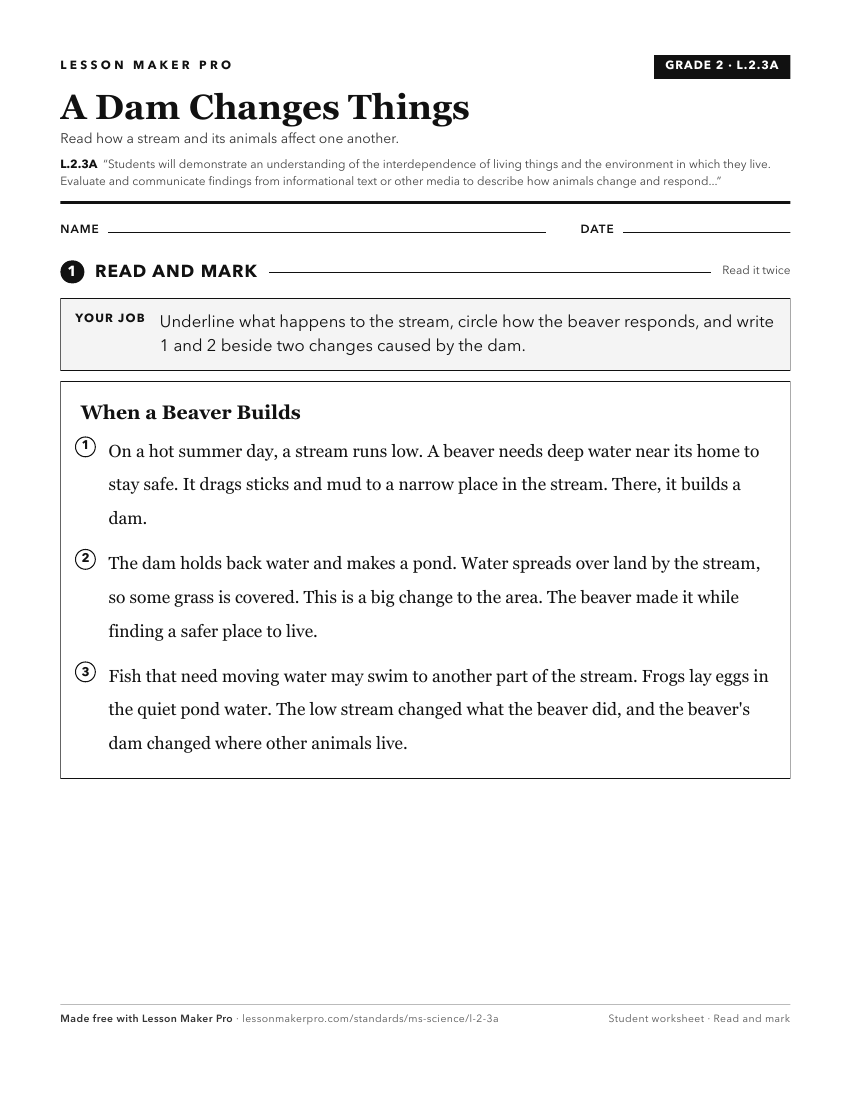
A ready-to-print activity worksheet aligned to L.2.3A, with an answer key for the teacher on its own page. No account needed.
PDF, US Letter, prints cleanly in black and white.
Download the worksheetKeep exploring
Related Standards
- ENV.4
Students will demonstrate an understanding of the interdependence of human sustainability and the environment.
- BIO.5
Students will Investigate and evaluate the interdependence of living organisms and their environment.
- FB.6
Students will understand the interdependence of living organisms and their environment.
- L.2.3B
Students will demonstrate an understanding of the interdependence of living things.
Turn this cluster into a lesson
Grade, subject, topic, and the complete cluster are prefilled. Create one free, no account needed.
Also for this cluster:Make a WorksheetMake a QuizMake a Sub Lesson