Mississippi Science L.2.3B
Standard Cluster
Students will demonstrate an understanding of the interdependence of living things. Evaluate and communicate findings from informational text or other media to describe and to compare how animals interact with other animals and plants in the environment (i.e., predator-prey relationships, herbivore, carnivore, omnivore). Conduct an investigation to find evidence where plants and animals compete or cooperate with other plants and animals for food or space. Present findings (i.e., using technology or models).
2026 Mississippi College- and Career-Readiness Standards for Science · Ecology and Interdependence
Cluster contents
Standards in This Cluster
L.2.3B is a cluster heading. These are the individual standards under it.
- L.2.3B.1
Evaluate and communicate findings from informational text or other media to describe and to compare how animals interact with other animals and plants in the en...
- L.2.3B.2
Conduct an investigation to find evidence where plants and animals compete or cooperate with other plants and animals for food or space. Present findings (i.e.,...
Teacher's field guide
What This Cluster Means
What Students Need to Do
- Students use a short text or picture to compare how living things get food and interact. They identify animals that eat plants, animals, or both. They look for evidence that plants or animals compete for space or food, then show what they found in a labeled sketch.
What Mastery Looks Like
- A student can label a rabbit that eats grass, an owl that eats mice, and a bear that eats berries and fish by their diets. They can use a detail from a text or picture to explain how a bee helps a flower, then compare that interaction with an owl eating a mouse. They can point to overlapping leaves as a clue that plants may compete for light.
Common Misconceptions
- Students may call a bear a carnivore after seeing it eat fish, forgetting that it also eats plants. They may think a bee only takes nectar, missing that it carries pollen between flowers. They may assume plants growing close together help each other rather than compete for light and space.
How to Assess It
- Show two picture captions: “A bee takes nectar and carries pollen to another flower” and “An owl eats a mouse.” Ask students to explain how the interactions differ and use one detail from each caption as evidence.
Lesson moves
Ways to Teach It
Place a paper square on a crowded patch of grass, then sketch leaves that overlap and shade other leaves.
Read a short passage about bees and flowers, then ask: What does each get, and which detail tells you?
Sort picture cards of a rabbit eating grass, an owl eating a mouse, and a bear eating berries and fish; explain each choice.
Use a photo of birds at a feeder, circle their shared food, and explain why the birds might compete for seeds.
Free download
Printable L.2.3B Worksheet
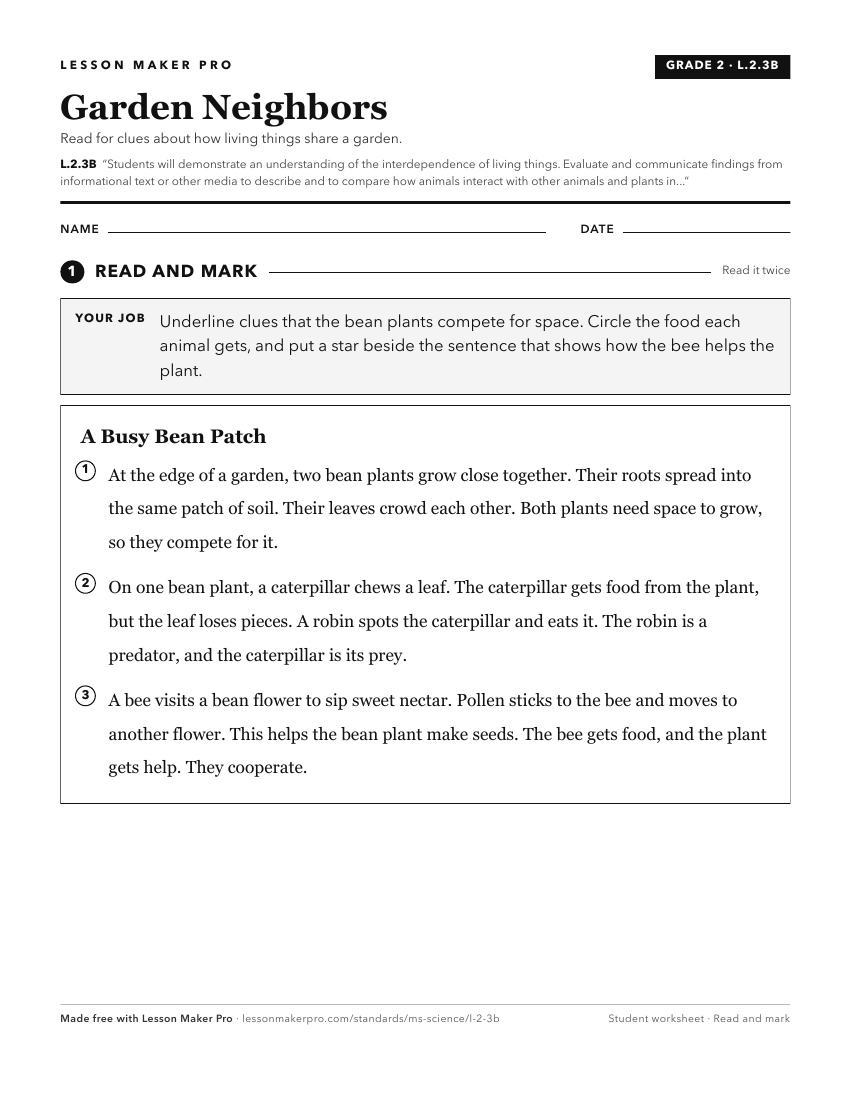
A ready-to-print activity worksheet aligned to L.2.3B, with an answer key for the teacher on its own page. No account needed.
PDF, US Letter, prints cleanly in black and white.
Download the worksheetKeep exploring
Related Standards
- L.2.3A
Students will demonstrate an understanding of the interdependence of living things and the environment in which they live.
- L.K.1A
Students will demonstrate an understanding of living and non-living things.
- BIO.5
Students will Investigate and evaluate the interdependence of living organisms and their environment.
- FB.6
Students will understand the interdependence of living organisms and their environment.
Turn this cluster into a lesson
Grade, subject, topic, and the complete cluster are prefilled. Create one free, no account needed.
Also for this cluster:Make a WorksheetMake a QuizMake a Sub Lesson