Mississippi Science BIO.5
Standard Cluster
Students will Investigate and evaluate the interdependence of living organisms and their environment. Illustrate levels of ecological hierarchy, including organism, population, community, ecosystem, biome, and biosphere. Analyze models of the cycling of matter (e.g., carbon, nitrogen, phosphorus, and water) between abiotic and biotic factors in an ecosystem and evaluate the ability of these cycles to maintain the health and sustainability of the ecosystem. Analyze and interpret quantitative data to construct an explanation for the effects of greenhouse gases on the carbon dioxide cycle and global climate. Develop and use models to describe the flow of energy and amount of biomass through food chains, food webs, and food pyramids. Evaluate symbiotic relationships (e.g., mutualism, parasitism, and commensalism) and other co-evolutionary (e.g., predator-prey, cooperation, competition, and mimicry) relationships within specific environments. Analyze and interpret population data to define limiting factors, both density-dependent and density-independent. Use graphical representations (growth curves) to illustrate the carrying capacity within ecosystems. Investigate and evaluate factors involved in primary and secondary ecological succession using local, real-world examples. Enrichment: Use an engineering design process to create a solution that addresses changing ecological conditions (e.g., climate change, invasive species, loss of biodiversity, human population growth, habitat destruction, biomagnification, or natural phenomena). * Enrichment: Use an engineering design process to investigate and model current technological uses of biomimicry to address solutions to real-world problems. *
2026 Mississippi College- and Career-Readiness Standards for Science · Interdependence of Organisms and Their Environments
Cluster contents
Standards in This Cluster
BIO.5 is a cluster heading. These are the individual standards under it.
- BIO.5.1
Illustrate levels of ecological hierarchy, including organism, population, community, ecosystem, biome, and biosphere.
- BIO.5.2
Analyze models of the cycling of matter (e.g., carbon, nitrogen, phosphorus, and water) between abiotic and biotic factors in an ecosystem and evaluate the abil...
- BIO.5.3
Analyze and interpret quantitative data to construct an explanation for the effects of greenhouse gases on the carbon dioxide cycle and global climate.
- BIO.5.4
Develop and use models to describe the flow of energy and amount of biomass through food chains, food webs, and food pyramids.
- BIO.5.5
Evaluate symbiotic relationships (e.g., mutualism, parasitism, and commensalism) and other co-evolutionary (e.g., predator-prey, cooperation, competition, and m...
- BIO.5.6
Analyze and interpret population data to define limiting factors, both density-dependent and density-independent. Use graphical representations (growth curves) ...
- BIO.5.7
Investigate and evaluate factors involved in primary and secondary ecological succession using local, real-world examples.
- BIO.5.8
Enrichment: Use an engineering design process to create a solution that addresses changing ecological conditions (e.g., climate change, invasive species, loss o...
- BIO.5.9
Enrichment: Use an engineering design process to investigate and model current technological uses of biomimicry to address solutions to real-world problems. *
Teacher's field guide
What This Cluster Means
What Students Need to Do
- Students identify ecological levels and trace carbon, nitrogen, phosphorus, and water through living and nonliving parts of ecosystems. They model energy flow and biomass in food webs. They use climate and population data to explain greenhouse gases and carrying capacity, then examine species relationships and succession.
What Mastery Looks Like
- A student can label a pond food web, trace carbon into plants, and explain why herons have less biomass than fish. They can estimate carrying capacity from a graph and name a factor that could lower it. They can distinguish mutualism from parasitism and regrowth after fire from growth on bare rock.
Common Misconceptions
- Students may confuse a population with a community or think energy cycles like matter. They may assume predators have the most biomass or that carrying capacity never changes. They may call regrowth after a fire primary succession.
How to Assess It
- Draw algae → insects → fish → heron and a fish population curve that levels off at 80. Ask students to mark where carbon enters, explain why biomass decreases up the chain, estimate carrying capacity, and name a factor that could lower it.
Lesson moves
Ways to Teach It
Give groups organism cards and yarn to build a pond food web, then use 1,000, 100, and 10 gram cards to stack biomass.
Ask students to write a carbon atom's route from air to grass to rabbit to soil, then explain what burning fuel adds to the air.
Hand out three population graphs and have pairs match each to drought, disease, or scarce food, defending each match with the curve.
Bring photos of a recently cleared local lot and a bare rock face; ask which site already has soil and will regrow faster.
Free download
Printable BIO.5 Worksheet
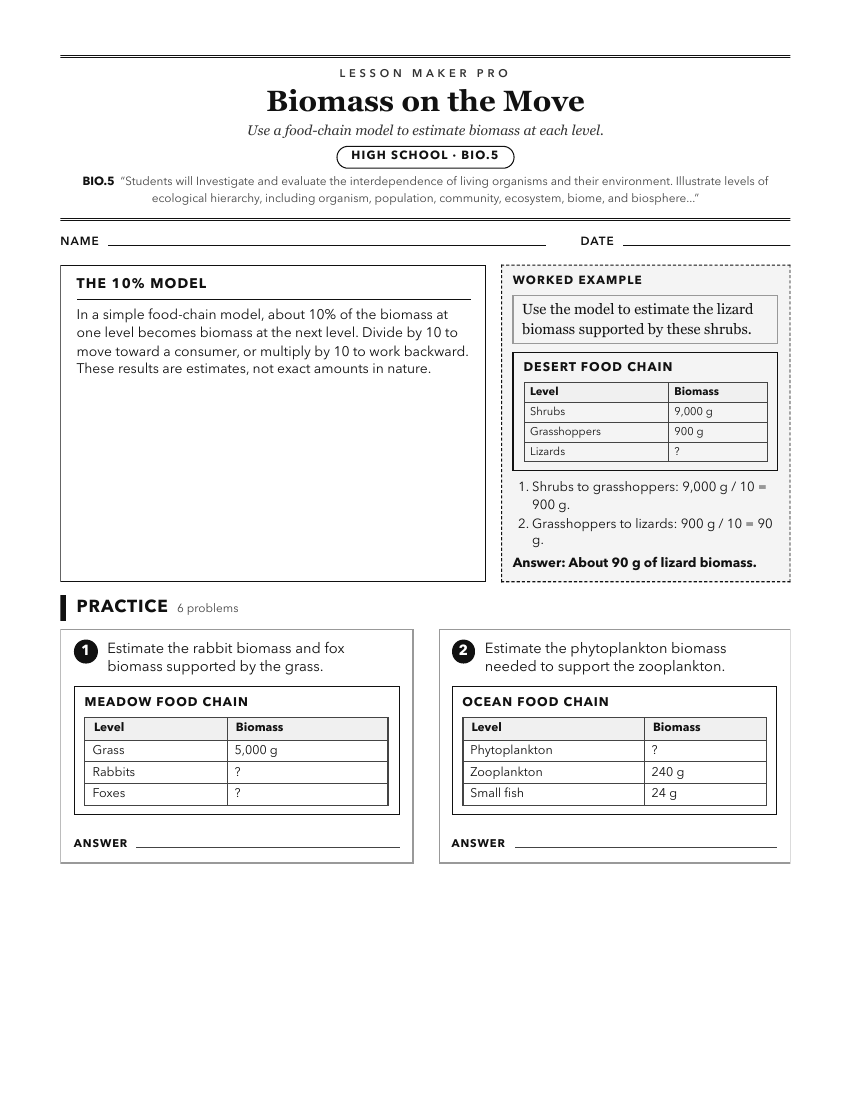
A ready-to-print activity worksheet aligned to BIO.5, with an answer key for the teacher on its own page. No account needed.
PDF, US Letter, prints cleanly in black and white.
Download the worksheetKeep exploring
Related Standards
- L.2.3A
Students will demonstrate an understanding of the interdependence of living things and the environment in which they live.
- ENV.1
Students will investigate the interdependence of diverse living organisms and their interactions with the components of the biosphere.
- FB.6
Students will understand the interdependence of living organisms and their environment.
- L.2.3B
Students will demonstrate an understanding of the interdependence of living things.
Turn this cluster into a lesson
Grade, subject, topic, and the complete cluster are prefilled. Create one free, no account needed.
Also for this cluster:Make a WorksheetMake a QuizMake a Sub Lesson