Mississippi Science BIO.5.3
The Standard
- BIO.5
- Students will Investigate and evaluate the interdependence of living organisms and their environment.
Analyze and interpret quantitative data to construct an explanation for the effects of greenhouse gases on the carbon dioxide cycle and global climate.
2026 Mississippi College- and Career-Readiness Standards for Science · Interdependence of Organisms and Their Environments
Teacher's field guide
What This Standard Means
What Students Need to Do
- Students compare carbon dioxide and temperature data across years. They use the numbers to explain how added greenhouse gases warm Earth and how warming can change carbon uptake and release.
What Mastery Looks Like
- A student can calculate changes in CO2 concentration and temperature from a table and cite both numbers in an explanation. They can explain why a warmer ocean may absorb less CO2, leaving more in the atmosphere.
Common Misconceptions
- Students may think CO2 warms Earth by destroying the ozone layer. They may also treat the carbon cycle as a one-way path or assume every rise in atmospheric CO2 comes from natural sources.
How to Assess It
- Exit ticket: Atmospheric CO2 rose from 280 to 420 ppm, global temperature rose 1.2°C, and a model ocean absorbed 4 carbon units when cool but 2 when warm. Calculate the CO2 increase, then explain how CO2 affects temperature and how warming affects ocean uptake.
Lesson moves
Ways to Teach It
Move ten carbon counters to an atmosphere mat, then shift four to a cool-ocean mat or two to a warm-ocean mat.
Show pairs a CO2 and temperature graph; ask, "Which numbers show warming, and what can this graph alone not prove?"
Play a carbon budget card game: draw emission and uptake cards, update atmospheric totals, and identify the round with the largest increase.
Use a household electric bill and a utility emissions rate to calculate CO2 released, then label its path on a carbon cycle diagram.
Free download
Printable BIO.5.3 Worksheet
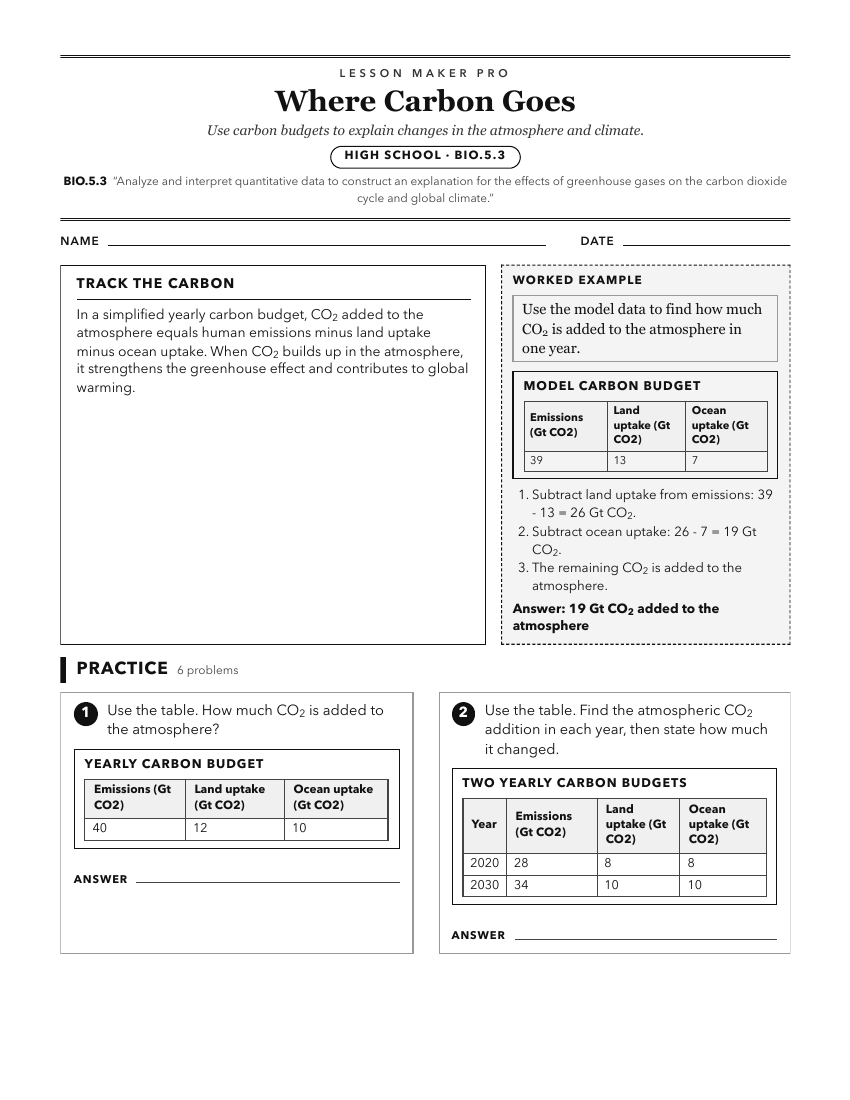
A ready-to-print activity worksheet aligned to BIO.5.3, with an answer key for the teacher on its own page. No account needed.
PDF, US Letter, prints cleanly in black and white.
Download the worksheetKeep exploring
Related Standards
- ENV.1.7
Analyze and interpret quantitative data to construct explanations of how the carrying capacity of an ecosystem may change as the availability of resources chang...
- ESS.3.6
Construct an explanation from data sets to obtain and evaluate scientific information to construct scientific arguments on changes in climate caused by various ...
- ENV.3.1
Use a model to describe cycling of carbon through the ocean, atmosphere, soil, and biosphere and how increases in carbon dioxide concentrations have resulted in...
- E.7.9B.2
Interpret data about the relationship between the release of carbon dioxide from burning fossil fuels into the atmosphere and the presence of greenhouse gases.
Turn this exact standard into a lesson
Grade, subject, topic, and the complete standard are prefilled. Create one free, no account needed.
Also for this standard:Make a WorksheetMake a QuizMake a Sub Lesson