Mississippi Science E.7.9B.2
The Standard
- E.7.9B
- Students will demonstrate an understanding of the relationship between natural phenomena, human activity, and global climate change.
Interpret data about the relationship between the release of carbon dioxide from burning fossil fuels into the atmosphere and the presence of greenhouse gases.
2026 Mississippi College- and Career-Readiness Standards for Science · Earth’s Systems and Cycles
Teacher's field guide
What This Standard Means
What Students Need to Do
- Students read data on fossil fuel CO2 emissions and CO2 levels in the air. They describe how both change over time. They recognize that CO2 is a greenhouse gas.
What Mastery Looks Like
- A student uses dates and numbers from a table to describe the trend in each measure. They explain that yearly emissions differ from the CO2 already in the air, and that CO2 data do not show whether methane changed.
Common Misconceptions
- Students may think CO2 is separate from greenhouse gases. They may mistake yearly emissions for the amount already in the air or assume that rising CO2 means every greenhouse gas is rising.
How to Assess It
- Exit ticket: In 2000, fossil fuel CO2 emissions were 25 billion tons and atmospheric CO2 was 370 parts per million. In 2019, they were 36 billion tons and 411 parts per million. Describe what changed, and identify which numbers measure CO2 already in the air.
Lesson moves
Ways to Teach It
Give pairs cards with the exit ticket's years and four measurements; have them assemble a table and mark the trend in each column.
Show the exit ticket data and ask, "Does this prove methane increased too? What evidence would you need?"
Play evidence or guess: students hold up E or G for claims about the exit ticket data, then cite a number.
Show a sample gas bill with 30 and 60 therms in two months; ask which month's gas use likely released more CO2.
Free download
Printable E.7.9B.2 Worksheet
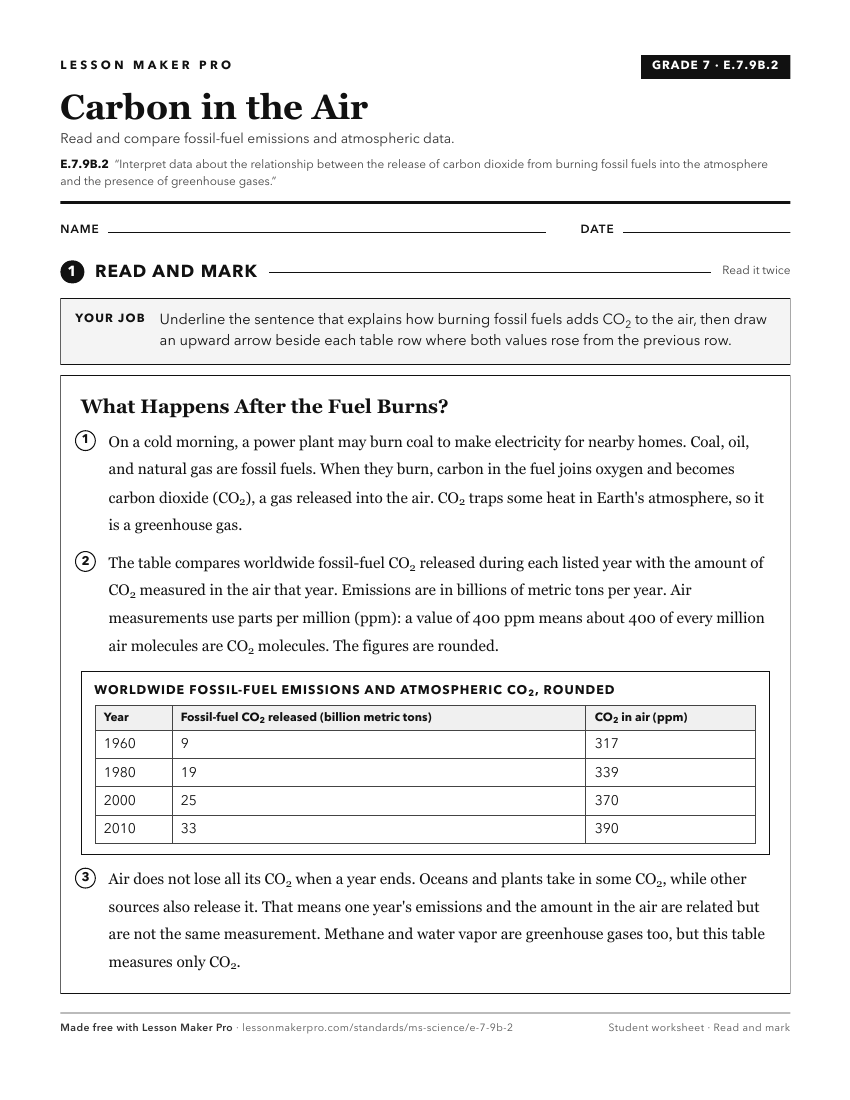
A ready-to-print activity worksheet aligned to E.7.9B.2, with an answer key for the teacher on its own page. No account needed.
PDF, US Letter, prints cleanly in black and white.
Download the worksheetKeep exploring
Related Standards
- BIO.5.3
Analyze and interpret quantitative data to construct an explanation for the effects of greenhouse gases on the carbon dioxide cycle and global climate.
- ESS.3.6
Construct an explanation from data sets to obtain and evaluate scientific information to construct scientific arguments on changes in climate caused by various ...
- ENV.3.2
Interpret data and climate models to predict how global and regional climate change can affect Earth’s systems (e.g., precipitation, temperature, impacts on sea...
- ENV.3.1
Use a model to describe cycling of carbon through the ocean, atmosphere, soil, and biosphere and how increases in carbon dioxide concentrations have resulted in...
Turn this exact standard into a lesson
Grade, subject, topic, and the complete standard are prefilled. Create one free, no account needed.
Also for this standard:Make a WorksheetMake a QuizMake a Sub Lesson