Mississippi Science ENV.4
Standard Cluster
Students will demonstrate an understanding of the interdependence of human sustainability and the environment. Identify human impact and develop a solution for protection of the atmosphere, considering pollutants (e.g., acid rain, air pollution, smog, ozone layer, or increased levels of greenhouse gases) and the impacts of pollutants on human health (e.g., asthma, COPD, emphysema, and cancer). Evaluate data and other information to explain how key natural resources (e.g., water sources, fertile soils, concentrations of minerals, and fossil fuels), natural hazards, and climate changes influence human activity (e.g., mass migrations, human health). Enrichment: Research and analyze case studies to determine the impact of human-related and natural environmental changes on human health and communicate possible solutions to reduce/resolve the dilemma. Enrichment: Explore online resources related to air pollution to determine air quality in a geographic area and communicate the possible effects on the environment and human health. Enrichment: Use an engineering design process to define a problem, design, construct, evaluate, and improve a device or method to reduce or prevent human impact on a natural resource (e.g., build a water filter, design an air purifier, develop a method to prevent parking lot pollution from entering a watershed).*
2026 Mississippi College- and Career-Readiness Standards for Science · Human Sustainability
Cluster contents
Standards in This Cluster
ENV.4 is a cluster heading. These are the individual standards under it.
- ENV.4.1
Identify human impact and develop a solution for protection of the atmosphere, considering pollutants (e.g., acid rain, air pollution, smog, ozone layer, or inc...
- ENV.4.2
Evaluate data and other information to explain how key natural resources (e.g., water sources, fertile soils, concentrations of minerals, and fossil fuels), nat...
- ENV.4.3
Enrichment: Research and analyze case studies to determine the impact of human-related and natural environmental changes on human health and communicate possibl...
- ENV.4.4
Enrichment: Explore online resources related to air pollution to determine air quality in a geographic area and communicate the possible effects on the environm...
- ENV.4.5
Enrichment: Use an engineering design process to define a problem, design, construct, evaluate, and improve a device or method to reduce or prevent human impact...
Teacher's field guide
What This Cluster Means
What Students Need to Do
- Students trace how air pollution affects health. They use maps and data to explain how water supplies, natural hazards, and climate changes affect where people live and work. They propose a practical way to reduce pollution or protect a resource.
What Mastery Looks Like
- A student can explain how traffic emissions help form ground-level ozone, which can worsen asthma. They can use a drought or flood map to explain why people might move, without claiming the map proves why they moved. They can propose a workable fix and name one limit.
Common Misconceptions
- Students may confuse harmful ground-level ozone with the protective ozone layer. They may think water that looks clear is safe to drink. They may assume that a link between pollution and illness proves pollution caused every illness.
How to Assess It
- Exit ticket: Town A has 35 µg/m³ of PM2.5 and 12 asthma visits per 1,000 people; Town B has 8 µg/m³ and 4 visits per 1,000. Ask students to compare the towns, name a possible pollution source, propose an emissions fix, and explain why the numbers alone do not prove cause.
Lesson moves
Ways to Teach It
Build a gravel, sand, and coffee-filter column; compare muddy water before and after, then explain why clearer water may still be unsafe.
Show a drought map and a flood-risk map; ask, “Where would you build homes, and how would water supplies affect your choice?”
Give pairs cards labeled traffic, exhaust gases, sunlight, ground-level ozone, and asthma; have them arrange and explain a cause-and-effect chain.
Open the local AirNow AQI report; have students write a two-sentence asthma advisory and name one way to cut vehicle emissions.
Free download
Printable ENV.4 Worksheet
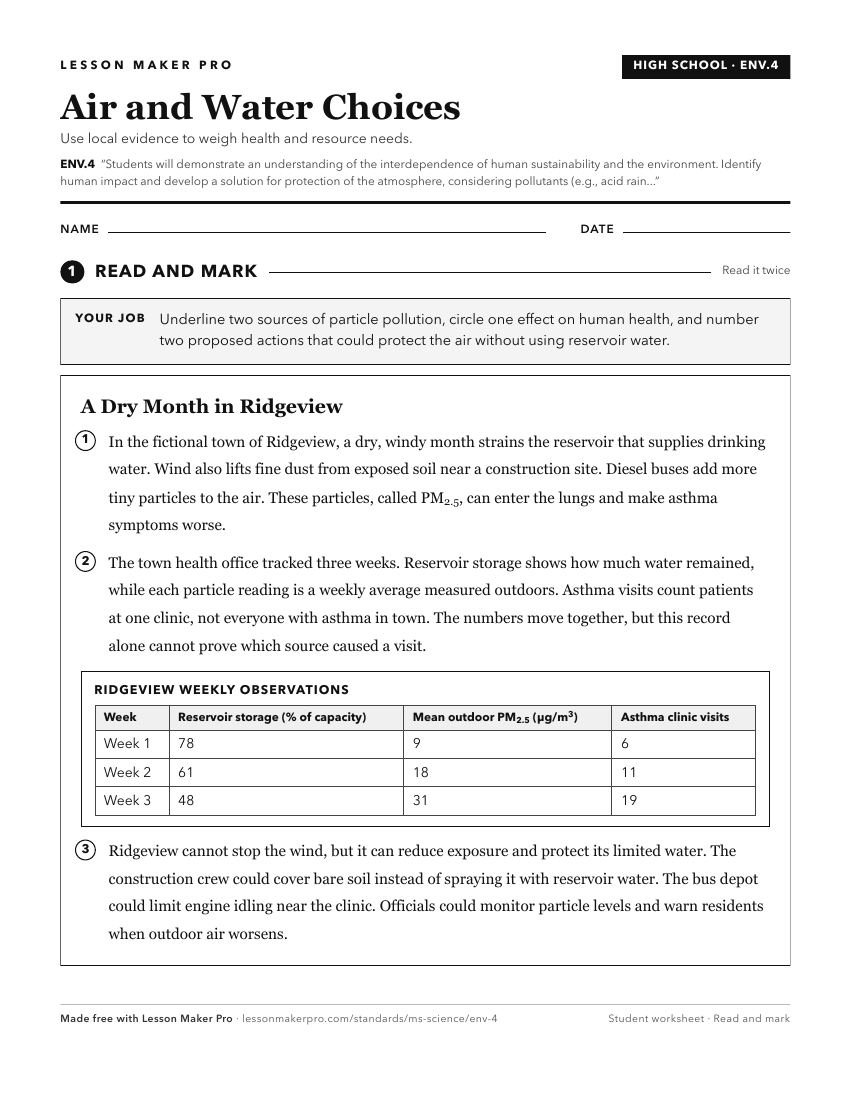
A ready-to-print activity worksheet aligned to ENV.4, with an answer key for the teacher on its own page. No account needed.
PDF, US Letter, prints cleanly in black and white.
Download the worksheetKeep exploring
Related Standards
- L.2.3A
Students will demonstrate an understanding of the interdependence of living things and the environment in which they live.
- E.2.10
Students will demonstrate an understanding of how humans use Earth’s resources.
- FB.6
Students will understand the interdependence of living organisms and their environment.
- L.2.3B
Students will demonstrate an understanding of the interdependence of living things.
Turn this cluster into a lesson
Grade, subject, topic, and the complete cluster are prefilled. Create one free, no account needed.
Also for this cluster:Make a WorksheetMake a QuizMake a Sub Lesson