Mississippi Science E.2.10
Standard Cluster
Students will demonstrate an understanding of how humans use Earth’s resources. Use informational text, other media, and first-hand observations to investigate, analyze, and compare the properties of Earth materials (including rocks, soils, sand, and water). Conduct an investigation to identify and classify everyday objects that are resources from the Earth (e.g., drinking water, granite countertops, clay dishes, wood furniture, or gas grill). Classify these objects as renewable and nonrenewable resources. Use informational text and other media to summarize and communicate how Earth materials are used (e.g., soil and water to grow plants; rocks to make roads, walls, or buildings; or sand to make glass). Use informational text, other media, and first-hand observations to investigate and communicate the process and consequences of soil erosion. With teacher guidance, investigate possible solutions to prevent or repair soil erosion.
2026 Mississippi College- and Career-Readiness Standards for Science · Earth’s Resources
Cluster contents
Standards in This Cluster
E.2.10 is a cluster heading. These are the individual standards under it.
- E.2.10.1
Use informational text, other media, and first-hand observations to investigate, analyze, and compare the properties of Earth materials (including rocks, soils,...
- E.2.10.2
Conduct an investigation to identify and classify everyday objects that are resources from the Earth (e.g., drinking water, granite countertops, clay dishes, wo...
- E.2.10.3
Use informational text and other media to summarize and communicate how Earth materials are used (e.g., soil and water to grow plants; rocks to make roads, wall...
- E.2.10.4
Use informational text, other media, and first-hand observations to investigate and communicate the process and consequences of soil erosion.
- E.2.10.5
With teacher guidance, investigate possible solutions to prevent or repair soil erosion.
Teacher's field guide
What This Cluster Means
What Students Need to Do
- Students compare rocks, soil, sand, and water by observing their properties. They identify the Earth materials in everyday objects and sort those materials as renewable or nonrenewable. They observe how water moves soil and test a way to keep it in place.
What Mastery Looks Like
- A student can explain that sand is used to make glass and that soil and water help plants grow. They identify wood as renewable when trees are regrown and granite as nonrenewable. They can show how water carries soil off bare ground and how a cover can slow it.
Common Misconceptions
- Students may think glass does not come from Earth because it is made in a factory. They may call rock renewable because more rocks exist. They may think eroded soil disappears rather than moving somewhere else.
How to Assess It
- Show pictures of a wooden chair, a granite counter, and muddy water running off bare soil. Ask students to name the chair’s and counter’s source materials, label each renewable or nonrenewable, and sketch one way to keep the soil in place.
Lesson moves
Ways to Teach It
Shape two soil slopes in foil pans, cover one with grass clippings, pour equal amounts of water over both, and compare the runoff.
Show a glass cup and wooden spoon; ask students to write their source materials and explain which can be replaced by growing more.
Sort picture cards of wooden chairs, granite counters, drinking water, and clay bowls; name each source and label it renewable or nonrenewable.
Walk the school grounds with a checklist for stone paths, wooden benches, and garden soil; note what each material is used for.
Free download
Printable E.2.10 Worksheet
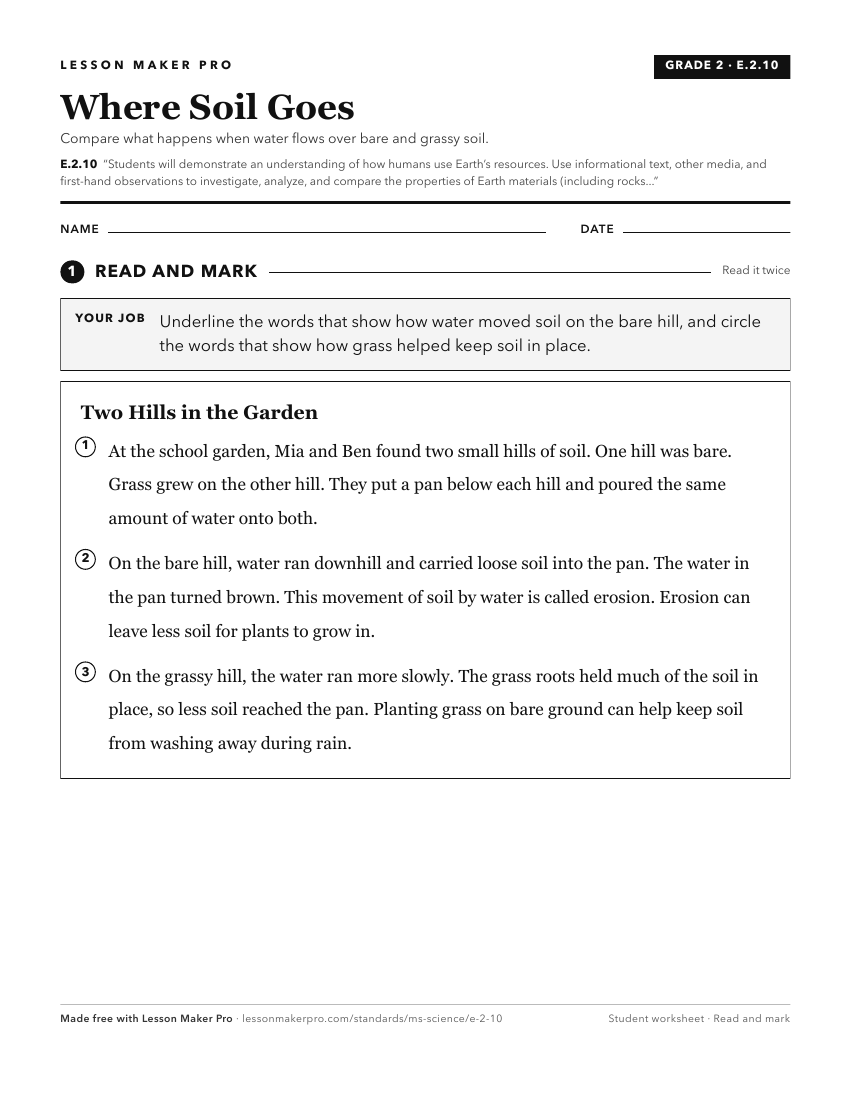
A ready-to-print activity worksheet aligned to E.2.10, with an answer key for the teacher on its own page. No account needed.
PDF, US Letter, prints cleanly in black and white.
Download the worksheetKeep exploring
Related Standards
- ENV.4
Students will demonstrate an understanding of the interdependence of human sustainability and the environment.
- E.5.10
Students will demonstrate an understanding of the effects of human interaction with Earth and how Earth’s natural resources can be protected and conserved.
- E.K.10
The Kindergarten version of this standard.
- ESS.4
Students will develop an understanding of Earth’s resources and the impact of human activities.
Turn this cluster into a lesson
Grade, subject, topic, and the complete cluster are prefilled. Create one free, no account needed.
Also for this cluster:Make a WorksheetMake a QuizMake a Sub Lesson