Mississippi Science E.2.10.2
The Standard
- E.2.10
- Students will demonstrate an understanding of how humans use Earth’s resources.
Conduct an investigation to identify and classify everyday objects that are resources from the Earth (e.g., drinking water, granite countertops, clay dishes, wood furniture, or gas grill). Classify these objects as renewable and nonrenewable resources.
2026 Mississippi College- and Career-Readiness Standards for Science · Earth’s Resources
Teacher's field guide
What This Standard Means
What Students Need to Do
- Students identify Earth materials in everyday objects, such as wood in a chair or stone in a counter. They sort the materials by whether nature can replace them quickly.
What Mastery Looks Like
- A student identifies wood in a chair and granite in a counter. They classify wood and water as renewable, and granite and clay as nonrenewable. They explain that trees can grow back, but granite forms too slowly to replace.
Common Misconceptions
- Students may think a metal spoon is renewable because it can be recycled. They may call wood nonrenewable because a cut tree is gone, or assume renewable water can never run out.
How to Assess It
- On an exit ticket, have students label water, a wooden chair, and a granite countertop renewable or nonrenewable. Ask them to explain one choice.
Lesson moves
Ways to Teach It
Set out a wood block, clay pot, stone, and cup of water; have pairs sort them by how quickly nature replaces each material.
Ask partners why trees can replace the wood in a chair but granite cannot be replaced as quickly.
Give pairs picture cards of a paper bag, metal spoon, clay dish, and drinking water to sort, then ask them to explain their choices.
Show a photo of a granite counter and wooden table; have students name each material and decide which nature replaces faster.
Free download
Printable E.2.10.2 Worksheet
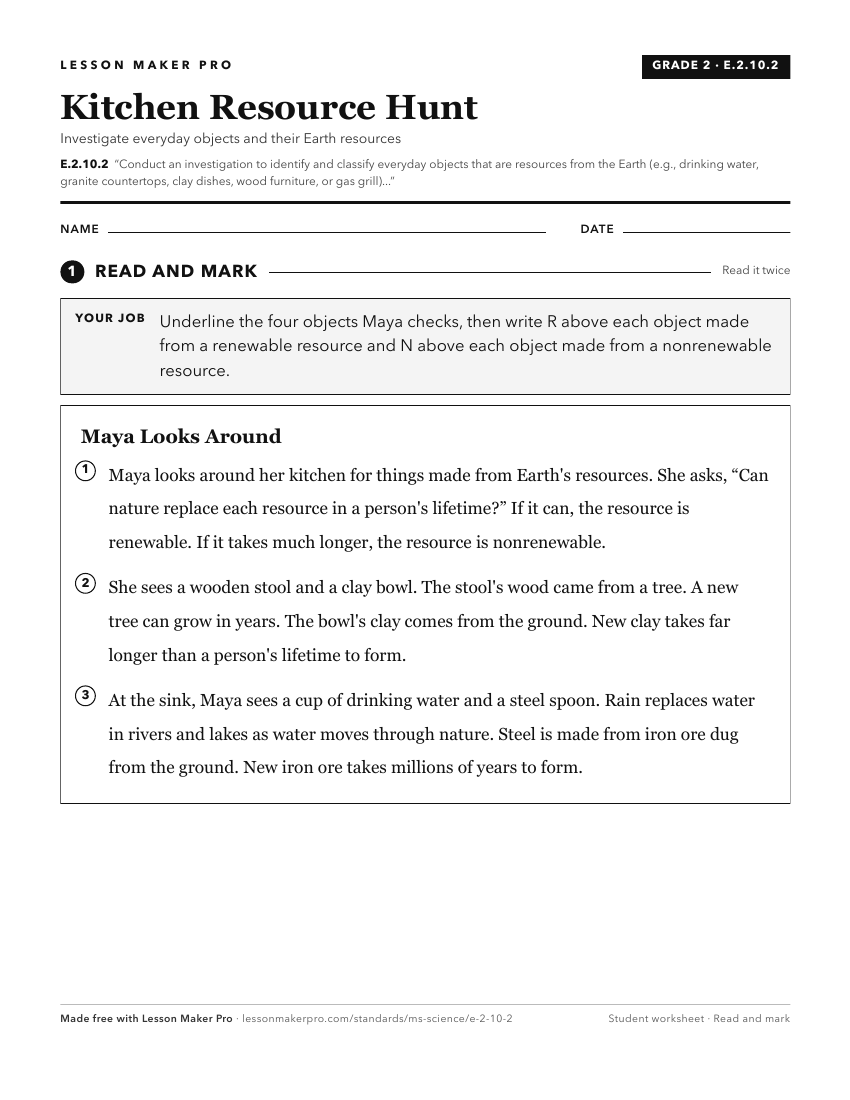
A ready-to-print activity worksheet aligned to E.2.10.2, with an answer key for the teacher on its own page. No account needed.
PDF, US Letter, prints cleanly in black and white.
Download the worksheetKeep exploring
Related Standards
- E.K.10.2
With teacher guidance, develop questions to conduct a structured investigation to determine ways to conserve Earth's resources (i.e., reduce, reuse, and recycle...
- E.3.10.2
Obtain and communicate information to exemplify how humans attain, use, and protect renewable and nonrenewable Earth resources.
- E.3.10.1
Identify some of Earth's resources that are used in everyday life such as water, wind, soil, forests, oil, natural gas, and minerals and classify as renewable o...
- ENV.2.1
Differentiate between renewable and nonrenewable resources and compare and contrast the pros and cons of using these resources.
Turn this exact standard into a lesson
Grade, subject, topic, and the complete standard are prefilled. Create one free, no account needed.
Also for this standard:Make a WorksheetMake a QuizMake a Sub Lesson