Mississippi Science ENV.2.1
The Standard
- ENV.2
- Students will relate the impact of human activities on the environment, conservation activities, and efforts to maintain and restore ecosystems.
Differentiate between renewable and nonrenewable resources and compare and contrast the pros and cons of using these resources.
2026 Mississippi College- and Career-Readiness Standards for Science · Natural Resources Use and Conservation
Teacher's field guide
What This Standard Means
What Students Need to Do
- Students sort resources by whether nature can replace them on a human timescale. They compare benefits and drawbacks of using each, such as cost, reliability, pollution, and land use.
What Mastery Looks Like
- A student identifies sunlight and sustainably harvested timber as renewable, and coal and natural gas as nonrenewable. They explain that solar power depends on daylight, while natural gas can supply power on demand but releases carbon dioxide.
Common Misconceptions
- Students may think renewable means unlimited or harmless, even though trees can be cut faster than they regrow. They may think coal is renewable because it came from plants, or assume solar panels generate power at night.
How to Assess It
- Exit ticket: Sort sunlight, coal, sustainably harvested timber, and natural gas by whether they can be replaced on a human timescale. Choose one from each group and give one benefit and one drawback of using it.
Lesson moves
Ways to Teach It
Give pairs cards for sunlight, sustainably harvested timber, coal, and oil; have them sort by replacement time and note one cost of using each.
Ask: Should our school use solar panels or natural gas? Write one benefit and one drawback of each.
Play a resource clue game: read 'forms over millions of years' or 'replanted after harvest'; teams name a resource and defend its category.
Use a local utility's fuel-mix chart; students circle renewable sources, underline nonrenewable sources, and name a tradeoff for each.
Free download
Printable ENV.2.1 Worksheet
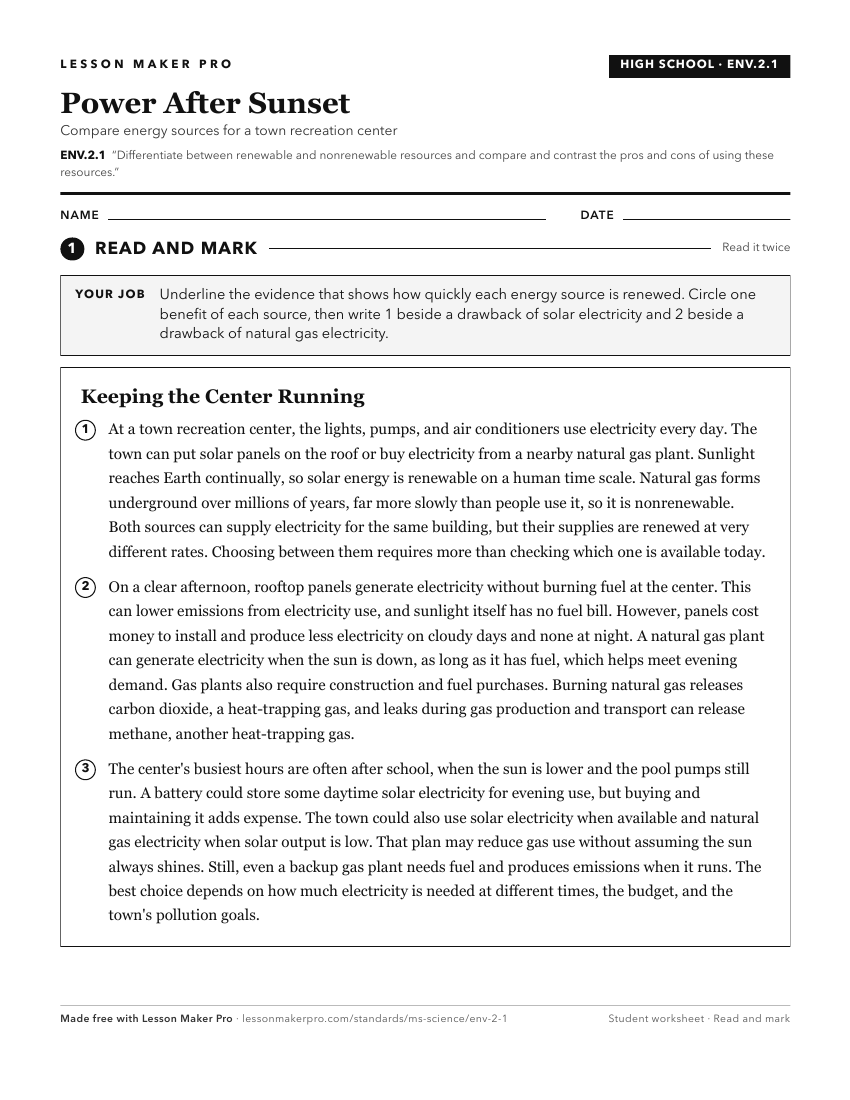
A ready-to-print activity worksheet aligned to ENV.2.1, with an answer key for the teacher on its own page. No account needed.
PDF, US Letter, prints cleanly in black and white.
Download the worksheetKeep exploring
Related Standards
- ENV.2.2
Investigate and research the pros and cons of using traditional sources of energy (e.g., fossil fuels) and alternative sources of energy (e.g., water, wind, geo...
- E.3.10.1
Identify some of Earth's resources that are used in everyday life such as water, wind, soil, forests, oil, natural gas, and minerals and classify as renewable o...
- E.8.10.1
Read and evaluate scientific information about advancements in renewable and nonrenewable resources. Propose and defend ways to decrease national and global dep...
- E.8.10.3
Using scientific data, debate the societal advantages and disadvantages of technological advancements in renewable energy sources.
Turn this exact standard into a lesson
Grade, subject, topic, and the complete standard are prefilled. Create one free, no account needed.
Also for this standard:Make a WorksheetMake a QuizMake a Sub Lesson