Mississippi Science E.5.10
Standard Cluster
Students will demonstrate an understanding of the effects of human interaction with Earth and how Earth’s natural resources can be protected and conserved. Collect and organize scientific ideas that individuals and communities can use to conserve Earth’s natural resources and systems (e.g., implementing watershed management practices to conserve water resources, utilizing no-till farming to improve soil fertility, reducing emissions to abate air pollution, or recycling to reduce landfill waste). Design a process for better preparing communities to withstand human-caused or natural disasters (e.g., removing oil from water or soil, systems that reduce the impact of floods, structures that resist hurricane forces). Use an engineering design process to define the problem, design, construct, evaluate, and improve the disaster plan. *
2026 Mississippi College- and Career-Readiness Standards for Science · Earth’s Recourses
Cluster contents
Standards in This Cluster
E.5.10 is a cluster heading. These are the individual standards under it.
- E.5.10.1
Collect and organize scientific ideas that individuals and communities can use to conserve Earth’s natural resources and systems (e.g., implementing watershed m...
- E.5.10.2
Design a process for better preparing communities to withstand human-caused or natural disasters (e.g., removing oil from water or soil, systems that reduce the...
Teacher's field guide
What This Cluster Means
What Students Need to Do
- Students sort ways to save water, protect soil, clean air, and cut waste. They explain how each action helps. They name a community flood or spill problem, build and test a model solution, then improve it using the results.
What Mastery Looks Like
- A student can explain why planted ground slows runoff or why recycling cuts landfill waste. They can test a model flood barrier with a measured amount of water, record what flooded, and change the barrier based on that result.
Common Misconceptions
- Students may think recycling protects every resource in the same way, or that a flood wall stops flooding everywhere. They may change a design without checking what failed, or use different amounts of water in each test.
How to Assess It
- Exit ticket: A neighborhood floods after heavy rain. Sketch a flood protection plan, name one way to protect its soil or water, and describe a fair test and one possible revision.
Lesson moves
Ways to Teach It
Build a clay levee around a paper neighborhood on a tray, pour one cup of water, record flooding, then revise and retest.
Ask, "Which protects soil better near a stream, bare dirt or planted grass, and what happens to the water after a storm?"
Give pairs cards labeled rain garden, no-till farming, bus rides, and recycling; have them match each to water, soil, air, or waste.
Walk to a schoolyard storm drain, sketch where rainwater flows, and mark a spot for a rain garden to slow runoff.
Free download
Printable E.5.10 Worksheet
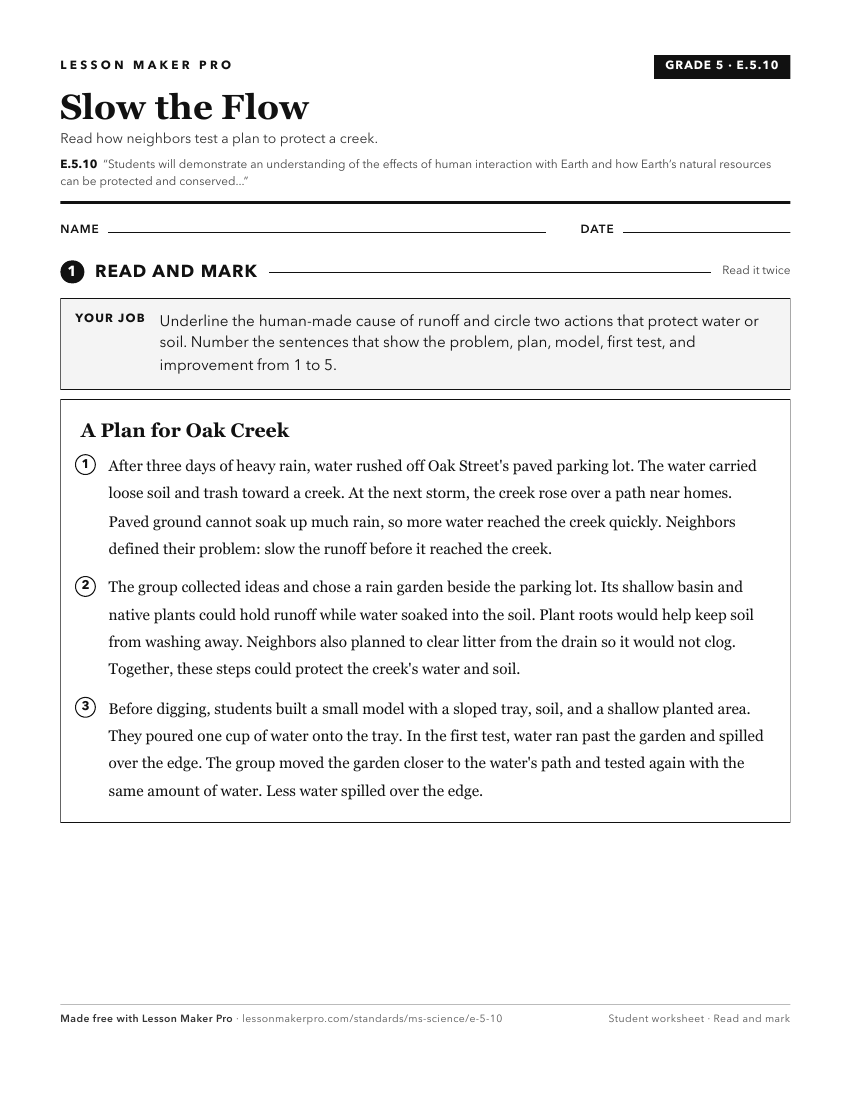
A ready-to-print activity worksheet aligned to E.5.10, with an answer key for the teacher on its own page. No account needed.
PDF, US Letter, prints cleanly in black and white.
Download the worksheetKeep exploring
Related Standards
- E.2.10
Students will demonstrate an understanding of how humans use Earth’s resources.
- E.K.10
Students will demonstrate an understanding of how humans use Earth’s resources.
- ESS.4
Students will develop an understanding of Earth’s resources and the impact of human activities.
- ENV.2
Students will relate the impact of human activities on the environment, conservation activities, and efforts to maintain and restore ecosystems.
Turn this cluster into a lesson
Grade, subject, topic, and the complete cluster are prefilled. Create one free, no account needed.
Also for this cluster:Make a WorksheetMake a QuizMake a Sub Lesson