Mississippi Science ENV.2
Standard Cluster
Students will relate the impact of human activities on the environment, conservation activities, and efforts to maintain and restore ecosystems. Differentiate between renewable and nonrenewable resources and compare and contrast the pros and cons of using these resources. Investigate and research the pros and cons of using traditional sources of energy (e.g., fossil fuels) and alternative sources of energy (e.g., water, wind, geothermal, biomass/biofuels, solar). Compare and contrast biodegradable and nonbiodegradable wastes and their significance in landfills. Examine solutions for developing, conserving, managing, recycling, and reusing energy and mineral resources to minimize impacts in natural systems (e.g., agricultural soil use, mining for coal, construction sites, and exploration of petroleum and natural gas sources). Research various resources related to water quality and pollution (e.g., nonfictional text, EPA’s Surf Your Watershed, MDEQ publications) and communicate the possible effects on the environment and human health. Enrichment: Obtain water from a local source (e.g., stream on campus, rainwater, ditch water) to monitor water quality over time, using a spreadsheet program to graphically represent collected data.
2026 Mississippi College- and Career-Readiness Standards for Science · Natural Resources Use and Conservation
Cluster contents
Standards in This Cluster
ENV.2 is a cluster heading. These are the individual standards under it.
- ENV.2.1
Differentiate between renewable and nonrenewable resources and compare and contrast the pros and cons of using these resources.
- ENV.2.2
Investigate and research the pros and cons of using traditional sources of energy (e.g., fossil fuels) and alternative sources of energy (e.g., water, wind, geo...
- ENV.2.3
Compare and contrast biodegradable and nonbiodegradable wastes and their significance in landfills.
- ENV.2.4
Examine solutions for developing, conserving, managing, recycling, and reusing energy and mineral resources to minimize impacts in natural systems (e.g., agricu...
- ENV.2.5
Research various resources related to water quality and pollution (e.g., nonfictional text, EPA’s Surf Your Watershed, MDEQ publications) and communicate the po...
- ENV.2.6
Enrichment: Obtain water from a local source (e.g., stream on campus, rainwater, ditch water) to monitor water quality over time, using a spreadsheet program to...
Teacher's field guide
What This Cluster Means
What Students Need to Do
- Students sort resources by whether they can be replenished and waste by whether it breaks down. They compare energy choices and explain how land use and pollution affect ecosystems, water, and human health. They suggest ways to conserve resources and repair damaged habitats.
What Mastery Looks Like
- Given a coal plant or a wind farm, a student names a benefit, a drawback, and a way to reduce harm. They explain why food scraps and plastic behave differently in a landfill. They use water quality results to describe a possible risk without claiming the results prove its cause.
Common Misconceptions
- Students may think renewable energy uses no finite materials. They may assume food scraps disappear quickly in a landfill, where little oxygen slows decay. Clear water can still contain pollutants or pathogens.
How to Assess It
- Exit ticket: Classify coal and sunlight as renewable or nonrenewable, give one benefit and drawback of each as energy sources, and suggest one way to protect a nearby stream.
Lesson moves
Ways to Teach It
Test tap and rainwater with pH strips, record readings, and graph them over three days.
Ask: Which would you approve near town, a wind farm or a coal plant? Defend your choice using two trade-offs.
Give pairs cards showing sunlight, coal, food scraps, and plastic; have them sort resources by renewability and waste by biodegradability.
Sketch a school parking lot and nearby storm drain, then mark where a rain garden could reduce runoff.
Free download
Printable ENV.2 Worksheet
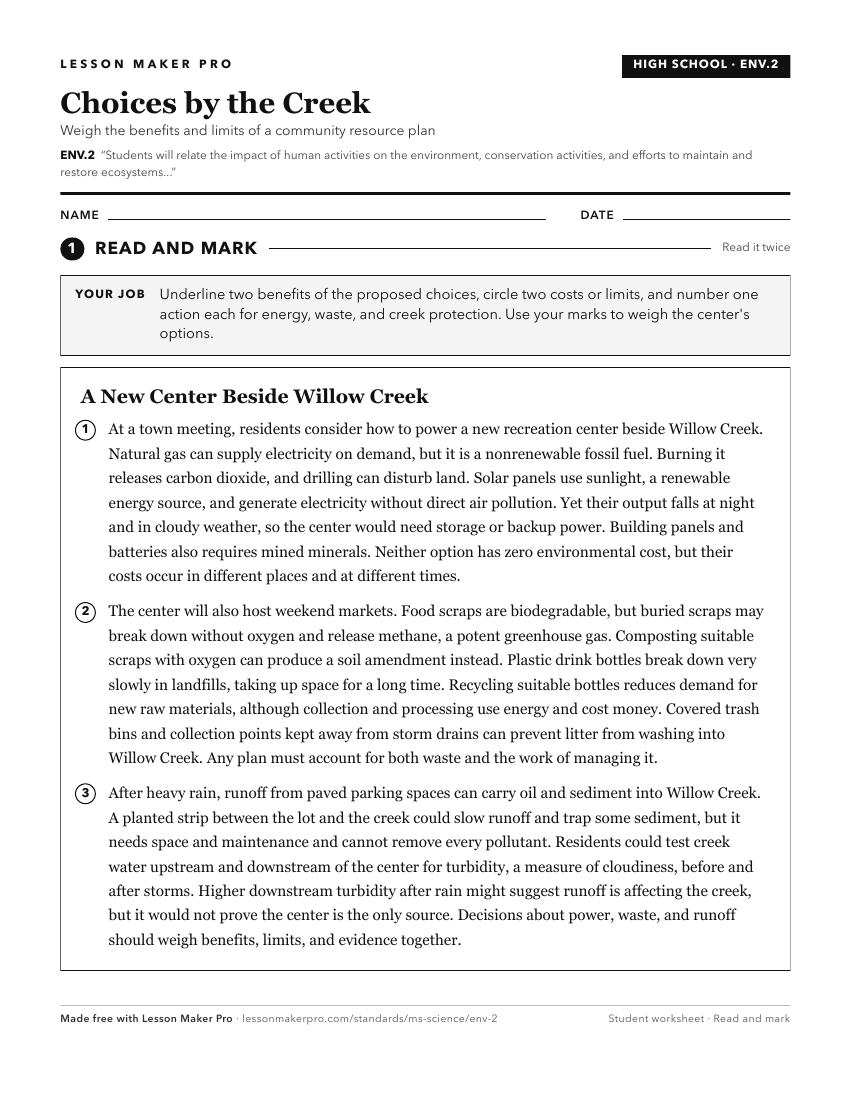
A ready-to-print activity worksheet aligned to ENV.2, with an answer key for the teacher on its own page. No account needed.
PDF, US Letter, prints cleanly in black and white.
Download the worksheetKeep exploring
Related Standards
- L.2.3A
Students will demonstrate an understanding of the interdependence of living things and the environment in which they live.
- ENV.4
Students will demonstrate an understanding of the interdependence of human sustainability and the environment.
- E.5.10
Students will demonstrate an understanding of the effects of human interaction with Earth and how Earth’s natural resources can be protected and conserved.
- ESS.4
Students will develop an understanding of Earth’s resources and the impact of human activities.
Turn this cluster into a lesson
Grade, subject, topic, and the complete cluster are prefilled. Create one free, no account needed.
Also for this cluster:Make a WorksheetMake a QuizMake a Sub Lesson