Mississippi Science ENV.2.3
The Standard
- ENV.2
- Students will relate the impact of human activities on the environment, conservation activities, and efforts to maintain and restore ecosystems.
Compare and contrast biodegradable and nonbiodegradable wastes and their significance in landfills.
2026 Mississippi College- and Career-Readiness Standards for Science · Natural Resources Use and Conservation
Teacher's field guide
What This Standard Means
What Students Need to Do
- Students sort common waste by whether microbes can break it down. They compare what happens to each kind in a landfill, where decay can be slow and food waste can produce methane.
What Mastery Looks Like
- A student can explain why a banana peel and newspaper are biodegradable, while a plastic bag and glass bottle are not. They can explain why buried food may release methane and why plastic remains in a landfill for a long time.
Common Misconceptions
- Students may think biodegradable waste disappears quickly, even in a tightly packed landfill. They may think plastic is biodegradable because it breaks into smaller pieces, or that all buried waste produces methane.
How to Assess It
- Exit ticket: Sort a banana peel, newspaper, plastic wrapper, and glass bottle into biodegradable and nonbiodegradable. Explain what could happen to the peel and wrapper in a landfill.
Lesson moves
Ways to Teach It
Give groups a banana peel, paper scrap, plastic wrapper, and foil; have them sort the items and explain their choices.
Ask students to write why a buried apple core might decay slowly and release methane while a plastic bottle does not.
Play a card sort with leaves, cotton, glass, cans, and foam cups; pairs label each item and challenge one choice.
Show your local waste guide and have students choose bins for a banana peel and plastic wrapper, then explain what burial would change.
Free download
Printable ENV.2.3 Worksheet
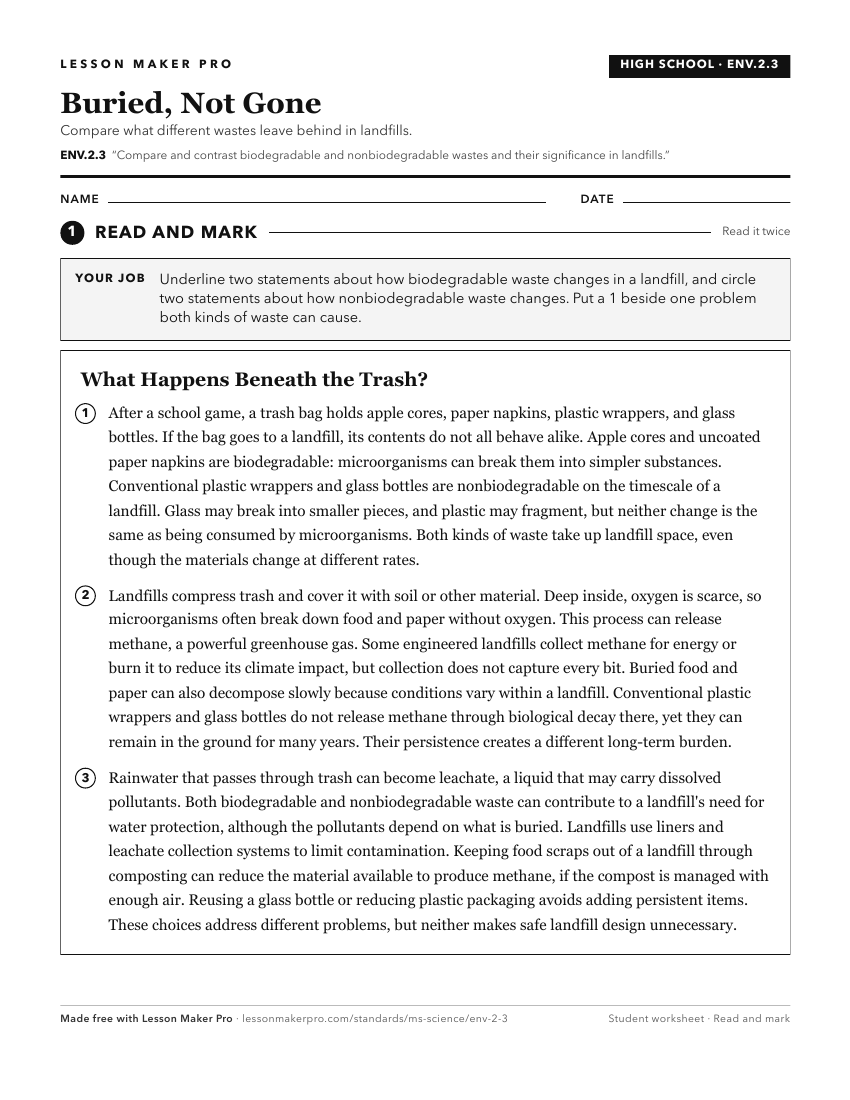
A ready-to-print activity worksheet aligned to ENV.2.3, with an answer key for the teacher on its own page. No account needed.
PDF, US Letter, prints cleanly in black and white.
Download the worksheetKeep exploring
Related Standards
- L.4.2.1
Compare and contrast life cycles of familiar plants and animals.
- BIO.1A.1
Develop criteria to differentiate between living and non-living things.
- ENV.2.1
Differentiate between renewable and nonrenewable resources and compare and contrast the pros and cons of using these resources.
- FB.6.1
Compare and contrast biotic and abiotic factors.
Turn this exact standard into a lesson
Grade, subject, topic, and the complete standard are prefilled. Create one free, no account needed.
Also for this standard:Make a WorksheetMake a QuizMake a Sub Lesson