Mississippi Science L.4.2.1
The Standard
- L.4.2
- Students will demonstrate an understanding of life cycles, including familiar plants and animals (e.g., reptiles, amphibians, or birds).
Compare and contrast life cycles of familiar plants and animals.
2026 Mississippi College- and Career-Readiness Standards for Science · Reproduction and Heredity
Teacher's field guide
What This Standard Means
What Students Need to Do
- Students put the stages of a bean plant and a butterfly in order, then show how each cycle repeats. They compare how the two organisms grow and make new plants or animals.
What Mastery Looks Like
- A student can label a cycle from bean seed to plant to new seeds, and another from butterfly egg to adult to new eggs. They can explain that both cycles repeat, but only the butterfly has a caterpillar and pupa stage.
Common Misconceptions
- Students may think a caterpillar and a butterfly are different animals. They may also end the bean plant's cycle at the flower and leave out the new seeds.
How to Assess It
- Give students four bean plant stage pictures and four butterfly stage pictures. Ask them to arrange each set in a loop and write one similarity and one difference.
Lesson moves
Ways to Teach It
Give pairs printed bean plant and butterfly stage cards to arrange in two loops, with arrows showing what comes next.
Ask students to write: What happens after a bean plant flowers, and what happens after a caterpillar becomes a butterfly?
Play a card swap game where partners trade stage cards, then race to rebuild both cycles and check each other's arrows.
Show a tomato with seeds and a photo of a butterfly; ask how each could begin another life cycle.
Free download
Printable L.4.2.1 Worksheet
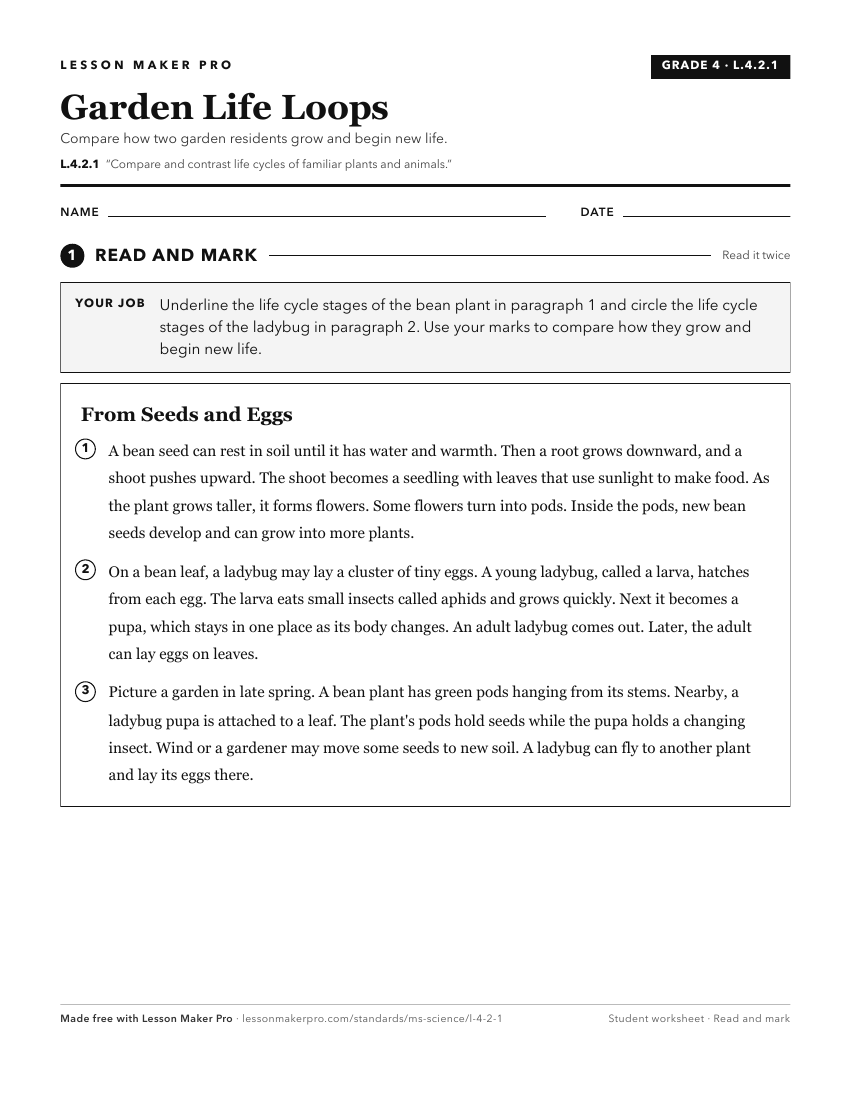
A ready-to-print activity worksheet aligned to L.4.2.1, with an answer key for the teacher on its own page. No account needed.
PDF, US Letter, prints cleanly in black and white.
Download the worksheetKeep exploring
Related Standards
- MAQ.6.5
Explain various life cycles found among animals (e.g., polyp and medusa in cnidarians, multiple hosts and stages in the platyhelminthic life cycle, and arthropo...
- L.4.2.2
Develop and use models to explain the unique and diverse life cycles of organisms other than humans (e.g., flowering plants, frogs, or butterflies) including co...
- L.4.2
Students will demonstrate an understanding of life cycles, including familiar plants and animals (e.g., reptiles, amphibians, or birds).
- MAQ.7.4
Differentiate various life cycles found among animals (e.g., egg, tadpole, and adult stages of the amphibian life cycle; leathery eggs on land in reptiles; hard...
Turn this exact standard into a lesson
Grade, subject, topic, and the complete standard are prefilled. Create one free, no account needed.
Also for this standard:Make a WorksheetMake a QuizMake a Sub Lesson